
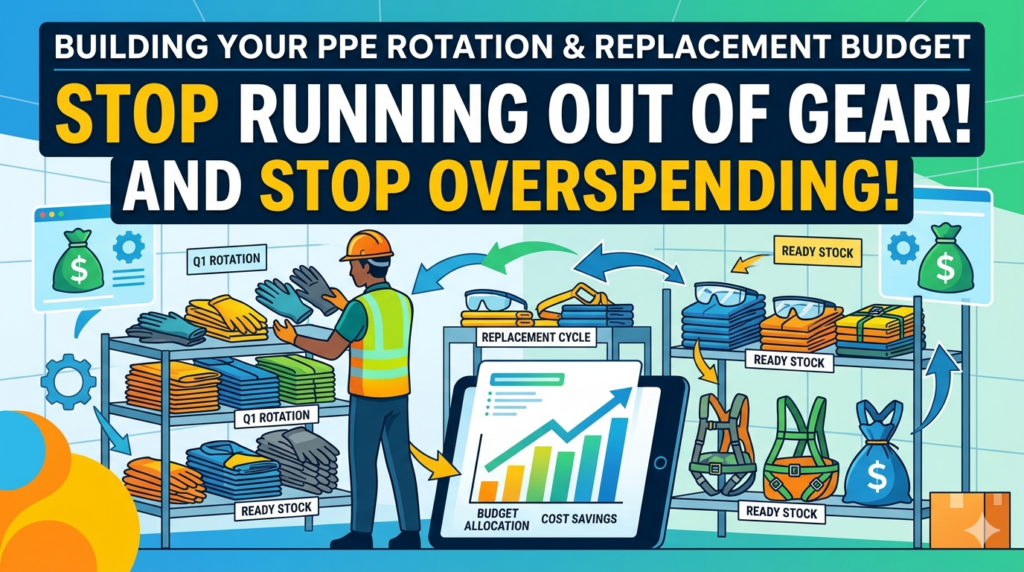
The Budget That Kills
A factory manager bought hard hats, gloves, and aprons for his 50-person team. He budgeted R15,000 total. “That should cover us for the year,” he thought.
By month three, gloves were gone. Workers were using torn gloves because “the bin is empty.” By month six, aprons were missing (lost, damaged, contaminated). By month eight, he was in a panic—no budget left, workers unprotected, compliance audit approaching.
What went wrong? He confused one-time capital investment with ongoing consumable costs.
Hard hats last 5 years; budget once. Gloves last days to weeks; budget every month. Cartridge respirators last years; cartridges last weeks. Aprons last 6–12 months; budget annually.
Most SA site managers get this wrong. They buy PPE once, congratulate themselves, then wonder why they run out by quarter two.
This post walks you through building a realistic PPE budget: what’s capital (buy once), what’s consumable (budget constantly), how to calculate real costs, and how to track inventory so you never run out.
The Critical Distinction: Capital vs. Consumable
PPE falls into two cost categories. Getting this wrong breaks your budget.
Capital Equipment (Buy Once, Amortise Over Years)
What: Equipment that lasts multiple years and can be inspected/maintained rather than replaced.
Examples:
- Hard hats (5–10 year lifespan)
- Safety helmets with faceshields (5–7 years)
- Arc helmets with fixed lenses (5–7 years, assuming lens replacement is separate)
- Full-body rescue harnesses (5–10 years with proper maintenance)
- Earmuff hearing protection (3–5 years)
- Tool belts and work harnesses
- Some protective suits (reusable chemical suits, if properly maintained)
Budget approach:
- Calculate total cost
- Amortise over expected lifespan (e.g., R500 hard hat ÷ 7 years = R71/year per worker)
- Depreciate: Year 1 cost is full amount; Year 2–7 is just replacement/maintenance
Example:
- 50 workers × R500 hard hat = R25,000 (Year 1)
- Replace damaged hats (assume 10% per year) = 5 hats × R500 = R2,500/year (Years 2–7)
- Total Year 1: R25,000; Years 2–7: R2,500/year
Consumable Equipment (Budget Constantly)
What: Equipment that wears out, gets contaminated, or loses effectiveness and must be replaced regularly.
Examples:
- Disposable gloves (days to weeks)
- Reusable gloves (6–12 months with heavy use)
- Respirator cartridges (6–8 weeks of use)
- Foam earplugs (1 pair per day)
- Earmuff hearing protection foam pads (annual replacement)
- Disposable protective gowns (one per use)
- Aprons (6–18 months depending on wear)
- Reflective vests (annual replacement due to fading)
- Dust masks (1–2 weeks)
Budget approach:
- Calculate monthly or annual consumption
- Budget every year (not one-time)
- Track inventory so you don’t run out
Example:
- 50 workers × 2 pairs gloves/day × 22 working days/month = 2,200 pairs/month
- 2,200 × 12 months = 26,400 pairs/year
- 26,400 × R50/pair = R1,320,000/year
Wait—that’s huge. Let me recalculate more realistically:
Realistic consumption:
- Not every worker needs 2 pairs/day (some tasks need more, some need fewer)
- Assume average 1 pair/worker/day
- 50 workers × 1 pair/day × 22 days = 1,100 pairs/month
- 1,100 × 12 = 13,200 pairs/year
- 13,200 × R50 = R660,000/year
Still seems high. But this is consumable glove reality: ongoing, significant cost.
PPE Budget Template: By Equipment Type
Here’s a realistic budgeting framework for a medium-sized operation (50 workers, mixed light-to-moderate hazard):
Scenario: General Manufacturing (50 Workers, Mixed Hazards)
CAPITAL EQUIPMENT (Year 1 Purchase, Then Maintenance)
| Item | Unit Cost | Quantity | Year 1 Cost | Useful Life | Annual Replacement (Yrs 2+) |
|---|---|---|---|---|---|
| Hard hats | R400 | 50 | R20,000 | 7 years | R3,000 (10% damage/loss) |
| Safety glasses | R150 | 50 | R7,500 | 3 years | R2,500 (annual refresh + damage) |
| Earmuffs | R300 | 50 | R15,000 | 5 years | R3,500 (pads + replacement) |
| Work harnesses | R800 | 10 | R8,000 | 5 years | R1,500 (maintenance + replacement) |
| Capital Subtotal | R50,500 | R10,500/year |
CONSUMABLE EQUIPMENT (Annual Budget)
| Item | Unit Cost | Monthly Consumption | Annual Units | Annual Cost |
|---|---|---|---|---|
| Cut-resistant gloves (Level C) | R100 | 100 pairs | 1,200 | R120,000 |
| Nitrile chemical gloves | R50 | 50 pairs | 600 | R30,000 |
| Protective aprons | R200 | 15 units | 180 | R36,000 |
| Earmuff foam pads (replacement) | R80 | 10 sets | 120 | R9,600 |
| Protective vests (annual refresh) | R250 | 5 vests | 60 | R15,000 |
| Dust masks/respirator cartridges | R20 | 200 masks | 2,400 | R48,000 |
| Consumable Subtotal | R258,600/year |
TOTAL ANNUAL PPE BUDGET
| Category | Year 1 | Year 2+ |
|---|---|---|
| Capital equipment (one-time) | R50,500 | — |
| Capital maintenance (annual) | — | R10,500 |
| Consumable equipment | R258,600 | R258,600 |
| TOTAL | R309,100 | R269,100 |
Cost per worker per year:
- Year 1: R309,100 ÷ 50 = R6,182/worker
- Year 2+: R269,100 ÷ 50 = R5,382/worker
Monthly cash flow: R309,100 ÷ 12 = R25,758/month (Year 1), R22,425/month (Years 2+)
The Consumable Calculation: How to Avoid Running Out
The glove example above is instructive. Let me break it down more realistically.
Glove Consumption Example (Most Variable Cost)
Assumption: 50 workers, Level C cut-resistant gloves (moderate hazard manufacturing), averaging 1 pair per worker per day.
Monthly calculation:
- 50 workers
- 1 pair/day per worker
- 22 working days/month
- 50 × 1 × 22 = 1,100 pairs/month
Annual calculation:
- 1,100 pairs/month × 12 = 13,200 pairs/year
- 13,200 × R100/pair = R1,320,000/year
But wait—that’s if every worker uses exactly 1 pair/day.
Reality check:
- Some workers use more (heavy cutting tasks = 2–3 pairs/day)
- Some use less (light assembly = 0.5 pairs/day)
- Some gloves are damaged and discarded (not full daily use)
- Consumption varies by season, task mix, worker turnover
Better estimate:
- Budget 1.2 pairs/worker/day (accounting for waste/damage/variability)
- 50 × 1.2 × 22 = 1,320 pairs/month
- 1,320 × 12 = 15,840 pairs/year
- 15,840 × R100 = R1,584,000/year
Or per worker per year:
- 15,840 ÷ 50 = 316.8 pairs per worker
- 316.8 × R100 = R31,680/worker/year
This is a staggering number. Many site managers say “that can’t be right.”
But it is. Here’s why:
- Workers lose gloves (left in locker, fallen off site, contaminated and discarded)
- Gloves get damaged (torn, punctured, contaminated)
- Some workers prefer certain sizes (XL workers get through 3–4 pairs/day; S workers might get 0.5; averaging 1 is conservative)
- High-turnover jobs have waste (new workers get multiple pairs, some left unopened when they leave)
The lesson: Never assume one pair per worker per day. Budget 1.2–1.5x that estimate, then track actual consumption and adjust.
Tracking Inventory: The System That Works
Most sites run out of PPE because they don’t track it. Here’s a simple system that actually works.
Method 1: Monthly Bin Audit (Simple, Manual)
Setup:
- Designated PPE bins (one per equipment type: gloves, aprons, earmuffs, vests, etc.)
- Bins clearly labelled with item name and minimum stock level
- Audit every month on the same date
Process:
- Count each bin on audit day
- Record quantities in spreadsheet
- Calculate monthly consumption (previous month’s count minus current month’s count)
- When any item drops to minimum stock, order immediately
- Track ordering lead time (how long from order to delivery)
Minimum stock calculation:
- Minimum = (monthly consumption) × (lead time in months) + safety buffer
- Example: 1,100 gloves/month consumed, 2-week lead time = ~550 gloves minimum stock
Spreadsheet columns:
- Item name
- Previous month count
- Current month count
- Monthly consumption
- Minimum threshold
- Reorder action (Y/N)
- Order date
- Delivery date
Cost: Free (spreadsheet only) Effort: 1 hour per month Effectiveness: High if discipline is maintained
Method 2: Automated Consumption Tracking (Better, Tech-Enabled)
Setup:
- Log each issue of PPE (who got it, when, how much)
- Track consumption automatically over time
- System alerts when stock drops to threshold
Tools:
- Simple Google Sheets with running total (free)
- Inventory management software (R2,000–10,000 one-time; R500/month ongoing)
- Bin-level sensors (RFID or weight-based; R5,000–15,000 per bin; auto-alerts when low)
Spreadsheet approach (free):
- One row per issue event
- Worker name, date, item, quantity
- Running total auto-calculates
- Chart shows consumption trend
Inventory software approach (modest cost):
- Dedicated system for PPE tracking
- Auto-generates low-stock alerts
- Reports on consumption trends
- Helps with budgeting next year
Cost: R0–10,000 initial; R0–500/month ongoing Effort: Minimal (10 minutes per week to log issues) Effectiveness: Very high; prevents stock-outs
Method 3: Fixed Issuance Quantities (Simplest, Least Flexible)
Setup:
- Each worker gets fixed quantity per week/month
- No questions, no variations
- When they run out, they reorder
Example:
- Each worker gets 5 pairs of gloves per week (issued every Monday)
- Each worker gets 1 apron per month
- Each worker gets 2 respirator cartridges per quarter
Pros:
- Simple to administer
- Prevents hoarding (if you give everyone 5 pairs, nobody over-orders)
- Predictable consumption (5 pairs × 50 workers × 52 weeks = 13,000 pairs/year)
Cons:
- Doesn’t accommodate individual variation (some workers need more, some less)
- Workers may run out mid-week if they damage gear
- Less flexible for seasonal changes or task variation
Cost: R0 (no tracking system needed) Effort: Minimal (just distribute on schedule) Effectiveness: Moderate; works if consumption is consistent; fails if tasks vary wildly
Budget Models: Three Realistic Scenarios
Scenario 1: Small Manufacturing (10 Workers, Light Hazard)
Environment: Light assembly, minimal cut/chemical risk, local transportation of materials.
Equipment needs:
- Hard hats (light impact only)
- Safety glasses
- Work gloves (basic, not cut-resistant; lighter duty)
- Aprons (light soiling)
- No respirators, no hearing protection (noise <85 dB)
Year 1 budget:
| Category | Item | Qty | Unit | Year 1 Cost |
|---|---|---|---|---|
| Capital | Hard hats | 10 | R350 | R3,500 |
| Capital | Safety glasses | 10 | R100 | R1,000 |
| Capital | Work harness (if climbing) | 0 | — | — |
| Consumable | Work gloves (basic) | 600 pairs/year | R30 | R18,000 |
| Consumable | Protective aprons | 40 total/year | R150 | R6,000 |
| Consumable | Replacement safety glasses (damage) | 2 sets | R100 | R200 |
| TOTAL | R28,700 |
Annual ongoing (Year 2+):
- Capital replacement/maintenance: R500
- Consumable (gloves + aprons + glasses): R24,200
- Total Year 2+: R24,700
Cost per worker per year: R2,870 (Year 1), R2,470 (Year 2+)
Budget approach: Buy capital items once, then budget R2,058/month for consumables.
Scenario 2: Heavy Manufacturing (50 Workers, Mixed Hazard)
(Covered in detail earlier in this post)
Year 1 budget: R309,100 Year 2+ budget: R269,100 Cost per worker per year: R6,182 (Year 1), R5,382 (Year 2+)
Budget approach: Buy capital items Year 1, then budget R22,425/month ongoing for consumables + maintenance.
Scenario 3: Hazmat/Emergency Response (12 Personnel, Extreme Hazard)
Environment: Chemical spill response, hazmat team, confined space rescue, unknown atmospheres.
Equipment needs:
- SCBA units (capital, expensive)
- Full-body protective suits (reusable + disposables)
- Rescue harnesses and lifelines (capital)
- Respirator cartridges (consumable, high consumption)
- Monitoring equipment (capital)
- Training (annual, not consumable but budgeted)
Year 1 budget:
| Category | Item | Qty | Unit | Year 1 Cost |
|---|---|---|---|---|
| Capital | SCBA units (positive-pressure) | 6 | R20,000 | R120,000 |
| Capital | Rescue harnesses | 6 | R1,500 | R9,000 |
| Capital | Atmospheric monitor (4-gas) | 2 | R8,000 | R16,000 |
| Capital | Rescue extraction equipment | 1 set | R15,000 | R15,000 |
| Capital | Hard hats with integrated systems | 12 | R600 | R7,200 |
| Consumable | Protective suits (nitrile, reusable) | 12 | R700 | R8,400 |
| Consumable | Disposable gowns (non-woven) | 2,000 | R80 | R160,000 |
| Consumable | Gloves (heavy-duty nitrile) | 10,000 pairs | R60 | R600,000 |
| Consumable | SCBA cartridge refills | 200 refills/year | R500 | R100,000 |
| Consumable | Monitoring sensor replacement | 12 sets | R1,200 | R14,400 |
| Training | Confined space + SCBA + rescue | 12 workers | R4,000 | R48,000 |
| TOTAL | R1,098,000 |
Annual ongoing (Year 2+):
- Capital maintenance/replacement: R30,000
- Consumable (suits, gowns, gloves, cartridges, sensors): R874,400
- Training (annual refresher): R48,000
- Total Year 2+: R952,400
Cost per worker per year: R91,500 (Year 1), R79,367 (Year 2+)
Budget approach: Major capital investment Year 1, then ongoing commitment of R79,000+/year. This is non-negotiable for hazmat/emergency response.
Common Budgeting Mistakes (And How to Avoid Them)
Mistake 1: Confusing Year 1 Cost with Ongoing Cost “We spent R50,000 on PPE last year; this year should be R50,000.”
Wrong. Year 1 includes capital equipment (lasts years). Year 2+ is just consumables + replacement. Your Year 2 budget should be ~30–50% lower.
Fix: Separate capital from consumable. Budget capital once; budget consumable annually.
Mistake 2: Under-Estimating Consumption “We bought 500 pairs of gloves; that should last 6 months for 50 workers.”
Wrong. 500 pairs ÷ 50 workers = 10 pairs per worker over 6 months = 0.33 pairs/week per worker = not enough.
Fix: Track actual monthly consumption. Budget 1.2–1.5x your estimate. Adjust based on data.
Mistake 3: Not Budgeting for Replacement Cycles “We bought aprons; they’re still here.”
But are they? Used aprons degrade after 6–18 months (depending on wear). If you’re not replacing them, workers are wearing degraded protection.
Fix: Establish replacement schedule (aprons every 12 months, gloves continuously, glasses every 2–3 years, etc.). Budget for it annually.
Mistake 4: No Buffer for Variability “Consumption was 1,000 units last month; budget 12,000 for the year.”
But what if work ramps up? What if a new high-risk task is introduced? What if workers are more careful/less careful than usual?
Fix: Budget 1.2x your baseline estimate. Track actual consumption. Adjust quarterly.
Mistake 5: Assuming Bulk Order = Lower Cost “We ordered 10,000 pairs of gloves at R40/pair instead of R60/pair; huge savings!”
But do you have storage? Can you use 10,000 pairs before they degrade? Are you paying for storage space? Is cash flow impacted by the bulk order?
Fix: Calculate total cost of ownership, including storage and carrying costs. Bulk is great if you use it; wasteful if it sits unused.
The Monthly Cash Flow: What This Actually Costs
Let’s make this concrete with a real monthly cash flow for the 50-person manufacturing scenario.
Month 1 (Year 1)
Capital purchases (one-time, upfront):
- Hard hats + glasses + earmuffs + harnesses: R50,500
Consumable purchases (monthly):
- Gloves, aprons, dust masks, foam pads: R21,550/month
Month 1 total: R50,500 + R21,550 = R72,050
Month 2–12 (Year 1)
Capital: R0 (already purchased)
Consumable: R21,550/month
Year 1 total: R50,500 + (R21,550 × 12) = R309,100
Year 2 Monthly
Capital maintenance: R875/month (amortised)
Consumable: R21,550/month
Year 2 monthly: R22,425
Inventory Minimum Thresholds: Never Run Out
For each consumable item, set a minimum stock threshold. When inventory hits that threshold, reorder immediately.
Formula:
Minimum stock = (monthly consumption) × (supplier lead time in months) + safety bufferExample: Cut-resistant gloves
- Monthly consumption: 1,100 pairs
- Lead time: 2 weeks (0.5 months)
- Safety buffer: 20% (to account for surge demand or delivery delay)
- Minimum = (1,100 × 0.5) + (1,100 × 0.2) = 550 + 220 = 770 pairs
When inventory reaches 770 pairs, order immediately.
Apply to every consumable item:
| Item | Monthly Use | Lead Time | Safety Buffer | Minimum Stock |
|---|---|---|---|---|
| Gloves | 1,100 pairs | 2 weeks | 20% | 770 pairs |
| Aprons | 15 units | 3 weeks | 20% | 15 units |
| Dust masks | 200 units | 1 week | 20% | 60 units |
| Cartridges | 20 units | 2 weeks | 20% | 13 units |
| Earmuff pads | 10 sets | 3 weeks | 20% | 12 sets |
Quarterly Budget Review: Adjust Based on Reality
Every quarter (3 months), review actual vs. budgeted spending.
Questions to ask:
- Did consumption match forecast?
- Did we run out of any items? (If yes, increase minimum stock)
- Did we over-purchase? (If items expired or became unused, reduce order quantities)
- Did prices change? (Supplier prices fluctuate; adjust budget accordingly)
- Did task mix change? (New hazards = new PPE; adjust budget)
- Did team size change? (Hiring/attrition affects consumption)
Adjust Year 2 budget based on Year 1 actual data.
Example adjustment:
- Year 1 budgeted: R21,550/month for consumables
- Year 1 actual: R24,200/month (higher due to unexpected wear, worker turnover, task changes)
- Year 2 revised budget: R24,200/month instead of R21,550
Spreadsheet Template: Download & Use
Here’s a simple budgeting spreadsheet structure you can build in Excel or Google Sheets:
VGH Safety PPE Budget Template
Sheet 1: Capital Equipment
| Item | Qty | Unit Cost | Total | Useful Life (Yrs) | Depreciation/Yr |
|---|---|---|---|---|---|
| Hard hats | 50 | R400 | R20,000 | 7 | R2,857 |
| Safety glasses | 50 | R150 | R7,500 | 3 | R2,500 |
| [Add more items] | |||||
| Total Capital | R27,500 | R5,357/yr |
Sheet 2: Consumables (Monthly)
| Item | Workers Using | Daily Usage/Worker | Monthly Units | Unit Cost | Monthly Cost |
|---|---|---|---|---|---|
| Gloves | 50 | 1.2 pairs | 1,320 | R100 | R132,000 |
| Aprons | 50 | 1 per 4 days | 275 | R200 | R55,000 |
| Masks | 20 | 1 per shift | 440 | R20 | R8,800 |
| [Add more items] | |||||
| Total Consumable/Month | R195,800 |
Sheet 3: Annual Summary
| Category | Year 1 | Year 2 | Year 3 |
|---|---|---|---|
| Capital (one-time) | R27,500 | — | — |
| Consumable annual (monthly × 12) | R2,349,600 | R2,349,600 | R2,349,600 |
| Capital maintenance | — | R5,357 | R5,357 |
| Total annual | R2,377,100 | R2,354,957 | R2,354,957 |
| Cost per worker/year | R47,542 | R47,099 | R47,099 |
Note: This is a simplified example. Your actual numbers will vary.
The Bottom Line
PPE budgeting isn’t glamorous, but it’s critical. Get it wrong, and you either:
- Run out of gear (workers unprotected; compliance failure)
- Over-spend massively (waste money on unused stock)
- Fail audit (documentation shows under-specification or non-compliance)
The formula is simple:
- Capital: Calculate total cost; depreciate over useful life; budget maintenance annually
- Consumable: Calculate monthly consumption; budget monthly; track inventory; reorder at minimum threshold
- Review quarterly: Adjust forecast based on actual data
- Separate capital from consumable: Don’t confuse Year 1 (expensive) with Year 2+ (cheaper)
For a 50-person manufacturing operation:
- Year 1: ~R300,000 (capital + consumables)
- Year 2+: ~R270,000/year (consumables + maintenance only)
- Per worker per year: ~R5,400–6,200
Use the spreadsheet template above. Build it in Google Sheets. Track actual monthly consumption. Adjust quarterly. You’ll never run out of gear again.
Browse VGH by Equipment Category (For Bulk Orders)
When you’re ready to buy, here’s what to order from where:
| Consumable Category | Typical Annual Consumption (50 workers) | Unit Cost | Annual Budget | Where to Buy |
|---|---|---|---|---|
| Cut-resistant gloves | 13,200 pairs | R50–100 | R660,000–1,320,000 | Pioneer Workwear |
| Nitrile gloves | 2,640 pairs | R40–60 | R105,600–158,400 | Pioneer Workwear or Protective Clothing |
| Protective aprons | 180–300 | R150–300 | R27,000–90,000 | Protective Clothing |
| High-visibility vests | 60 | R200–300 | R12,000–18,000 | High-Viz Accessories |
| Earplugs/earmuff pads | 120 sets/year | R80–150 | R9,600–18,000 | Protective Clothing |
| Respirator cartridges | 200–400/year | R150–400 | R30,000–160,000 | Respiratory Protection |
Questions on Budget Planning?
Building your PPE budget is complex. VGH can help.
Email [contact] with:
- Team size
- Primary hazards (chemical, thermal, cutting, visibility, etc.)
- Current spending (if known)
- Specific equipment you’re unsure about
We’ll provide:
- Realistic consumption estimates for your scenario
- Annual budget breakdown
- Bulk order pricing for your volume
- Inventory tracking recommendation
Your PPE budget is an investment in worker health. Get it right.