The Rescue That Became a Tragedy
A confined space entry team was called to rescue a worker who’d collapsed in a sewage tank. Standard procedure: Establish atmospheric monitoring, SCBA preparation, safety line setup, trained entry person geared up.
But the team was under-equipped. Their SCBA sets were old, not properly serviced. Their lifelines were marginal (rope, not redundant harnesses). Their rescue plan was incomplete.
The entry person went in. Thirty seconds later, something went wrong—later investigations suggested a stuck regulator on the SCBA. No communication. The entry person panicked, disconnected from lifeline.
By the time the rescue team realized something was amiss and extracted him, he’d been without oxygen for critical minutes. Permanent brain damage. Career ended.
The devastating part? Proper SCBA equipment (well-maintained, redundant systems, trained team), appropriate rescue harnesses, backup lifelines, and a pre-planned rescue procedure would have prevented this.
Cost of proper confined space gear: R50,000–100,000. Cost of not having it? A life permanently changed.
Confined space rescue is the most specialized, highest-consequence PPE scenario in occupational safety. Yet many South African sites treat it casually—”we’ll figure it out if it happens”—rather than preparing properly.
This post covers confined space hazards, SCBA equipment, rescue harnesses and lifelines, multi-hazard protection, and real scenarios where equipment choices mean life or death.
What Makes Confined Spaces So Dangerous
Definition: What Is a Confined Space?
A confined space is an area that:
- Is large enough for a worker to enter and work
- Has limited/restricted entry/exit
- Is not designed for continuous occupancy
- May contain atmospheric hazards
Common examples in SA:
- Sewage/wastewater tanks
- Storage tanks (grain, chemicals, water)
- Silos and hoppers
- Boiler rooms and furnaces
- Underground vaults and basements
- Pipelines and culverts
- Mine shafts (extraction/inspection)
The Hazards: Why Confined Spaces Kill
Confined space hazards are often multiple and invisible.
Atmospheric hazards (most common):
- Oxygen deficiency (<19.5% O₂) – Workers lose consciousness; death within minutes
- Oxygen enrichment (>23.5% O₂) – Makes combustion easier; fire/explosion risk
- Toxic gases (H₂S, CO, CO₂, ammonia, chlorine) – Immediate toxicity; loss of consciousness; death
- Flammable gases (methane, propane) – Explosion/fire risk if ignition source present
Physical hazards:
- Engulfment (powders in silos, grain) – Aspiration into lungs; burial; death in minutes
- Entanglement (rotating equipment, machinery) – Traumatic injury
- Temperature extremes – Thermal stress; hypothermia/heat stroke
- Confined/difficult rescue – If something goes wrong, extraction is slow and difficult
The cruelty of confined spaces: The hazards are often invisible and fast-acting. A worker enters a tank that appears empty and safe. Oxygen-deficient atmosphere (caused by bacterial decomposition or chemical reaction) renders them unconscious in seconds. Dead in minutes. By the time rescuers realize what happened, it’s often too late.
Why Standard PPE Isn’t Enough
Standard hard hat, glasses, gloves—none of that helps in an oxygen-deficient atmosphere or with toxic gas exposure.
You need:
- Atmospheric monitoring (equipment to detect hazards before entry)
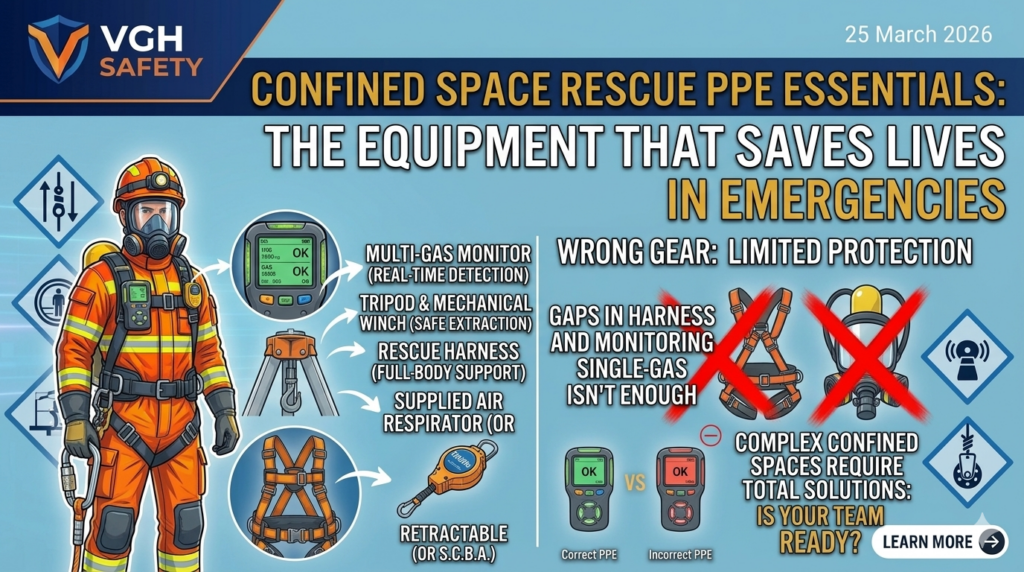
- Respiratory protection (self-contained air supply, not just cartridge filters)
- Harness and lifeline (escape if something goes wrong)
- Communication (stay connected with outside team)
- Rescue equipment (way to extract worker if disabled)
This is specialized. This requires training. This requires equipment most SA SMEs don’t have.
SCBA: Self-Contained Breathing Apparatus
When you’re in a confined space with unknown/toxic atmosphere, you can’t rely on filtering air (like cartridge respirators do). You need your own air supply.
SCBA is the gold standard for this.
How SCBA Works
An SCBA unit consists of:
- Air cylinder – Compressed air tank (usually 2–6 liters, pressurized to 200+ bar)
- Regulator – Reduces pressure from cylinder to breathable pressure
- Facepiece – Covers nose and mouth (or full-face for maximum protection)
- Harness – Holds cylinder to worker’s back; distributes weight
- Air consumption gauge – Shows remaining air time (critical for safety)
How it works:
- Worker puts on harness and facepiece
- Opens air valve on cylinder
- Breathes normally
- Regulator automatically delivers air at correct pressure
- When air runs low, worker exits
SCBA Duration: How Long Does It Last?
Air duration depends on cylinder size and worker’s breathing rate.
Typical duration (at rest):
- Small cylinder (2L): 10–15 minutes
- Medium cylinder (4L): 20–30 minutes
- Large cylinder (6L): 30–45 minutes
At exertion (climbing, working, panic):
- Breathing rate increases 3–4x
- Duration cuts in half (small cylinder drops to 5–7 minutes of heavy work)
Critical rule: You must exit before air runs out. If air runs out while inside the tank, you’re trapped without oxygen.
Safety protocol:
- Rule of thirds: Use 1/3 of air for entry, 1/3 for work, 1/3 for exit/emergency
- Example: 30-minute cylinder = 10 min entry, 10 min work, 10 min exit buffer
- This is non-negotiable; violating it gets people killed
SCBA Types
Demand Valve SCBA (Most Common)
- Facepiece sealed to face; air only flows when wearer inhales
- Lower air consumption (longer duration)
- Slightly higher risk if seal breaks (negative pressure pulls outside air in; not ideal but less critical than positive-pressure failures)
- Cost: R8,000–15,000 per unit
- Best for: Most confined space work
Positive-Pressure SCBA (Superior)
- Facepiece sealed to face; air flows continuously, creating pressure slightly above outside pressure
- If seal breaks, air blows outward (keeps contamination out)
- Higher air consumption (shorter duration)
- Cost: R15,000–25,000+ per unit
- Best for: Extreme hazards, unknown atmospheres, high-risk entry
Supplied-Air Respirator (Tethered)
- Air supplied from outside via hose, not from worn cylinder
- Air supply doesn’t deplete (can work indefinitely)
- Worker tethered to air pump/filtration system outside
- Risk: Hose damage, entanglement, rescue complexity
- Cost: R10,000–20,000+ per system
- Best for: Confined space work where duration >45 minutes or mobility restricted
SCBA Maintenance & Certification
SCBA units must be:
- Tested annually (functionality, seal integrity, regulator performance)
- Cleaned after each use (condensation, salt, contamination can degrade seals)
- Stored properly (cool, dry, low humidity; cylinders can corrode)
- Cylinders refilled regularly (pressure checked; air quality verified—compressed air must be breathing-grade, not industrial)
Cost of maintenance: R1,000–2,000 per unit annually
Many sites skip maintenance. Then when a confined space entry happens, the SCBA fails because it hasn’t been tested in years. People die.
Real Scenario: SCBA Failure
A mining company had old SCBA units stored in a warehouse. During an emergency mine entry for equipment retrieval, they pulled the units out without checking. One unit’s regulator had corroded (due to improper storage). During entry, the regulator failed. Worker ran out of air. Died before rescue could extract.
Investigation later: Unit had never been serviced in 12 years.
Rescue Harnesses: Getting People Out
An SCBA unit lets you survive in a toxic atmosphere. But if you collapse, get stuck, or panic, you need a way out.
Rescue harness + lifeline is that way out.
Harness Types
Type 1: Full-Body Harness
What: Straps around torso, waist, thighs, and shoulders (5–7 attachment points). Designed to distribute rescue load evenly.
Why full-body? If rescuers need to pull an unconscious worker up a vertical shaft, a full-body harness prevents the worker from slipping, rotating, or twisting during extraction.
Cost: R800–2,000 per harness
Inspection: Check for fraying, cracks, bent D-rings (attachment points). Replace if damaged.
Where to buy: Snake Equipment stocks full-body rescue harnesses.
Type 2: Harness with Integrated Lanyard
What: Harness with built-in lifeline attached (shorter, emergency-only).
Pros:
- One integrated system (no separate lifeline to manage)
- Quick-clip connections
Cons:
- Lanyard is short (only good for short drops)
- Doesn’t replace main lifeline (still need external backup)
Cost: R1,200–2,500
Where to buy: Snake Equipment.
Lifelines: The Rope That Saves You
A lifeline is the connection between the worker inside the confined space and the rescue team outside.
Lifeline requirements:
- Strength: Must support at least the weight of the worker + SCBA (typically 100+ kg) without stretching or breaking
- Redundancy: Never single lifeline; always two independent lines (one for safety, one for rescue)
- Material: Rope or cable rated for rescue; not regular industrial rope
- Length: Must reach from entry point to deepest work area, plus extra for extraction
- Inspection: Check for fraying, damage, contamination; replace yearly or after any load
Lifeline types:
Static Rope
- Minimal stretch (less than 5%; doesn’t bounce)
- Ideal for confined space (predictable, won’t swing worker into walls)
- Cost: R50–100 per metre
- Example: 30-metre rope for a 20-metre tank = R1,500–3,000
Dynamic Rope
- Stretch on load (absorbs impact, like rock climbing ropes)
- NOT suitable for confined space rescue (swing and bounce is dangerous; worker hits walls/obstacles)
- Don’t use this
Cable
- Steel cable; maximum strength; no stretch
- Heavy; harder to manage; overkill for most confined spaces
- Cost: Higher than rope
Lifeline Management
Setup:
- Secure the lifeline to a fixed point outside the confined space (beam, anchor, not a person)
- Attach worker’s harness to the lifeline via carabiner or clip
- Maintain tension on the lifeline (never slack; if worker falls, lifeline must arrest fall instantly)
- Keep communication link open (radio or verbal with outside team)
Rescue:
- If worker becomes unconscious or trapped, outside team immediately begins extraction
- Using mechanical advantage (pulley system, winch, or human power), pull worker out
- Full-body harness distributes load; prevents spinning or slipping
Common mistakes:
- Single lifeline (if it breaks, worker is lost)
- Lifeline attached to another person (if rescuer falls, both are in trouble)
- Slack lifeline (if worker falls, rope bounces; worker hits bottom)
- Lifeline too short (worker can’t reach work area safely)
Atmospheric Monitoring: The Essential First Step
Before anyone enters a confined space, you must know what’s in there.
Types of Hazardous Atmospheres
Oxygen levels:
- Safe: 19.5%–23.5%
- Below 19.5%: Oxygen deficient (unconsciousness, death)
- Above 23.5%: Oxygen enriched (fire/explosion hazard)
Toxic gases (common in confined spaces):
- H₂S (hydrogen sulfide) – Sewage, decomposition; lethal at low concentration
- CO (carbon monoxide) – Engine exhaust, incomplete combustion; odourless, lethal
- CO₂ (carbon dioxide) – Fermentation, decomposition; odourless, causes rapid unconsciousness
- NH₃ (ammonia) – Chemical plants, fertiliser; pungent, burns respiratory tract
Flammable gases:
- Methane – Sewage, landfills; explosive when mixed with air
Atmospheric Monitoring Equipment
4-Gas Monitor (Standard)
- Measures: O₂, CO, H₂S, LEL (lower explosive limit, for flammable gases)
- Cost: R5,000–12,000
- Usage: Bump test every shift; calibrate every 6 months
Multi-Gas Monitor (Advanced)
- Measures: O₂, CO, H₂S, LEL, plus additional gases as needed (CO₂, ammonia, chlorine, etc.)
- Cost: R8,000–18,000
- Usage: More comprehensive; better for unknown atmospheres
The Monitoring Protocol
Before any confined space entry:
- Pre-entry test: Place monitor at entry point and depth; run for 10+ minutes
- Interpretation: All readings must be in safe range (19.5–23.5% O₂, zero toxic gases, zero flammable)
- Continuous monitoring: During entry, monitor must run continuously outside the space
- Re-test if conditions change: If worker is inside for >30 minutes, re-test atmosphere (can change with temperature, chemical reactions, etc.)
- Document: Record all readings; have entry supervisor sign off
If any hazard is detected: No entry. Period. No exceptions, no workarounds.
Three Real Confined Space Scenarios
Scenario 1: Sewage Tank Inspection (2 Entry Personnel, Single Tank)
Environment: Municipal wastewater treatment facility. Tank is 15 metres deep, partially filled with sewage sludge. Entry required for routine inspection/cleaning.
Hazards:
- Oxygen deficiency (bacterial decomposition consumes oxygen)
- H₂S generation (anaerobic bacteria produce hydrogen sulfide; extremely toxic, lethal at low concentration)
- Engulfment risk (sludge can act like quicksand; aspiration risk)
- Atmospheric change during entry (warm sun heats tank, gases redistribute)
PPE Spec:
SCBA & Entry:
- 2 × Positive-pressure SCBA units (superior protection for unknown/extreme hazard): 2 × R20,000 = R40,000
- 2 × Full-body rescue harnesses: 2 × R1,500 = R3,000
- 2 × Static lifelines (30 metres each, double redundancy = 4 ropes total): 4 × (30m × R75) = R9,000
- Carabiners, clips, attachment hardware: R1,500
- Communication (radio headsets, intercom system): R2,500
Atmospheric Monitoring:
- 4-gas monitor (O₂, CO, H₂S, LEL): R8,000
- Spare sensor cartridges (annual replacement): R1,500
Rescue Equipment:
- Mechanical pulley system (for extraction if worker disabled): R5,000
- Tripod stand (anchor for lifelines): R3,000
Training & Certification:
- Confined space entry training for both workers: R3,000
- SCBA training and fit-testing: R2,000
Total Year 1: ~R78,500 Annual ongoing: ~R15,000 (maintenance, monitoring cartridges, training refresher)
Implementation:
- Week 1: Purchase SCBA units, harnesses, lifelines, monitoring equipment
- Week 2: SCBA training and fit-testing; confined space entry training
- Week 3: First entry with supervisor observation; practice rescue procedure
- Ongoing: Monthly SCBA maintenance; atmospheric monitoring before every entry; annual refresher training
Where to buy:
- Snake Equipment for harnesses, lifelines, rescue equipment
- SCBA units and monitoring equipment through occupational health suppliers (VGH can refer)
Cost per entry:
- Direct equipment cost: ~R4,000 (SCBA refill, monitoring time, harness inspection)
- Labor (2 workers + supervisor): ~R2,000
- Per-entry cost: ~R6,000
Real scenario rationale: Sewage tank entries kill people. H₂S is lethal. This is not optional; this is life or death. Full SCBA, double lifelines, atmospheric monitoring, rescue equipment are non-negotiable. The investment is high, but the cost of a fatality (R500,000+ compensation + investigation + shutdown) is infinitely higher.
Scenario 2: Mine Shaft Inspection (1 Entry Person, Vertical Shaft, Limited Duration)
Environment: Small mining operation (mineral extraction or exploration). Vertical shaft, 40 metres deep. Entry required to inspect equipment or secure an area.
Hazards:
- Oxygen deficiency (geological deposits can absorb oxygen)
- CO/CO₂ accumulation (from decomposing matter, coal oxidation)
- Entanglement/fall (vertical shaft, narrow space, machinery at depth)
- Limited rescue access (narrow shaft means rescue is slow, difficult)
PPE Spec:
SCBA & Entry:
- 1 × Demand-valve SCBA (adequate for moderate hazard; lower air consumption for longer duration): 1 × R12,000 = R12,000
- 1 × Full-body rescue harness (critical for vertical extraction): 1 × R1,500 = R1,500
- 2 × Static lifelines (40 metres each, double redundancy): 2 × (40m × R75) = R6,000
- Carabiners, clips: R800
Atmospheric Monitoring:
- 4-gas monitor: R8,000
- Sensor cartridges: R1,500
Rescue Equipment:
- Mechanical pulley/tripod for vertical extraction (critical for narrow shaft): R8,000
- Rope ladder or descent device (alternative extraction method): R3,000
Confined Space & Vertical Entry Training:
- Specialized mine/vertical entry training: R5,000
- Annual refresher: R2,000
Total Year 1: ~R48,300 Annual ongoing: ~R12,000
Implementation:
- Week 1: Equipment purchase; occupational health assessment (atmospheric test, geological survey)
- Week 2: Vertical entry training; SCBA fit-testing
- Week 3: First entry with external supervisor; practice rescue extraction via pulley system
Where to buy:
- Snake Equipment for harnesses, lifelines, rescue pulleys
- SCBA through occupational health suppliers
Cost per entry:
- Direct cost (SCBA refill, monitoring, supervision): ~R3,000
- Labor (1 worker + 2 supervisors external): ~R1,500
- Per-entry cost: ~R4,500
Why this approach? Mine shafts are high-risk. Demand-valve SCBA gives reasonable air duration (20–30 min). Double lifelines provide redundancy (if one snaps, second holds). Mechanical extraction is critical for a vertical shaft where human-power extraction is slow and risky. Training for vertical/mine entry is specialized; standard confined space training isn’t enough.
Scenario 3: Chemical Tank Entry (Emergency Response Team, Unknown Hazard)
Environment: Chemical manufacturing facility. Worker collapsed in chemical storage tank. Unknown atmospheric hazard; unknown chemical. Emergency rescue required.
Hazards:
- Unknown toxic gas (could be extremely hazardous)
- Chemical vapor (inhalation and skin contact)
- Liquid chemical at bottom (immersion/absorption risk)
- Rapid deterioration of casualty (every second counts)
- Extreme urgency + darkness = high stress for rescuer
PPE Spec (Emergency Response Level):
SCBA & Entry:
- 2 × Positive-pressure SCBA with maximum air duration (6L cylinders): 2 × R25,000 = R50,000
- 2 × Full-body rescue harnesses with integrated locator beacons (for dark/complex space): 2 × R2,500 = R5,000
- 3 × Static lifelines (redundant + emergency backup): 3 × (30m × R75) = R6,750
- Carabiners, clips, additional hardware: R2,000
Protective Clothing:
- 2 × Full-body chemical-resistant suits (nitrile, for chemical splash risk): 2 × R700 = R1,400
- 2 × Chemical-resistant gloves (for handling): 2 × R200 = R400
Atmospheric Monitoring:
- Multi-gas monitor (comprehensive, for unknown hazard): R15,000
- Portable air quality analyzer (additional safety): R5,000
Rescue Equipment:
- Electric winch (for rapid extraction): R12,000
- Mobile pulley tripod system: R4,000
- Rescue stretcher (for casualty extraction): R2,000
Communication & Safety:
- Professional radio system (redundant communication): R3,000
- External observation/control setup: R2,000
Training:
- Emergency confined space entry certification: R8,000
- Hazmat response training: R5,000
Total Initial Investment: ~R122,550 Annual ongoing: ~R25,000 (SCBA maintenance, sensor replacement, training refresher, equipment inspection)
Implementation:
- Weeks 1–2: Equipment purchase; emergency response team training
- Week 3: Dry-run rescue drills (practice extraction, response protocols)
- Ongoing: Monthly equipment checks; quarterly refresher drills; real-time response readiness
Where to buy:
- Snake Equipment for harnesses, lifelines, rescue systems
- Chemical protective gear from Protective Clothing
- SCBA and atmospheric monitoring through occupational health suppliers
Cost per emergency:
- Actual rescue cost varies (1–2 hours typical) = ~R8,000–15,000 in direct equipment + labor
Real scenario rationale: Emergency chemical tank rescue is life-or-death. Unknown atmosphere = assume worst. Positive-pressure SCBA (if entry person’s equipment fails, air blows out, not in). Multiple lifelines (redundancy critical). Electric winch (time is critical; manual extraction too slow). Professional communication. This is the highest-risk scenario; full investment is justified.
Multi-Hazard Integration: Confined Space + Other Hazards
Confined space work often involves multiple overlapping hazards:
Confined Space + Chemical Exposure:
- SCBA (air supply)
- Full-body chemical-resistant suit
- From Snake Equipment + Protective Clothing
Confined Space + High Temperature:
- SCBA with cooling system (integrated or external)
- Heat-resistant protective suit
- Specialized equipment; often custom order
Confined Space + Electrical Hazard:
- Non-conductive harness and tools
- Grounding protocols
- From Snake Equipment
Confined Space + Engulfment Risk (grain silos, etc.):
- SCBA + harness + lifeline
- Retrieval winch (extraction against engulfment flow)
- From Snake Equipment
Confined Space + Unknown/Multiple Hazards (emergency response):
- Positive-pressure SCBA + multi-gas monitoring
- Full chemical/biological protective suit
- Rescue harness + multiple lifelines + electric extraction
- This is the maximum-protection scenario
How to Prepare for Confined Space Entry (Organizational Checklist)
Most SA sites don’t do confined space work regularly. But if you do, preparation is everything.
Step 1: Identify All Confined Spaces on Your Property
- Tanks, silos, vaults, shafts, underground spaces, enclosed equipment
- Map them; label them; mark as confined space hazard
Step 2: Establish a Confined Space Entry Program
- Written procedure for entry, monitoring, rescue
- Designate entry supervisor (trained, experienced)
- Designate rescue team (trained, equipped)
- Establish permit system (every entry requires written permit with atmospheric readings, rescue plan, supervisor sign-off)
Step 3: Equip Your Rescue Team
- SCBA units (minimum 2; maintain/test annually)
- Rescue harnesses and lifelines (double redundancy)
- Atmospheric monitoring equipment (calibrated, ready)
- Rescue equipment (pulleys, tripod, extraction method)
Step 4: Train Personnel
- Entry supervisors: 40+ hours formal confined space training
- Entry workers: 40+ hours (entry + SCBA + rescue awareness)
- Rescue team: 40+ hours (rescue techniques, extraction, emergency response)
- Annual refresher training (2+ days)
Step 5: Establish Protocols
- Pre-entry checklist (atmospheric test, equipment inspection, communication check, rescue plan review)
- Entry procedures (who goes, how long, what work, what communication)
- Monitoring (continuous atmospheric monitoring during entry)
- Emergency response (what happens if worker becomes incapacitated; how rescue unfolds)
Step 6: Document Everything
- Confined space inventory (all spaces, hazards, entry procedures)
- SCBA maintenance logs (testing, servicing, air refills)
- Atmospheric monitoring records (pre-entry and continuous readings)
- Entry permits (one per entry; all readings, supervisor sign-off)
- Incident/near-miss reports (any anomalies, equipment issues, close calls)
The Bottom Line
Confined space rescue is the highest-consequence PPE scenario. Get it wrong, and people die. Get it right, and workers come home at the end of the shift.
Most SA SMEs avoid confined space work or do it unprepared because:
- Equipment is expensive (R50,000–100,000+ initial investment)
- Training is demanding (40+ hours per person)
- Risk is high (one mistake = fatality)
- Most businesses don’t do it regularly (hard to justify ongoing investment)
But if you do work in confined spaces:
- Proper SCBA, rescue harnesses, lifelines, atmospheric monitoring, and rescue equipment are non-negotiable
- Training must be comprehensive and current (annual refresher minimum)
- Protocols must be written, followed, and documented
- No shortcuts, no improvisation, no workarounds
Your options:
- Don’t enter confined spaces. Avoid entirely. Hire contractors with proper equipment/training if work is necessary.
- Enter unprepared. Cut corners on SCBA, skip atmospheric monitoring, improvise lifelines. High risk. People die.
- Invest in proper equipment, training, and protocols. Year 1: R50,000–125,000 depending on scenario. Ongoing: R15,000–25,000 annually. Actual protection. Compliance. Workers come home.
VGH stocks rescue harnesses, lifelines, and specialized equipment. Browse Snake Equipment for confined space rescue gear.
SCBA units, atmospheric monitoring equipment, and rescue training require specialized suppliers. VGH can refer you to certified providers for these critical components.
Questions on confined space hazard assessment, rescue planning, or equipment requirements? Email [contact] with your specific confined space details. We’ll guide you on the right spec and connect you with training providers.
Browse Confined Space PPE by Scenario
| Scenario | Primary Hazard | SCBA Type | Rescue Method | Monitoring | Investment |
|---|---|---|---|---|---|
| Sewage/wastewater tank | H₂S, oxygen deficiency | Positive-pressure | Mechanical extraction | 4-gas monitor | R80,000–120,000 |
| Storage tank (grain, chemicals) | Oxygen deficiency, engulfment | Demand-valve | Mechanical pulley | Multi-gas monitor | R60,000–100,000 |
| Mine shaft vertical entry | Oxygen deficiency, CO | Demand-valve | Electric winch | 4-gas monitor | R50,000–80,000 |
| Emergency response/unknown | Multiple hazards | Positive-pressure + backup | Electric extraction + manual | Multi-gas + analyzer | R120,000–180,000 |
| Small underground space (basement, vault) | Oxygen deficiency, CO | Demand-valve | Manual extraction + lifeline | 4-gas monitor | R40,000–60,000 |
You Also Need to Know: Rescue Team Readiness
Having equipment is necessary but not sufficient. Your rescue team must be trained, drilled, and ready.
Minimum requirements:
- Entry supervisor: 40+ hours confined space training; SCBA certified; familiar with your specific spaces
- Entry worker: 40+ hours confined space training; SCBA certified; rescue awareness
- Rescue team: 40+ hours rescue-specific training; regular drills (monthly minimum); able to extract incapacitated worker in <10 minutes
Red flags (do not enter if these aren’t met):
- No written confined space program
- SCBA units untested/un-serviced
- Rescue team hasn’t drilled in >6 months
- No atmospheric monitoring
- No documented entry permits
- Entry supervisor doesn’t have current training
If any red flag exists, do not enter. Call a professional contractor with proper certification instead.