
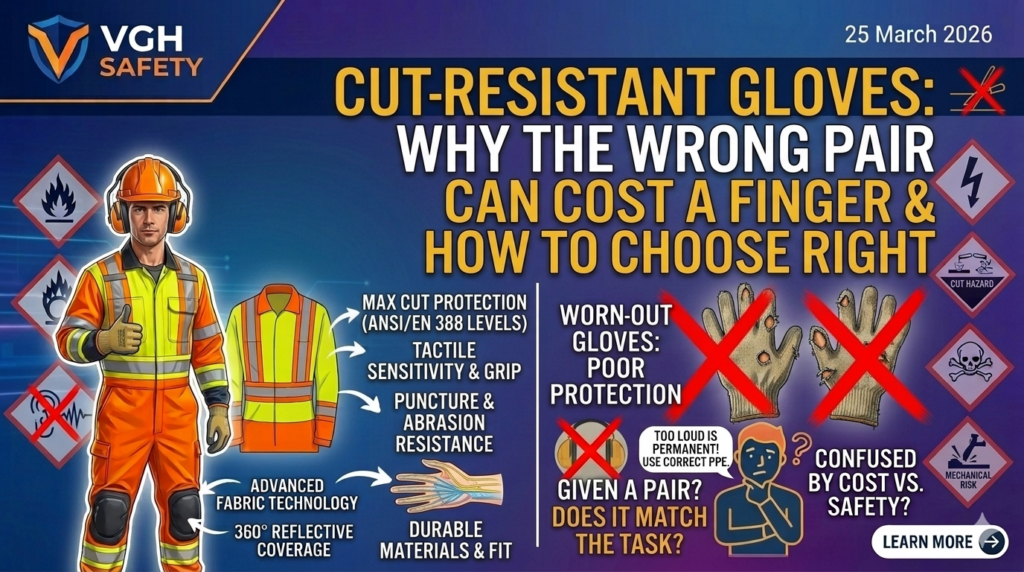
The Five-Second Decision That Cost Everything
A factory supervisor on a fabrication line was handling sheet metal offcuts. Quick job, 30 seconds tops. She reached for a glove—grabbed a basic cotton gardening glove instead of her assigned cut-resistant pair (wrong bins, rush, muscle memory).
Five seconds later: Sheet edge caught her hand. The cotton glove tore. Blood.
Result? Deep laceration across three fingers. Emergency room. Stitches. Two weeks off work. Permanent scarring. Weakness in grip. Ongoing pain.
Medical cost: R12,000. Lost wages: R8,000. Permanent reduced grip function: priceless.
Cost of the right gloves she should have grabbed? R80.
Here’s what makes this story tragic: She knew the hazard. She knew she needed cut-resistant gloves. But in a moment of hurry or convenience, she grabbed something “close enough.”
This happens constantly on South African fabrication floors, construction sites, and warehouses. Workers either:
- Don’t understand glove ratings (think all “work gloves” are the same)
- Grab whatever’s closest (the wrong bin)
- Choose comfort over protection (cut-resistant gloves can feel stiff)
- Use gloves past their lifespan (once torn, they provide zero protection)
This post explains what actually makes a glove cut-resistant, how to match glove rating to hazard, and why cheap gloves cost more in the long run.
Why Regular Gloves Fail Against Cuts
Before talking about cut-resistant gloves, understand why standard work gloves don’t work.
The Hazard: Sheet Metal, Glass, Sharp Edges
Sheet metal edges: Often deburr poorly, leaving microscopic barbs and razor-sharp edges.
Broken glass: Fractured edges are unpredictably sharp; pieces can hide in bins or on surfaces.
Ceramic/tile: Glazed edges chip, creating sharp fragments.
Wire/rope: Strand ends can cut if twisted or under tension.
Contaminated surfaces: Nails, staples, broken tools hidden in scrap or recycled material.
What Happens With Wrong Glove
Scenario: Worker in thin cotton glove contacts sharp edge
- Contact: Hand pressure pushes edge into glove
- Penetration: Thin fabric tears instantly (cotton at ~0.5 mm thickness)
- Laceration: Sharp edge now directly contacts skin
- Wound: Depending on depth and speed, minor cut to serious laceration
- Infection risk: Contaminated edge (rust, bacteria) can cause serious infection
Scenario: Worker in leather gardening glove contacts sharp edge
Leather is tougher than cotton, but still penetrable. A sheet metal edge with enough force can tear leather. Result: Same as cotton.
What Makes a Fabric Cut-Resistant
Cut-resistant fabric characteristics:
1. High tensile strength – Resists tearing when stressed
2. Layering – Multiple layers make penetration harder (fabric must tear multiple times, not once)
3. Specialized material – Synthetic fibres (polyethylene, aramid, UHMWPE) are stronger than cotton or basic leather
4. Tight weave – Densely woven fabric resists snagging and tearing
Example comparison:
| Material | Tensile Strength | Layers | Cut Resistance |
|---|---|---|---|
| Cotton glove | Low | 1 | Poor (tears instantly) |
| Leather gardening glove | Medium | 1–2 | Fair (tears with pressure) |
| Cut-resistant nylon blend | High | 3–5 | Good (resists most cuts) |
| Cut-resistant with aramid (Kevlar) | Very high | 5–7 | Excellent (stops most sharp edges) |
The maths: A cut-resistant glove with aramid layers can resist cuts that would tear a cotton glove in milliseconds.
SABS 1968: Cut-Resistance Levels Explained
South Africa adopted SABS 1968: Industrial Safety Gloves standard, which rates cut-resistance on a scale from A to F (A = lowest, F = highest).
The rating is determined by a standardized test where a weighted blade with specific sharpness is drawn across the glove material under controlled force. The number of strokes required to cut through the material determines the level.
The Six SABS 1968 Cut-Resistance Levels
| Level | Strokes Required to Cut | Protection | Cost | Best For |
|---|---|---|---|---|
| A | 200–499 | Minimal | R40–60 | Light handling (paper, fabric, light plastic) |
| B | 500–1,999 | Low | R60–100 | General factory work, light material |
| C | 2,000–4,999 | Moderate | R80–150 | Fabrication, material handling, mixed hazards |
| D | 5,000–9,999 | High | R120–200 | Heavy fabrication, sheet metal, glass handling |
| E | 10,000–24,999 | Very high | R180–300 | Extreme cutting hazards (razor blades, shard glass) |
| F | 25,000+ | Maximum | R250–400 | Specialized (e.g., meat processing, broken glass sorting) |
The Critical Mistake: Over-Specification or Under-Specification
Over-specification (buying Level F for light work):
- Cost: R300 per glove vs. R60 for Level A
- Gloves often stiffer and less comfortable
- Workers remove them due to discomfort
- False economy (expensive gloves sitting in bins)
Under-specification (buying Level A for heavy fabrication):
- Cost: R60 but zero protection for actual hazard
- Glove tears instantly on sheet metal edge
- Worker gets cut
- Medical cost: R5,000–15,000
- Lost time: R3,000–10,000
- Total cost of under-specification: R8,000–25,000
The rule: Match glove level to your specific hazard, not to budget or comfort preference.
Matching Hazard to Glove Level: Decision Framework
Level A Gloves (Minimal Protection)
Hazards they protect against:
- Paper (no sharp edges, just abrasion)
- Light plastic (smooth edges)
- Fabric and textiles (no cut risk)
- Cardboard (dull, no sharp edges)
Where to use:
- Warehouse picking (cardboard boxes)
- Textile/apparel manufacturing
- Paper/print operations
- General material handling (non-sharp items)
Cost: R40–60 per glove
Where to buy: Pioneer Workwear for basic Level A gloves.
Real scenario: A warehouse supervisor picking cartons of soft goods. No cutting hazard. Level A gloves sufficient. Budget: R50/glove × 10 workers = R500/year.
Level B Gloves (Low Protection)
Hazards they protect against:
- Dull-edged metal (filed, deburred, smooth)
- Light wire (not under tension)
- Rough edges (not razor-sharp)
- Wood splinters (small, low-speed contact)
Where to use:
- General factory assembly (handling deburred parts)
- Construction (moving processed lumber, smooth metal angles)
- Automotive assembly (handling pre-processed components)
- Light sheet metal work (if edges are deburred)
Cost: R60–100 per glove
Where to buy: Pioneer Workwear for Level B gloves in nylon or leather-nylon blend.
Real scenario: A factory assembling pre-cut metal components (edges deburred). Workers handling pieces all day. Level B adequate for deburred edges. Budget: R80/glove × 20 workers = R1,600/year (replacement as needed).
Level C Gloves (Moderate Protection)
Hazards they protect against:
- Sharp metal edges (normal fabrication cuts, not razor-sharp)
- Broken ceramics (chipped, not fracture-sharp)
- Glass edges (normal cuts, not extreme shards)
- Rough wire (twisted, under tension)
- Mixed cutting hazards (multiple sharp materials in one environment)
Where to use:
- Fabrication shops (standard sheet metal work)
- General construction (roofing, ductwork, metal stairs)
- Recycling/scrap handling (mixed sharp waste)
- Warehouse with mixed hazards (both soft and hard goods)
- Glass/tile handling (non-extreme)
Cost: R80–150 per glove
Where to buy: Pioneer Workwear for Level C nylon or polyester blend.
Real scenario: A fabrication shop doing standard metal work—cutting, grinding, forming sheet metal. Edges are sharp but not razor-grade. Level C adequate, comfortable enough for 8-hour shifts. Budget: R120/glove × 15 workers = R1,800/year.
Level D Gloves (High Protection)
Hazards they protect against:
- Very sharp metal edges (minimal deburring)
- Fractured glass (jagged, unpredictable)
- Razor-sharp wire
- High-tension rope/cable cuts
- Heavy sheet metal work
- Hazards requiring maximum cut protection without sacrificing mobility
Where to use:
- Heavy fabrication shops
- Sheet metal shops with minimal deburring
- Glass/mirror shops
- Tile/stone cutting operations
- Recycling plants (high-speed sorting of contaminated material)
- Any high-cut-risk environment where worker still needs dexterity
Cost: R120–200 per glove
Where to buy: Pioneer Workwear for Level D gloves, often with aramid (Kevlar) blend or UHMWPE core.
Real scenario: A metal fabrication shop doing heavy cutting and forming work. Edges are sharp, no time for deburring. Constant cut risk. Level D mandatory. Cost: R180/glove × 20 workers = R3,600/year, but prevents serious injuries worth R20,000+ each.
Level E & F Gloves (Extreme Protection)
Hazards they protect against:
- Razor blades (direct contact)
- Fractured glass (sharp, unpredictable)
- Surgical/medical sharp instruments
- Meat/poultry processing (high-speed blade hazards)
- Contaminated sharps (needles, broken metal in waste)
Where to use:
- Meat processing plants
- Specialized cutting operations (knife work, scalpels)
- Medical waste handling
- Glass/ceramic sorting from contaminated loads
- Rare in typical manufacturing/construction
Cost: R180–400 per glove (expensive; often specialty orders)
Where to buy: Pioneer Workwear may require special order. Meat processors and medical facilities usually source through specialized suppliers.
Reality: Most South African manufacturing and construction don’t need Level E or F. If you think you do, confirm with occupational health professional.
Material Matters: Leather vs. Synthetic
Cut-resistant gloves come in two main material types, each with trade-offs.
Leather Gloves (Cowhide or Goatskin)
Pros:
- Natural feel; less “clammy” in hot conditions
- Good abrasion resistance (lasts longer)
- Breathable
- Workers often prefer the feel
Cons:
- Lower cut resistance than synthetics (leather ≈ Level B–C max)
- Susceptible to moisture (swelling, degradation)
- More expensive than basic synthetic
- Quality varies (cheap leather is poor quality)
Best for:
- Moderate cut hazards (Level B–C range)
- Situations where worker comfort drives compliance
- Environments where gloves last >6 months (leather durability pays off)
Cost: R100–250 per glove
Where to buy: Pioneer Workwear for leather options.
Synthetic Gloves (Nylon, Polyester, Aramid, UHMWPE)
Pros:
- Higher cut resistance (can achieve Level D–F)
- Lighter and more flexible (better dexterity)
- Moisture-resistant (won’t degrade in wet environments)
- Often cheaper than leather (especially basic nylon)
- Consistent quality (less variation batch-to-batch)
Cons:
- Can feel “plasticky” or clammy (workers may resist)
- Less durable for abrasion (tear or puncture easier)
- Some synthetics get stiff in cold
- Harder to inspect for damage (wear not always visible)
Best for:
- High cut-resistance requirements (Level D+)
- Wet environments
- Cost-sensitive operations (basic nylon is cheap)
- Situations where dexterity is important (fine work, assembly)
Cost: R60–400 per glove (depends on material—basic nylon is cheap; aramid/UHMWPE premium)
Where to buy: Pioneer Workwear for full synthetic range.
Hybrid (Leather + Synthetic Blend)
What: Leather palm/fingers for durability + synthetic back/cuff for cut resistance.
Pros:
- Best of both worlds: durability (leather) + cut resistance (synthetic)
- Good worker acceptance
- Moderate cost
Cons:
- Slightly more expensive than pure synthetic
- Requires proper sizing (not one-size-fits-all)
Best for:
- Mixed hazards (abrasion + cuts)
- Situations where durability and compliance matter equally
Cost: R120–250 per glove
Where to buy: Pioneer Workwear for hybrid blends.
Glove Fit & Replacement: The Parts Most Sites Miss
Proper Fit Is Critical
A glove that doesn’t fit properly won’t be worn—or will be worn incorrectly, reducing protection.
Common fit problems:
Too loose: Bunches up, reduces dexterity, awkward to grip, worker removes it
Too tight: Restricts blood flow, causes hand fatigue, painful after 2–3 hours, worker removes it
Wrong size range: One size fits all doesn’t work. Hands vary from small to extra-large.
Solution: Offer multiple sizes (XS/S/M/L/XL minimum). Let workers try on before bulk purchase. Expect some workers to need custom fit if hands are unusual sizes.
Cost impact: Buying 100 size-medium gloves when team includes XS–XL sizes = 60% non-compliance (wrong sizes sitting unused while workers grab whatever fits).
Replacement Cycles: When Cut-Resistant Gloves Expire
Cut-resistant gloves don’t last forever. Once damaged, they provide zero protection.
Replacement triggers:
Visible damage: Tear, hole, puncture → discard immediately
Worn edges: Cuffs frayed, seams coming apart → discard
Loss of fit: Elastic degraded, glove bunches or slips → discard
Contamination: Soaked in chemicals, blood, or other substances → discard
Time-based: Even without visible damage, after 6–12 months of regular use, material degrades → discard and replace
Replacement budget: Many sites forget to plan for glove replacement. They buy 10 pairs per worker once and wonder why they run out by month 3.
Real calculation:
- Team of 20 workers
- Each gets 2 gloves per day (used, contaminated, or damaged)
- 20 × 2 × 22 working days/month = 880 gloves/month
- 880 × 12 = 10,560 gloves/year
- At R100/glove = R1,056,000/year budget needed
Wait—that doesn’t seem right. Let me recalculate with realistic consumption:
Realistic scenario:
- Team of 20 workers
- One pair of gloves per worker per day (worn out, contaminated, or torn)
- 20 gloves/day × 22 working days = 440 gloves/month
- 440 × 12 = 5,280 gloves/year
- At R100/glove (Level C cost) = R528,000/year
Still seems high. Here’s the reality: Most sites under-estimate glove consumption because:
- Workers reuse damaged gloves (thinking “still good enough”)
- Gloves get lost or misplaced
- Contamination or wear isn’t always replaced immediately
- Bulk buying up-front feels cheaper than ongoing consumption
Better calculation (conservative):
- Assume one pair per worker per 1.5 days (some reuse, some replacement)
- 20 workers ÷ 1.5 = ~13 gloves per day
- 13 × 22 days = 286 gloves/month
- 286 × 12 = 3,432 gloves/year
- At R100 = R343,200/year
Or ~R1,430 per worker per year in gloves alone.
This is why many sites use basic Level A/B gloves: Cheaper upfront. But if they’re under-protecting, the cost of one serious cut (R15,000+) exceeds the annual glove budget.
Common Cut-Glove Mistakes (The Ones That Cost Fingers)
Mistake 1: Confusing “Work Gloves” with Cut-Resistant Gloves “We provide gloves for all workers.” Yes, but are they cut-resistant? A basic cotton garden glove is not a cut-resistant glove. Check SABS 1968 rating on the label.
Fix: Look for SABS 1968 rating (A–F) on packaging/product details. No rating = not cut-resistant.
Mistake 2: Buying One Size for All Workers “We bought size Medium for everyone.” Wrong sizes sit unused. Workers grab whatever’s available (often wrong size, worse protection, or none).
Fix: Offer XS/S/M/L/XL. Let workers select proper fit. Cost difference per size is negligible; compliance improvement is huge.
Mistake 3: Under-Specifying for the Hazard “Our sheet metal work is Level B, it’s fine.” Sheet metal edges are often Level C or D hazards, not B. Result: Gloves tear on first cut.
Fix: Identify your specific cutting hazard (sharp edges, glass, wire, etc.). Ask glove supplier which level matches. When in doubt, go up one level.
Mistake 4: Not Replacing Worn/Damaged Gloves “These gloves are still here; we can use them.” If they’re torn, damaged, or contaminated, they provide zero protection. Discard and replace.
Fix: Visual inspection monthly. Replace damaged gloves immediately. Budget for ongoing consumption, not one-time purchase.
Mistake 5: Workers Choosing Comfort Over Protection “The Level D gloves are stiff; I’ll use the Level B instead.” Cheaper/lighter gloves are worn. High-protection gloves sit unused.
Fix: Test gloves with actual workers before bulk purchase. Choose gloves that balance protection and comfort. Level C is often the sweet spot (good protection, still comfortable for 8-hour shifts).
Three Real Cut-Glove Scenarios
Scenario 1: General Manufacturing Assembly (25 Workers, Mixed Materials)
Environment: Assembly line handling components (some deburred, some not), occasional sharp edges, varied material types.
Hazard Assessment:
- Mostly smooth deburred parts (Level B adequate)
- ~20% of components have sharp edges (Level C needed)
- Mixed hazard = go with Level C as baseline
PPE Spec:
- Level C cut-resistant gloves (nylon blend): 25 × R120 = R3,000 (initial kit, 1 pair per worker + spares)
- Replacement gloves (budget 1 pair per worker per week = 5 pairs/week × 25 workers):
- Year 1: 5 × 52 × R120 = R31,200
- Annual: ~R31,200
- Size distribution (XS/S/M/L/XL): Ensure variety in initial purchase
Total Year 1: ~R34,200 Annual ongoing: ~R31,200
Implementation:
- Week 1: Order Level C gloves in size variety; try-on session with team
- Week 2: Distribute, establish replacement schedule
- Ongoing: Weekly inventory checks; replace damaged/worn gloves immediately
Where to buy: Pioneer Workwear for Level C nylon blend gloves.
Cost per worker per year:
- Glove consumption: R1,248
- Initial fit/sizing: Included in training
- Total: ~R1,248/worker/year
Real scenario: Factory supervisor tells us: “We switched from Level A to Level C. Cut incidents dropped from 3–4 per year to zero in 12 months. Cost: R31,200/year. Value: Priceless (literally—one incident costs R15,000+).”
Scenario 2: Heavy Fabrication Shop (18 Workers, Sharp Metal Edges)
Environment: Sheet metal cutting, forming, welding. Edges are sharp, minimal deburring. Constant cut risk.
Hazard Assessment:
- Sheet metal edges (Level D needed)
- Wire and metal scraps (Level D needed)
- High-speed work (no time for careful handling)
- = Level D mandatory
PPE Spec:
- Level D cut-resistant gloves (aramid/synthetic blend): 18 × R180 = R3,240 (initial kit)
- Replacement gloves (1 pair per worker per 3 days due to heavy use and damage):
- Year 1: (18 workers ÷ 3) × 22 days × R180 = ~R23,760
- Annual: ~R23,760
- Size variety essential (fabricators have varied hand sizes)
- Training on proper insertion/removal (prevent accelerated wear)
Total Year 1: ~R27,000 Annual ongoing: ~R23,760
Implementation:
- Week 1: Occupational health assessment (confirm Level D needed via noise/hazard survey); order Level D gloves
- Week 2: Glove fit session; training on handling and replacement
- Ongoing: Daily visual inspection (heavy use = daily damage); weekly inventory; monthly compliance check
Where to buy: Pioneer Workwear for Level D aramid-blend gloves.
Cost per worker per year:
- Glove consumption: R1,320
- Fit/training: R100
- Total: ~R1,420/worker/year
ROI Calculation:
- Cost to protect team: R27,000 Year 1
- Cost of ONE serious laceration (stitches, infection risk, lost time): R15,000–25,000
- Cost of ONE lost finger (emergency surgery + disability): R80,000–150,000+
- One incident prevented = entire Year 1 budget justified
Real scenario: A fabricator that doesn’t use Level D gloves in heavy sheet metal work is gambling. The math favors protection.
Scenario 3: Recycling/Scrap Sorting (12 Workers, Unknown/Contaminated Sharp Hazards)
Environment: Sorting mixed scrap (metal, glass, contaminated waste). Hazards include sharp edges, contaminated materials, fractured glass, hidden nails/staples.
Hazard Challenge: Extreme variability. Could be Level C could be Level D. Unknown contamination adds biological hazard risk.
PPE Spec:
- Level D cut-resistant gloves (synthetic, durable): 12 × R180 = R2,160 (initial kit)
- Replacement gloves (heavy use + contamination): 1 pair per worker every 1–2 days
- Year 1: (12 × 22 days) + 50% extra = 330 gloves = 165 pairs
- Cost: 165 × R180 = R29,700
- Nitrile gloves (underneath, for contaminated material handling): 12 × R50 = R600 (initial); ongoing R100/month = R1,200/year
- Training on contamination protocol
Total Year 1: ~R33,660 Annual ongoing: ~R31,000
Implementation:
- Week 1: Occupational health hazard assessment (identify specific contamination risks); order Level D gloves + nitrile underlayers
- Week 2: Training on double-glove protocol; fit session
- Ongoing: Daily glove replacement (contaminated material); weekly inventory; monthly infection risk review (if biological hazard)
Where to buy:
- Pioneer Workwear for Level D gloves
- Protective Clothing for nitrile underlayer gloves
Cost per worker per year:
- Level D gloves: R2,475
- Nitrile underlayer: R100
- Total: ~R2,575/worker/year
Why this cost? Recycling/scrap is high-hazard. Workers handle unknown contamination + sharp materials daily. Level D + nitrile dual-glove is the defensible approach.
Multi-Hazard Integration: Cut-Resistant + Other Glove Types
Many operations need multiple glove types simultaneously:
Manufacturing + Chemical + Cut Hazard:
- Outer glove: Level C cut-resistant (nylon)
- Underneath: Nitrile for chemical resistance
- Purpose: Cut protection + chemical barrier
Welding + Spatter + Cut Hazard:
- Outer glove: Welding-specific gauntlet (thermal + cut resistant)
- Underneath: Lightweight cut-resistant liner
- Purpose: Thermal + cut protection
Medical/Emergency Response + Biological + Cut Hazard:
- Outer glove: Puncture-resistant, cut-resistant
- Underneath: Nitrile for biological barrier
- Purpose: Biological contamination + sharp protection
Don’t buy gloves in isolation. Understand all hazards, then spec complementary protection.
For chemical-resistant components, see Protective Clothing. For welding-specific gauntlets, see Welding Accessories.
How to Buy Cut-Resistant Gloves from VGH (Checklist)
Step 1: Identify Your Cutting Hazards
- What’s the sharp object? (sheet metal, glass, wire, ceramic, contaminated waste)
- How sharp? (dull deburred edges vs. razor-sharp vs. unknown)
- How frequent is contact? (occasional vs. continuous)
- What’s the speed? (quick handling vs. high-speed machinery contact)
Step 2: Determine SABS 1968 Level Required
- Use hazard description to match to Level A–F
- When in doubt, go up one level (cost difference is small; protection difference is large)
- Confirm with occupational health professional if uncertain
Step 3: Choose Material
- Leather (if durability/comfort paramount, hazard is moderate)
- Synthetic nylon (if cost is priority, hazard is moderate–high)
- Aramid/UHMWPE blend (if maximum cut resistance needed)
- Hybrid (if mixed abrasion + cut hazards)
Step 4: Plan Size & Inventory
- Offer XS/S/M/L/XL (don’t force one size)
- Calculate replacement rate: 1 pair per worker per X days (depends on hazard intensity)
- Budget for consumption, not one-time purchase
Step 5: Browse Pioneer Workwear
- Filter by SABS 1968 level (A, B, C, D, etc.)
- Check material type (leather, nylon, aramid blend)
- Verify size range available
- Review cost per glove for annual budgeting
- Read customer feedback on fit/durability
Step 6: Confirm Hazard Match
- Describe your specific cutting hazard to VGH
- Ask which SABS level is recommended
- Verify glove specs match your needs
- Request sample pairs to test with workers
Step 7: Order & Implement
- Place order with size variety
- Request timely delivery
- Schedule glove fit session with team before rollout
- Document which workers got which size (for reordering consistency)
Step 8: Ongoing Management
- Monthly visual inspections (damage, wear, contamination)
- Replace damaged gloves immediately (don’t wait for end of month)
- Track inventory (reorder when stock drops below 2-week supply)
- Quarterly fit check (hands change size; worker preference may evolve)
The Bottom Line
Cut-resistant gloves are the cheapest safety investment you can make. A Level C glove costs R100–150. A serious hand laceration costs R10,000–30,000 in medical bills plus lost time and pain.
Yet workers skip cut-resistant gloves because:
- They don’t understand the hazard (think “work gloves” are all the same)
- They prioritise comfort over protection (stiff gloves → removed)
- They grab whatever’s closest (wrong bin, wrong size, wrong level)
The solution is straightforward:
- Identify your cutting hazard (be specific: sheet metal edge sharpness, glass type, wire gauge)
- Match SABS 1968 level (A for soft goods, C for typical fabrication, D for extreme cuts)
- Offer multiple sizes (workers won’t wear wrong-fitting gloves)
- Budget for replacement (gloves wear out; plan for consumption, not one-time purchase)
- Train workers on proper use (show what hazard level means, why it matters)
VGH stocks SABS 1968 rated cut-resistant gloves across all levels. Browse Pioneer Workwear for Level A–D options in leather, nylon, and hybrid blends.
Questions on glove level selection, fit, or specific hazard matching? Email [contact] with your cutting hazard details. We’ll recommend the right SABS level.
Browse Cut-Resistant Gloves by Hazard
| Cutting Hazard | Sharpness | Recommended SABS Level | Material | Cost | Shop at VGH |
|---|---|---|---|---|---|
| Paper, cardboard | Dull | Level A | Cotton, basic nylon | R40–60 | Pioneer Workwear |
| Soft goods, fabric, light plastic | Very dull | Level A–B | Cotton blend, nylon | R60–100 | Pioneer Workwear |
| Deburred metal, light wire | Mild | Level B–C | Nylon, leather-nylon | R80–150 | Pioneer Workwear |
| Sheet metal edges, broken glass, rough wire | Sharp | Level C–D | Synthetic nylon, hybrid | R120–200 | Pioneer Workwear |
| Heavy sheet metal, fractured glass, razor wire | Very sharp | Level D | Aramid blend, UHMWPE | R180–300 | Pioneer Workwear |
| Meat/medical/extreme contamination | Extreme | Level E–F | Specialized aramid, UHMWPE | R250–400 | Pioneer Workwear or specialist order |
You Also Need to Know: Complementary Hand Protection
Cut-resistant gloves often work alongside other hand hazards:
Cut + Chemical Exposure:
- Outer: Level C–D cut-resistant
- Underneath: Nitrile (chemical barrier)
- From Pioneer Workwear + Protective Clothing
Cut + Thermal Hazard (welding/hot work):
- Outer: Welding-specific gauntlet (thermal + cut resistant)
- From Welding Accessories
Cut + Biological Hazard (medical/emergency):
- Outer: Puncture/cut-resistant, nitrile
- Underneath: Nitrile for biological barrier
- From Pioneer Workwear + Protective Clothing
VGH covers all combinations. Ask about multi-layer glove systems for your specific hazard mix.