
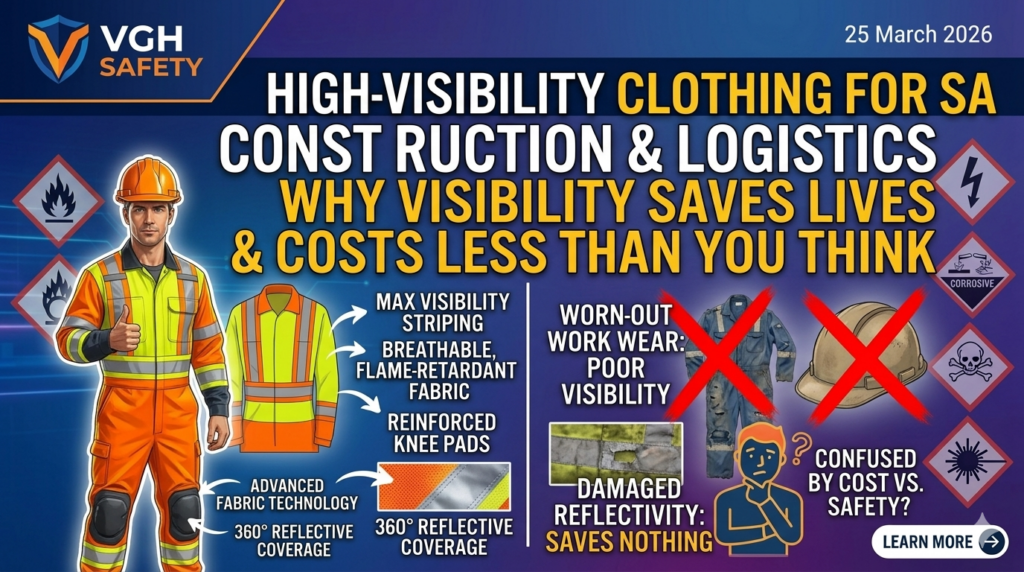
The Near-Miss That Became Reality
A traffic management supervisor on a Cape Town construction site tells this story: A worker was standing in an orange safety vest on the side of a busy road, directing traffic around the site. Late afternoon, overcast sky, fading light.
A truck driver, distracted by his phone, didn’t see the worker until the last second. He swerved. Missed him by metres. The worker didn’t move—frozen, shocked.
The supervisor later asked him: “Did you see how close that was?” The worker replied: “I felt the wind from the truck. If I hadn’t been wearing the vest, he wouldn’t have seen me at all.”
That vest cost R150. The near-miss prevented an injury (or worse) that could have cost R200,000+ in medical bills, lost productivity, and workers’ compensation claims.
Yet across South African construction sites and logistics yards, you see workers in dark clothing or unrated vests, standing in mixed traffic zones. Many site managers think high-visibility PPE is optional, uncomfortable, or “just a safety compliance checkbox.”
It’s not. It’s the difference between going home and going to hospital.
This post covers what actually makes clothing visible, the South African standards you need to meet, what to buy for different scenarios, and why proper high-visibility gear pays for itself on day one.
Why Dark Clothing Fails in High-Risk Visibility Zones
Before diving into what works, understand why standard work clothing doesn’t.
The Physics of Visibility
Visibility depends on two factors:
1. Contrast (How Much the Object Stands Out)
- Dark blue worker on dark pavement = invisible (no contrast)
- Orange worker on dark pavement = visible (high contrast)
- Reflective vest on dark pavement = highly visible (contrast + light reflection)
2. Retroreflection (Bouncing Light Back to the Source)
- Regular orange fabric reflects light diffusely (scatters in many directions)
- Reflective tape/material bounces light directly back to the source (the truck driver’s headlights)
- At night or dusk, retroreflection is what makes you visible—not the colour
Real Scenario: Visibility in Different Light Conditions
Scenario: Construction worker in traffic lane
Dark clothing (black/navy shirt, jeans):
- Daylight, good weather: Barely visible at 30 metres
- Overcast/dusk: Nearly invisible at 20 metres
- Night with headlights: Invisible unless directly in beam
- Result: Driver has <3 seconds to react at typical highway speed
High-visibility vest (basic orange, no reflective material):
- Daylight, good weather: Visible at 100+ metres
- Overcast/dusk: Visible at 60+ metres
- Night with headlights: Poorly visible (no retroreflection)
- Result: Driver has ~8 seconds to react at highway speed
SABS EN ISO 20471 Class 2 vest (orange + silver reflective stripes):
- Daylight, good weather: Visible at 150+ metres
- Overcast/dusk: Visible at 100+ metres
- Night with headlights: Visible at 150+ metres (retroreflection)
- Result: Driver has 12–15+ seconds to react at highway speed
The maths is stark: Standard work clothing gives a truck driver 3 seconds to avoid a worker. A proper high-visibility vest with reflective material gives 12+ seconds. At 50 km/h, that’s the difference between a near-miss and a fatality.
SABS EN ISO 20471: The South African Standard You Must Know
South Africa adopted EN ISO 20471 as its high-visibility standard. Most construction sites and logistics operations are legally required to meet it.
The standard defines three classes of visibility:
Class 1 (Basic, Minimal Risk)
What it includes:
- Minimum fluorescent background material (150 m² or greater)
- Minimum reflective material (0.5 m²)
- Usually a basic safety vest or armband
Visibility distance: ~150 metres in daylight; poor at night
Best for:
- Low-speed work environments (<50 km/h traffic)
- Pedestrian-only zones (no vehicles)
- Indoor warehouse work (visibility to staff, not road traffic)
- Short-duration high-visibility needs (e.g., crossing a parking lot)
Cost: R80–150 per item
Where to buy: VGH High-Visibility Accessories stocks Class 1 vests and bands for basic needs.
Real scenario: A warehouse supervisor needs workers visible when moving through the facility. Class 1 armbands on workers cost R100 each and solve the problem. Full-body Class 3 gear is overkill for indoor work.
Class 2 (Moderate Risk, Most Common)
What it includes:
- Larger fluorescent background material (0.5 m²)
- Larger reflective material (0.13 m²)
- Usually a full safety vest or light jacket with sleeves
Visibility distance: ~200 metres in daylight; ~100+ metres at night with headlights
Best for:
- Construction sites with vehicle movement
- Roadside work (not high-speed highways)
- Logistics yards
- Traffic management (lower-speed zones)
- Any site with mixed foot and vehicle traffic
Cost: R150–300 per vest/jacket
Where to buy: VGH High-Visibility Accessories has extensive Class 2 inventory—vests, jackets, and combination gear.
Real scenario: A construction site with daily site traffic, forklifts, and delivery vehicles. Class 2 vests for all 30 workers cost R6,000–9,000 one-time. Prevents vehicle-pedestrian incidents. Compliance with SABS. Cost justified immediately.
Class 3 (High Risk, Maximum Protection)
What it includes:
- Largest fluorescent background material (0.8 m²)
- Largest reflective material (0.2 m²)
- Full-body coverage (usually pants + jacket or full suit)
- Reflective stripes on arms and legs
Visibility distance: ~300+ metres in daylight; ~150+ metres at night with headlights
Best for:
- Roadside work on main roads (high-speed traffic, 80+ km/h)
- Emergency response (firefighters, paramedics, police on roadside)
- Motorway/highway work
- Night-shift roadside operations
- High-volume traffic zones (heavy vehicle movement, limited sightlines)
Cost: R500–1,200 per full suit (pants + jacket)
Where to buy: VGH High-Visibility Accessories stocks Class 3 full suits and component pieces.
Real scenario: A road construction crew working on a main road outside Johannesburg. Vehicles passing at 80+ km/h. Class 3 gear is non-negotiable. Cost per worker: R800. Cost of one fatality: incalculable. Budget allocated.
Visibility in Practice: The Class Decision Matrix
| Work Environment | Traffic Speed | Visibility Hazard | Recommended Class | Why |
|---|---|---|---|---|
| Indoor warehouse | Stationary/slow | Forklifts at low speed | Class 1 | Minimal risk; visibility to staff |
| Construction site, low traffic | 20–40 km/h | Site vehicles, occasional trucks | Class 2 | Moderate risk; standard protection |
| Busy construction site | 40–60 km/h | Heavy site traffic, mixed vehicles | Class 2–3 | Higher risk; lean toward Class 3 if dusk/night work |
| Logistics yard | 20–50 km/h | Forklifts, yard trucks, delivery vehicles | Class 2 | Moderate risk; standard for logistics |
| Roadside work (local road) | 50–80 km/h | Mixed traffic, occasional heavy vehicles | Class 2–3 | Class 2 bare minimum; Class 3 if night shift |
| Motorway/highway work | 80+ km/h | High-speed traffic, limited sightlines | Class 3 | High risk; maximum protection only |
| Emergency response (roadside) | 50–100 km/h | Traffic approaching incident scene | Class 3 | Very high risk; visibility critical |
| Night-shift any external work | Variable | Darkness; retroreflection critical | Class 3 | Night visibility requires maximum retroreflection |
High-Visibility Clothing Types: What to Actually Buy
Type 1: Vests (Most Common)
What: Sleeveless or short-sleeved vest that goes over regular clothing. Fluorescent background (orange, yellow, lime green) + reflective stripes.
Pros:
- Cheap (R150–400)
- Easy to put on/remove (workers actually wear them)
- Works over any clothing (summer or winter)
- Easy to clean/replace
- Standard on most construction sites
Cons:
- Arms not protected (only torso)
- Limited retroreflection (stripes only on front/back)
- No legs covered
Best for: Class 1–2 protection in moderate-risk sites. Construction, logistics, traffic management where workers wear regular clothes underneath.
Cost: R150–300 per vest
Where to buy: VGH High-Visibility Accessories has Class 1 and Class 2 vest options.
Real scenario: Construction site of 20 workers. Budget R250/vest × 20 = R5,000. One-time investment. Vests worn over regular clothing. Compliance + visibility achieved.
Type 2: Full-Body Suits (Pants + Jacket)
What: Matching pants and jacket in high-visibility material with reflective stripes on arms, legs, torso.
Pros:
- Maximum visibility (arms, legs, torso all covered)
- Full Class 3 protection possible
- Professional appearance
- Good for night shift or high-speed traffic zones
Cons:
- Expensive (R800–1,500 per suit)
- Less flexibility (you’re committed to wearing full suit, not layering over regular clothes)
- Harder to manage in varied temperatures (winter vs. summer)
- Requires regular washing/replacement (wears faster as primary workwear)
Best for: Class 3 protection. Roadside work, emergency response, night-shift external operations, motorway work.
Cost: R800–1,200 per suit
Where to buy: VGH High-Visibility Accessories stocks Class 3 full suits.
Real scenario: Emergency response team (8 personnel). Budget R1,000/suit × 8 = R8,000. Full Class 3 protection for high-speed roadside incidents.
Type 3: Jackets (Layering Option)
What: High-visibility jacket worn over regular clothing or workwear. Can be Class 2 or 3 depending on reflective content.
Pros:
- Flexibility (wear over anything, remove when indoors)
- Professional appearance (looks like a work jacket, not safety gear)
- Good for variable weather (zip on/off as temperature changes)
- Durable (can be made of heavier material than vests)
Cons:
- More expensive than vests (R400–800)
- Legs not covered (unless paired with reflective pants)
- Less visibility than full suits (jacket only covers torso/arms)
Best for: Class 2 protection in mixed environments. Workers who move between indoor and outdoor work. Construction, logistics, traffic management where layering is needed.
Cost: R400–800 per jacket
Where to buy: VGH High-Visibility Accessories offers jackets in multiple classes.
Real scenario: Site supervisors who move between office (indoor) and site (outdoor). Class 2 jacket (R600) worn over regular clothes. Visibility when on-site, professional appearance when indoors.
Type 4: Armbands & Leg Bands (Minimal Coverage)
What: Reflective bands worn on arms or legs. Minimal coverage but very cheap and easy to use.
Pros:
- Extremely cheap (R50–100)
- Easy to put on (slip-on bands)
- Minimal resistance (workers actually wear them, no discomfort)
- Quick to deploy (ideal for temporary work)
Cons:
- Very limited visibility (only works if limb is visible)
- Usually Class 1 only
- Relies on limb movement for visibility (arms/legs visible depends on body position)
Best for: Low-risk, indoor, pedestrian-only zones. Warehouse staff, parking attendants, pedestrian crossing supervisors. NOT suitable for vehicular traffic areas.
Cost: R50–100 per band
Where to buy: VGH High-Visibility Accessories stocks reflective armbands.
Real scenario: Parking attendants directing vehicles in a car park (low-speed, controlled environment). Armbands (R80 each) provide visibility without the bulk of a full vest. Cost-effective for low-risk scenario.
Colour Matters (More Than You’d Think)
High-visibility standards specify colour for a reason: human eyes are most sensitive to certain wavelengths.
Approved High-Visibility Colours
Fluorescent Orange-Red (Most Common)
- Best contrast against sky, pavement, vegetation
- Most visible in daylight
- Standard in SA construction (what people expect to see)
- Slightly less visible in artificial light than other colours
Fluorescent Yellow-Green (Growing in Popularity)
- Better visibility in artificial light (street lamps, headlights)
- Excellent in low-light conditions
- Less contrasts against green vegetation (forests)
- Often preferred for night-shift work
Fluorescent Yellow (Less Common)
- Excellent visibility in very low light (dusk, early morning)
- Poor visibility at night (unless reflective material adds visibility)
- Often seen on school uniforms, not industrial PPE
Which Colour for Your Site?
Daytime construction sites: Orange is fine (standard, people recognise it).
Night-shift or dusk work: Yellow-green or yellow. Better visibility in artificial light and headlights.
Mixed day/night: Yellow-green is the best compromise (visible in all conditions).
Real scenario: A roadside construction crew working day shift can use orange Class 2 vests. If the same crew does occasional night shifts, upgrade to yellow-green or add high-visibility pants (reflective material on legs adds visibility in headlights, regardless of colour).
Common High-Visibility Mistakes (And Solutions)
Mistake 1: Buying the Cheapest Unrated Vest “This orange vest is R50, it looks bright, good enough.” No SABS certification, minimal reflective material, poor quality. Doesn’t actually meet the standard.
Fix: Always check for Class rating (Class 1, 2, or 3) on the product label or VGH listing. Pay the extra R100–200 for SABS-certified gear. It’s not expensive.
Mistake 2: Class 1 Gear for High-Risk Environments “We bought cheap Class 1 vests for everyone on the construction site.” Class 1 visibility is ~150 metres in daylight, terrible at night. Workers on a site with heavy traffic are underprotected.
Fix: Match class to environment. Roadside/high-traffic = Class 2 minimum. Motorway/emergency response = Class 3 only.
Mistake 3: Poor Fit = Non-Compliance Ordering one size for everyone. Some workers’ vests hang loose, providing less visibility. Others don’t fit and workers remove them.
Fix: Order vests in multiple sizes (S/M/L/XL). Proper fit means workers actually wear them. Cost per size is negligible; non-compliance cost is huge.
Mistake 4: Not Replacing Faded Gear “We bought vests 3 years ago, they’re still bright enough.” Fluorescent material fades over time (especially with sun exposure). After 12–18 months, visibility drops significantly.
Fix: Replace vests annually or when fading is visible. Budget for consumable replacement, not one-time purchase.
Mistake 5: Visibility Gear + Dark Clothing Underneath Worker wears a high-visibility vest but dark navy pants and dark arms exposed. Legs and arms (often moving, drawing attention) are invisible.
Fix: For high-risk sites, require light-coloured or high-visibility clothing under the vest. Or upgrade to full-body Class 3 suits (eliminates the issue).
Three Real High-Visibility Scenarios
Scenario 1: Small Construction Site (15 Workers, Local Area)
Environment: Urban construction site, busy local road, mixed site/public traffic (20–40 km/h typical).
Hazard: Occasional vehicle movement through site perimeter; workers occasionally move to roadside for material delivery/coordination.
PPE Spec:
- Class 2 vests (basic, no frills): 15 × R200 = R3,000
- Replacement vests (annual, accounting for loss/damage): 3–5 extra vests = R600–1,000
- Armbands (optional, for supervisors on roadside): 3 × R80 = R240
- Total Year 1: ~R3,840
- Annual replacement: ~R800–1,200
Implementation:
- Week 1: Order Class 2 vests, multiple sizes (S/M/L/XL)
- Week 2: Distribute to workers, verify fit
- Ongoing: Replace damaged/faded vests quarterly; inspect quarterly for fading
Where to buy: VGH High-Visibility Accessories for Class 2 vests.
Real scenario breakdown:
- Cost per worker Year 1: R256
- Cost per worker Year 2+: R53–80
- Cost per worker per day: <R1
- Cost of one serious incident: R100,000–500,000+
- ROI: Obvious
Scenario 2: Busy Logistics/Construction Yard (40 Workers, High Traffic)
Environment: Large yard with constant vehicle movement—forklifts, delivery trucks, site traffic (40–60 km/h at points).
Hazard: Heavy visibility demand; workers visible at all times to drivers; dusk/early morning shifts common.
PPE Spec:
- Class 2 vests (primary): 40 × R250 = R10,000
- Class 2 jackets (for supervisors, outdoor-only staff): 8 × R600 = R4,800
- Reflective leg bands (optional, for additional lower-body visibility): 40 × R80 = R3,200
- Replacement vests (10% buffer, annual): 4 × R250 = R1,000
- Total Year 1: ~R19,000
- Annual replacement: ~R4,000–5,000
Implementation:
- Week 1: Order Class 2 vests + jackets, verify sizes with team
- Week 2: Distribute, do fit check, enforce compliance
- Ongoing: Monthly visual inspection for fading; replace as needed
Where to buy: VGH High-Visibility Accessories for vests, jackets, and bands.
Cost analysis:
- Cost per worker Year 1: R475
- Cost per worker per day: ~R1.30 (if equipment lasts 12 months)
- One incident prevented: Saves R100,000+
- Compliance value: Audit-ready, insurable, professional
Scenario 3: Roadside/Emergency Work (10 Personnel, Night Shift)
Environment: Roadside incident scene, motorway accident response, night-shift operations. High-speed traffic (80+ km/h), darkness, emergency context.
Hazard: Extreme visibility demand; retroreflection critical; Class 3 only; night-specific colour (yellow-green or yellow preferred).
PPE Spec:
- Class 3 full-body suits (yellow-green for night visibility): 10 × R1,200 = R12,000
- Class 3 high-visibility jackets (seasonal/layering): 10 × R800 = R8,000
- Reflective backpacks or equipment carriers (optional, for rescue gear): R2,000
- Replacement suits (higher wear rate, ~2 per person annually): 20 × R1,200 = R24,000
- Total Year 1: ~R46,000
- Annual replacement: ~R28,000–32,000
Implementation:
- Week 1: Order Class 3 suits, yellow-green colour, multiple sizes
- Week 2: Training on proper wear and care (suits are primary workwear, treated as equipment)
- Ongoing: Monthly inspection; replace damaged suits immediately; launder regularly (reflective material degrades with dirt)
Where to buy: VGH High-Visibility Accessories for Class 3 professional suits.
Cost analysis:
- Cost per person Year 1: R4,600
- Cost per person ongoing: R2,800–3,200/year
- Investment rationale: Working on high-speed roadside. One incident (vehicle strike during night response) costs R200,000–500,000+. Full Class 3 protection is mandatory and economically justified.
High-Visibility + Other PPE Integration
High-visibility is rarely the only hazard. Most sites have multiple overlapping risks:
Construction Site: Visibility + Impact + Heat
- High-visibility vest (Class 2)
- Hard hat (from Pioneer PPE)
- Safety glasses (from Pioneer PPE)
- Steel-toed boots (from Protective Clothing or partner suppliers)
Roadside Welding Work: Visibility + Thermal + Eye
- Class 3 high-visibility jacket + pants
- Arc helmet (from Welding Accessories)
- FR gloves (from Welding Accessories)
Emergency Response: Visibility + Multi-Hazard
- Class 3 high-visibility suit
- Hard hat with integrated visor (from Pioneer PPE)
- Respiratory protection if hazmat risk (from Respiratory Protection)
- Snake Equipment for rescue scenarios
Don’t buy high-visibility in isolation. Integrate it with site-specific hazards. VGH stocks all the pieces.
How to Buy High-Visibility Gear from VGH (Checklist)
Step 1: Assess Your Visibility Hazard
- What’s the traffic environment? (speed, volume, type—forklifts vs. trucks vs. cars)
- What’s the light condition? (daylight only, dusk/dawn, night shift)
- What’s the worker position? (stationary vs. moving, in-yard vs. roadside)
Step 2: Determine Class Requirement
- Indoor/pedestrian-only: Class 1 adequate
- Local traffic (<50 km/h): Class 2 minimum
- Busy construction/logistics (40–60 km/h): Class 2 recommended
- Roadside (50–80 km/h): Class 2–3
- Motorway/night shift: Class 3 required
Step 3: Choose Clothing Type
- Vests: Cheap, easy, works over regular clothes (Class 1–2)
- Jackets: Flexible, professional, layerable (Class 2–3)
- Full suits: Maximum protection, primary workwear (Class 3)
- Armbands: Minimal, low-risk only (Class 1)
Step 4: Select Colour
- Daytime sites: Orange standard
- Night shift or dusk work: Yellow-green preferred
- Mixed conditions: Yellow-green compromise
Step 5: Calculate Quantity & Sizes
- Workers: 1 vest/garment per person
- Buffer (10% extra for loss/damage): Spare units
- Multiple sizes (S/M/L/XL): Ensure proper fit
Step 6: Browse VGH High-Visibility Accessories
- Filter by class (Class 1, 2, 3)
- Check colours available
- Verify SABS EN ISO 20471 certification on product page
- Review cost per unit for budgeting
- Read customer reviews for fit/durability feedback
Step 7: Order & Implement
- Place order with size breakdown (e.g., 5 Small, 8 Medium, 6 Large, 5 XL)
- Request delivery with enough lead time
- Receive and inspect (no visible damage, reflective material intact)
Step 8: Distribute, Train, Enforce
- Hand out to workers, verify fit
- Explain why (visibility = safety, not just compliance)
- Document issue (who got what size, date)
- Make wearing mandatory (not optional)
Step 9: Ongoing Management
- Monthly visual inspection for fading/damage
- Replace damaged gear immediately
- Replace faded gear annually
- Track inventory (don’t run out mid-season)
The Bottom Line
High-visibility PPE is among the cheapest safety investments you can make. A Class 2 vest costs R200. It prevents a vehicle strike that costs R100,000+.
Yet many sites skip it or buy inadequate gear because:
- They think it’s “just a compliance checkbox”
- Workers resist wearing it (discomfort, appearance)
- Managers don’t understand the visibility science (why Class 2 vs. Class 1 matters)
Here’s the reality:
A proper high-visibility vest or jacket means the difference between a driver seeing you with 12+ seconds to react and 3 seconds to react. At typical traffic speeds, that’s the difference between a near-miss and a fatality.
Your options:
- No high-visibility gear: Year 1 cost = R0. Cost of one incident: R100,000–500,000+.
- Cheap unrated vests: Year 1 cost = R1,000. False sense of protection; incidents happen anyway.
- SABS-certified high-visibility gear, matched to your hazard class, replaced annually. Year 1 cost = R3,000–20,000 depending on scale. Actual protection. Compliance. Workers visible.
VGH stocks SABS-certified high-visibility gear across all classes. Browse High-Visibility Accessories for vests, jackets, and component pieces.
Questions on class selection, colour choice, or sizing? Email [contact] with your work environment details. We’ll recommend the right spec.
Browse High-Visibility by Scenario
| Environment | Traffic/Risk Level | Recommended Class | Best Garment Type | Colour | Shop at VGH |
|---|---|---|---|---|---|
| Indoor warehouse | Low (forklifts <20 km/h) | Class 1 | Vest or armband | Orange | High-Viz Accessories |
| Local construction site | Moderate (20–40 km/h) | Class 2 | Vest | Orange | High-Viz Accessories |
| Busy construction yard | High (40–60 km/h) | Class 2–3 | Vest + jacket | Orange or yellow-green | High-Viz Accessories |
| Logistics yard | Moderate–high (40–60 km/h) | Class 2 | Vest | Orange | High-Viz Accessories |
| Roadside work (main road) | Very high (50–80 km/h) | Class 3 | Full suit | Yellow-green | High-Viz Accessories |
| Motorway/emergency response | Extreme (80+ km/h, night) | Class 3 | Full suit + jacket | Yellow-green | High-Viz Accessories |
| Traffic management | Variable (20–60 km/h) | Class 2–3 | Vest + leg bands | Orange or yellow-green | High-Viz Accessories |
You Also Need to Know: Multi-Hazard Protection
Most high-visibility work sites have additional hazards:
Construction + Hard Hat + Visibility
- Pair Class 2 vest with hard hat from Pioneer PPE
- Add safety glasses if dusty environment
Roadside Work + Thermal Hazard (welding/hot work)
- Pair Class 3 high-visibility with FR workwear from Welding Accessories
- Add protective gloves
Emergency Response + Multi-Hazard
- Class 3 high-visibility base
- Add hard hat with integrated visor
- Add respiratory protection if needed
- Coordinate with rescue/specialized equipment
VGH stocks all of it. Think in layers: visibility is the base; add other PPE for secondary hazards.