
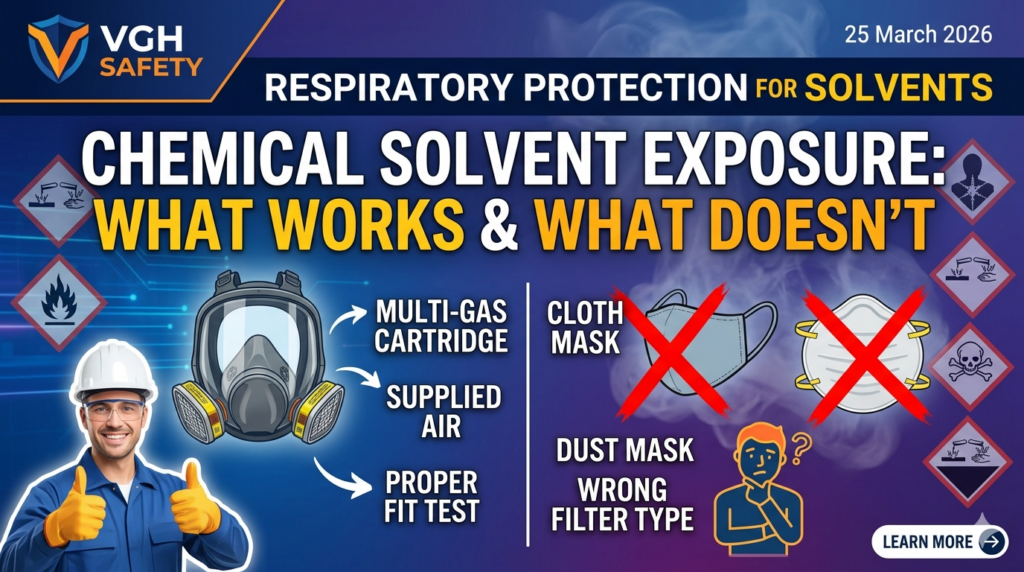
The Most Expensive PPE Mistake You Can Make
A manufacturing manager orders dust masks for solvent spray operations. “They’re cheap, everyone gets one, problem solved.”
Three months later: Workers develop headaches, respiratory irritation, and long-term neurological symptoms. One worker ends up with chronic solvent sensitivity requiring ongoing medical treatment. The company faces compensation claims, lost productivity, and a compliance audit failure.
Total cost of the “cheap mask” decision? R300,000+.
Cost of proper respiratory protection from the start? R8,000–12,000.
This happens constantly. Here’s why: Respiratory hazards are invisible. A worker doesn’t feel solvent vapours the same way they feel a falling object. By the time symptoms appear, damage is already done. And unlike cuts or burns, respiratory damage is often permanent.
This post walks you through the exact respirator types you need for different chemical exposures, how to size them properly, what cartridges actually filter what, and how much it actually costs. No guessing. No cheap shortcuts.
Why Not Just Use a Dust Mask?
This is the question we get asked every month.
Short answer: A dust mask (cloth or basic paper) filters particles—sawdust, cement dust, sand. It does absolutely nothing for vapours—solvent fumes, paint thinner, degreasers, chemical off-gassing.
The evidence: Solvent molecules are tiny. A dust mask has openings millions of times larger than those molecules. The vapour passes straight through like air through cheesecloth.
What happens: The worker wears the mask, feels a false sense of protection, and continues breathing solvent fumes. Exposure accumulates over weeks and months. Symptoms appear—dizziness, headaches, memory problems, respiratory irritation, dermatitis.
Why this matters for your site:
- Short-term: Worker productivity drops (discomfort, brain fog, illness)
- Medium-term: Worker leaves due to chronic symptoms; you lose experienced staff
- Long-term: Regulatory audit finds respiratory hazard with inadequate controls; compliance penalties, workers’ comp claims, reputational damage
- Legal: Worker develops occupational disease; you’re liable for medical costs and disability
Real scenario: A small printing shop used cloth masks for solvent exposure. One pressman developed permanent chemical sensitisation and couldn’t work. The employer faced:
- Medical costs: R15,000
- Lost productivity during illness: R20,000
- Compensation claim: R80,000+
- Regulatory fine: R10,000
- Replacement hiring + training: R25,000
- Total: ~R150,000
Cost of proper respirator from the start: R800 (half-mask + cartridges). Investment: less than 1% of the damage.
Respiratory Hazard Types: What You’re Actually Trying to Filter
Before buying a respirator, know what chemical you’re protecting against. Different chemicals need different cartridge types.
Type 1: Organic Vapours (Solvents)
What: Low-boiling-point organic chemicals—paint thinners, acetone, MEK, alcohols, degreasers, adhesives, fuel vapours.
Where you see it: Paint shops, adhesive work, solvent cleaning, degreasing operations, printing.
Why it matters: Organic vapours are fast-acting. Exposure causes immediate dizziness, headaches, respiratory irritation, and long-term neurological effects.
What you need: Activated charcoal cartridge rated for organic vapours (usually marked “OV” or “Organic Vapour” on the cartridge).
Reality check: An activated charcoal cartridge typically lasts 6–8 weeks of 8-hour daily use (less if vapour concentration is high). After that, the charcoal is saturated and stops filtering. You must replace it. Many operators forget this and think “I bought a mask once, I’m protected forever.” Wrong.
Cost per worker per year:
- Respirator (half-mask base): R300–500 (one-time)
- Cartridges (4–6 replacements/year): R600–1,000/year
- Total Year 1: ~R900–1,500; Year 2+: ~R600–1,000/year
Where to buy: VGH Respiratory Protection stocks half-mask respirators and OV cartridges. Check the product specs to confirm OV cartridge compatibility.
Type 2: Particulate + Organic Vapour (Mixed Exposure)
What: Operations involving both dust/aerosol AND solvent fumes—spray painting (paint + solvent), coating operations, mixing + spraying.
Where you see it: Paint shops, wood finishing, agricultural spray operations, automotive refinishing.
Why it matters: You can’t use a cartridge for vapours only; the dust will bypass it. You can’t use a dust filter only; vapours pass through. You need both.
What you need: Dual-cartridge respirator with OV + particulate (P100 or P2) combined, OR a respirator that accepts separate OV and particulate cartridges in different slots.
Cost per worker per year:
- Half-mask respirator: R500–700
- Dual-cartridges (6 replacements/year): R1,200–1,800/year
- Total Year 1: ~R1,700–2,500; Year 2+: ~R1,200–1,800/year
Pro tip: If you’re doing spray painting regularly, a full-face respirator (rather than half-mask) provides better seal and adds eye protection. Slightly higher cost but eliminates the need for separate eye protection.
Type 3: Particulate Only (Dust, Aerosols, No Vapours)
What: Dust inhalation without chemical vapours—grinding, cutting, sanding, concrete drilling, sawing, mineral dust, welding fumes without solvent.
Where you see it: Fabrication shops, construction (demolition, cutting), woodworking, mining/quarrying operations.
Why it matters: Dust inhalation causes silicosis (if silica dust), asbestosis (if asbestos), metal fume fever, or general pneumoconiosis. Cumulative, often irreversible.
What you need: P100 or P2 cartridge (particulate filter). The rating indicates filter efficiency:
- P1: 80% efficiency (not adequate for hazardous work)
- P2: 94% efficiency (basic particulate work)
- P100: 99.97% efficiency (high-risk particulate, including fine silica dust)
Standard in SA: SABS-certified respirators specify P100 for industrial particulate work.
Cost per worker per year:
- Half-mask respirator: R300–500
- P100 cartridges (6–8 replacements/year): R800–1,200/year
- Total Year 1: ~R1,100–1,700; Year 2+: ~R800–1,200/year
Reality: Many sites use disposable N95 masks for this, thinking it’s fine. N95 masks have comparable filtering (95% efficiency) but:
- Don’t fit as well as a fitted respirator
- Can’t be reused (more expensive over time)
- Offer no eye protection
A proper half-mask with P100 cartridges is more cost-effective long-term.
Type 4: Multi-Gas Exposure (Unknown or Complex Hazards)
What: Environments where you don’t know exactly what you’re protecting against, or multiple hazards coexist—emergency response, disaster cleanup, hazardous material sites, chemical plant incidents.
Where you see it: Emergency responders, hazmat cleanup crews, industrial accident response.
Why it matters: You can’t guess. Wrong cartridge = no protection.
What you need: Full-face respirator with multi-cartridge capability (OV + P100 + potentially ammonia, chlorine, or CO cartridges). Often supplied as a complete kit with trained operators.
Cost per worker per year:
- Full-face respirator: R1,500–2,500
- Multi-cartridges + spare filters (quarterly replacement): R2,000–3,500/year
- Total Year 1: ~R3,500–6,000; Year 2+: ~R2,000–3,500/year
Note: Multi-gas/unknown hazard scenarios usually require professional guidance. Talk to VGH Respiratory Protection directly—don’t guess on hazmat protection.
Half-Mask vs. Full-Face: Which Do You Actually Need?
Half-Mask Respirator
What: Covers nose and mouth only; cartridges attach below the chin or sides.
Pros:
- Cheaper (R300–700 vs. R1,500–2,500)
- Lighter, less hot (better long-term wear compliance)
- Easier to put on/remove for breaks
- Adequate for moderate vapour/dust exposure
Cons:
- No eye protection (you need separate safety glasses)
- Less facial seal; fit-testing is critical
- Can’t be worn with facial hair (poor seal)
- Not suitable for high-concentration hazards
Best for: Manufacturing, solvent work, general dusty environments where eye exposure isn’t the primary hazard.
Cost per worker/year: ~R900–2,000 (Year 1), R600–1,500 (ongoing)
Full-Face Respirator
What: Covers entire face (nose, mouth, eyes); cartridges attach to front or sides.
Pros:
- Integrated eye + respiratory protection (no separate glasses needed)
- Better facial seal (less dependent on facial hair)
- Suitable for high-concentration hazards
- More comfortable for longer wear (distributes weight)
Cons:
- Significantly more expensive (R1,500–3,000+)
- Heavier, can feel hot
- Fogging of visor (needs anti-fog treatment)
- Harder to communicate (muffled speech)
Best for: Spray painting, high-solvent-concentration work, high-risk chemical handling, emergency response, multi-hazard environments.
Cost per worker/year: ~R2,500–5,000 (Year 1), R2,000–3,500 (ongoing)
Cartridge Selection: The Part That Actually Matters
This is where most sites get it wrong. They buy a respirator and then grab whatever cartridge is cheapest or closest.
Cartridge codes matter. A lot.
Common Cartridge Types (SABS/ISO Standard Labeling)
| Cartridge Type | Filters | Used For | Duration | Cost/Cartridge |
|---|---|---|---|---|
| OV | Organic vapours only | Solvents, acetone, MEK | 6–8 weeks | R150–250 |
| P100 | Particulate (99.97% efficiency) | Dust, fine particles, silica | 6–8 weeks | R200–300 |
| OV + P100 | Vapours + particulate | Spray painting, solvent + dust | 6–8 weeks | R300–450 |
| Ammonia (NH3) | Ammonia gas | Fertiliser plants, industrial ammonia | 4–6 weeks | R250–350 |
| Chlorine/Acidic Gases (A2) | Chlorine, SO2, HCl | Chemical plants, bleach handling | 4–6 weeks | R250–350 |
| Multi-Gas (ABEK) | Organic, ammonia, chlorine, acidic gases | Complex/unknown hazards | 3–4 weeks | R400–600 |
The critical mistake: Buying a cartridge that doesn’t match your hazard.
- Using a P100 (dust only) for solvent spray painting? Vapours go straight through.
- Using an OV (vapours only) for spray painting? Dust bypasses the cartridge.
- Using a basic OV cartridge for high-concentration chlorine? Insufficient filtration.
How to avoid it:
- Identify your specific chemical/hazard (solvent type, dust type, gas type)
- Cross-reference the cartridge type needed for that hazard
- Buy the right cartridge
- Replace on schedule (6–8 weeks, or sooner if you notice odour breakthrough)
Real scenario: A manufacturing facility was using spray adhesive in an enclosed space. They bought respirators with OV cartridges but didn’t realise the adhesive also generated fine particulate mist. The vapour was filtered (good), but the mist bypassed the cartridge (bad). Workers were inhaling fine adhesive particles while thinking they were protected.
Solution? Switch to OV + P100 combined cartridges. Problem solved. Cost of the mistake: one worker’s respiratory sensitivity + management headache.
Fit-Testing: Why It’s Not Optional (Even Though Most Sites Skip It)
Here’s the uncomfortable truth: A respirator only works if it seals properly to your face.
If you have facial hair, if the straps are loose, if the size is wrong—air leaks around the edges and you’re breathing unfiltered air.
How many sites do fit-testing? In our experience, maybe 10–15% of SA SMEs. How many should? 100%.
What Fit-Testing Does
A fit-testing procedure checks that:
- The respirator size matches your face (small, medium, large, extra-large exist for a reason)
- The straps are positioned correctly
- The seal is achieved when you inhale
- There are no leaks around edges
Common fit-testing method: Qualitative (you wear the mask in a hood with bitter or sweet powder; if you taste it, seal is broken) or quantitative (machine measures leakage numerically).
How often? Annually, minimum. More frequently if:
- Worker gains/loses significant weight (face shape changes)
- Worker grows facial hair (changes seal)
- New model/size is introduced
Who Provides Fit-Testing?
In South Africa, occupational health clinics and some safety suppliers offer fit-testing. VGH Safety can advise on providers. Email [contact] or call with your location and team size.
Cost: ~R150–300 per worker per session. Not cheap, but negligible compared to respiratory damage claims.
The Real Question: Does Your Team Actually Get Fit-Tested?
If the answer is “not really” or “we did it once in 2019,” you’re operating with unverified protection. That’s a compliance gap and a serious health risk.
Cartridge Replacement: The Consumable Cost Most Sites Underestimate
This is where respiratory protection gets expensive if you don’t budget properly.
A cartridge isn’t a one-time purchase. It’s a consumable. You replace it every 6–8 weeks (or sooner if you notice odour breakthrough, which means saturation).
Real Replacement Budget Scenario
Manufacturing floor with 20 workers in solvent spray areas:
- Each worker uses OV cartridges
- High solvent concentration = cartridge lasts ~6 weeks
- 20 workers × 9 cartridges/year per worker = 180 cartridges/year
- 180 × R180/cartridge = R32,400/year in cartridges alone
Many sites budget R5,000 for “respirator equipment” and then run out of cartridges by mid-year.
How to avoid this:
- Calculate your consumption: Workers × exposure hours/week × cartridge life = replacements/year
- Budget for it: Set aside consumable budget separate from equipment budget
- Order in bulk: Bulk cartridge orders are cheaper (up to 20% discount vs. single units)
- Track replacement dates: A simple spreadsheet prevents “we forgot when we last changed it”
VGH can help: When you buy respirators from VGH Respiratory Protection, ask about bulk cartridge discounts. We stock multiple cartridge types and can advise on consumption rates for your specific operation.
Supplied-Air Systems: When Half-Masks and Full-Face Respirators Aren’t Enough
For extreme chemical exposure (confined space chemical work, high-concentration hazmat scenarios, asbestos removal), cartridge respirators have limits.
Why? Cartridge filtration eventually saturates. You can’t use one respirator for 10 hours if your cartridge life is 4 hours.
Alternative: Supplied-air respirators.
These don’t filter ambient air—they deliver fresh, uncontaminated air from a pump or cylinder to the facepiece. As long as your air supply is clean, you’re protected indefinitely.
Types of Supplied-Air Systems
1. Airline Respirator (Pump-Fed)
- What: Air pump (electric or pneumatic) feeds filtered air via hose to half-mask or full-face piece
- Best for: Continuous, high-concentration exposure (spray painting in booth, confined space chemical work)
- Pros: Indefinite duration; high air flow; comfortable
- Cons: Expensive (R8,000–15,000+); requires electricity/pneumatic supply; worker mobility limited by hose
- Cost/worker/year: R2,000–4,000 (maintenance, filter replacement)
2. SCBA (Self-Contained Breathing Apparatus)
- What: Worker carries compressed air cylinder; completely independent air supply
- Best for: Hazmat response, confined space rescue, extreme chemical exposure, unknown atmospheres
- Pros: Completely portable; doesn’t rely on external infrastructure
- Cons: Very expensive (R15,000–25,000+); requires extensive training; air supply duration limited (20–60 minutes)
- Cost/worker/year: R3,000–8,000 (cylinder refills, servicing)
When Do You Need Supplied-Air?
Most manufacturing and construction operations don’t. But if you’re in:
- Confined space work with chemical exposure
- Spray booths with sustained high-solvent-concentration exposure
- Asbestos removal or similar extreme particulate
- Emergency response or hazmat cleanup
- Chemical storage/handling with risk of high-concentration exposure
…then supplied-air is worth evaluating.
For guidance, contact VGH Respiratory Protection directly. We can discuss your specific scenario and whether cartridge respirators or supplied-air systems are appropriate.
Three Real Respiratory Protection Scenarios
Scenario 1: Small Paint Shop (5 Workers, Spray Paint Operations)
Hazard: Solvent paint vapours + fine paint mist
Environment: Open-air shop (not enclosed), natural ventilation
What to buy:
- Half-mask respirators with OV + P100 cartridges: 5 × R600 = R3,000
- Replacement cartridges (6 per worker per year): 5 × 6 × R300 = R9,000
- Fit-testing (annual): 5 × R200 = R1,000
- Total Year 1: ~R13,000
- Year 2+: ~R10,000/year
Where to buy: VGH Respiratory Protection for respirators and cartridges. Arrange fit-testing with local occupational health clinic.
Implementation:
- Week 1: Purchase respirators, conduct fit-testing
- Week 2: Train workers on cartridge replacement schedule
- Ongoing: Replace cartridges every 6 weeks (mark calendar)
Scenario 2: Manufacturing Floor with Mixed Solvent & Dust (30 Workers, Variable Exposure)
Hazard: Degreaser vapours (some areas), silica dust (grinding area), general manufacturing
Environment: Large, partly enclosed facility with spot ventilation
Challenge: Not all 30 workers face the same hazard. Tiers of exposure.
What to buy:
- High-exposure tier (10 workers in solvent/dust areas): Half-mask with OV + P100 cartridges
- Respirators: 10 × R700 = R7,000
- Cartridges (6 per worker/year): 10 × 6 × R350 = R21,000
- Fit-testing: 10 × R200 = R2,000
- Medium-exposure tier (15 workers in mixed areas): Half-mask with P100 only (no heavy solvent)
- Respirators: 15 × R500 = R7,500
- Cartridges (6 per worker/year): 15 × 6 × R200 = R18,000
- Fit-testing: 15 × R200 = R3,000
- Low-exposure tier (5 workers, occasional dust): Disposable P100 masks
- Masks (100 per worker/year): 5 × 100 × R40 = R20,000
- No fit-testing required
- Total Year 1: ~R79,500
- Year 2+: ~R59,000/year (minus initial respirator purchase)
Where to buy: VGH Respiratory Protection for half-masks and cartridges; disposables from Pioneer Protective Clothing or Pioneer Workwear.
Why tiering matters: You don’t buy high-end respirators for everyone if some workers have minimal exposure. This optimises cost while maintaining protection.
Scenario 3: Emergency Response Team (6 Personnel, Unknown/Multi-Hazard)
Hazard: Multiple unknowns—chemical spills, fire byproducts, biological contamination, dust
Environment: Variable (outdoor, indoor, confined space)
What to buy:
- Full-face respirators (ABEK multi-cartridge): 6 × R2,000 = R12,000
- Multi-cartridge set (ABEK, 6 replacements/year): 6 × 6 × R500 = R18,000
- Fit-testing (initial + annual): 6 × R300 × 2 = R3,600
- Training on respirator use & maintenance: ~R2,000
- Total Year 1: ~R35,600
- Year 2+: ~R21,600/year
Where to buy: VGH Respiratory Protection for full-face units and cartridges. Coordination with training provider for respiratory safety certification.
Why full-face + ABEK here: Unknown hazards require the most comprehensive protection. Multi-cartridge systems handle organic vapours, ammonia, chlorine, and acidic gases simultaneously. You can’t predict what you’re walking into, so you prepare for everything.
Common Respiratory Protection Mistakes (Expensive Ones)
Mistake 1: Wrong Cartridge Type for the Hazard Buying OV (vapours only) for spray painting where particulate is also present. Dust bypasses filtration. False security.
Fix: Identify your specific chemical/hazard. Confirm the cartridge type matches. Ask VGH if unsure.
Mistake 2: Not Replacing Cartridges on Schedule “The respirator cost R600, so I’m going to get a year out of it.” Nope. A cartridge lasts 6–8 weeks. After that, it’s saturated and stops filtering.
Fix: Budget for consumable replacement. Track replacement dates. Replace at the 6–8 week mark, sooner if you notice odour breakthrough.
Mistake 3: Skipping Fit-Testing “We bought the medium size, it should fit everyone.” Fit varies by face shape, facial hair, even hairstyle. A poorly fitting respirator is almost useless.
Fix: Conduct fit-testing annually. Make it non-negotiable. It costs R150–300 per worker and prevents expensive health claims.
Mistake 4: Storing Cartridges in the Sun or Hot Environments Activated charcoal in OV cartridges can off-gas if exposed to heat. You end up with a cartridge that’s already partially saturated before use.
Fix: Store cartridges in cool, dry conditions. Check expiry dates (cartridges can expire from storage, not just use).
Mistake 5: Assuming One Respirator Fits All Hazards “I bought a P100 respirator for dust work; I’ll use it for solvent spray painting.” P100 doesn’t filter vapours. You’re not protected.
Fix: Match respirator type to hazard. Keep different cartridge types on hand if your site has multiple hazard zones.
How to Buy Respiratory Protection from VGH (Practical Checklist)
Step 1: Identify Your Hazard
- What chemical/dust are workers exposed to?
- How many workers? Duration (hours per day)?
- Is it continuous or intermittent?
Step 2: Choose Respirator Type
- Low-moderate exposure + visibility okay? → Half-mask (cheaper, lighter)
- High exposure + eye protection needed? → Full-face (integrated protection)
- Extreme/unknown hazard? → Full-face ABEK multi-cartridge or supplied-air
Step 3: Select Cartridge Type
- OV only (organic vapours)
- P100 only (particulate)
- OV + P100 (vapours + dust)
- ABEK (multiple gas types)
Step 4: Calculate Quantities
- Respirators: 1 per worker (plus 1–2 spares)
- Cartridges: Estimate 6–8 replacements per worker per year (based on exposure hours)
Step 5: Browse VGH Respiratory Protection
- Filter by respirator type (half-mask vs. full-face)
- Check cartridge compatibility
- Confirm SABS certification on product page
- Review cost per cartridge (for ongoing budget planning)
Step 6: Order, Fit-Test, Train
- Place order
- Arrange fit-testing with occupational health provider
- Train workers on proper use, replacement schedule, storage
- Document everything (compliance auditors will ask)
Step 7: Ongoing Management
- Set calendar reminders for cartridge replacement
- Track inventory (don’t run out mid-month)
- Conduct annual fit-testing
- Replace damaged respirators immediately
The Bottom Line
Respiratory protection is expensive compared to other PPE. But it’s cheap compared to chronic respiratory disease, compensation claims, and regulatory penalties.
You have three options:
- Ignore it. Cheap upfront (R0). Expensive long-term (health claims, regulatory fines, worker compensation: R100,000+). Risk: Worker health damage, permanent.
- Buy cheap masks. R20–40 per mask. False sense of security. Workers exposed anyway. Same long-term costs as Option 1.
- Buy proper respirators, fit-test, replace cartridges on schedule. Year 1: R2,000–5,000 per worker. Year 2+: R1,000–2,000 per worker. Actual protection. Compliance. Worker health. Worth it.
VGH stocks everything you need for Option 3. Browse Respiratory Protection for half-mask and full-face options, cartridges, and compatible accessories.
Questions on what type suits your operation? Email [contact] with your hazard details. We’ll recommend the right system.
Browse Respiratory Protection by Scenario
| Scenario | Respirator Type | Cartridge | Shop at VGH |
|---|---|---|---|
| Solvent spray, open-air | Half-mask | OV + P100 | Respiratory Protection |
| Grinding, saw dust | Half-mask | P100 | Respiratory Protection |
| Mixed solvent + dust | Full-face | OV + P100 | Respiratory Protection |
| Spray booth, high concentration | Supplied-air (pump-fed) | Air filter only | Contact VGH directly |
| Emergency/hazmat response | Full-face | ABEK multi | Respiratory Protection |
| Confined space chemical work | SCBA or airline | Air cylinder/supply | Contact VGH directly |
You Also Need to Know: Multi-Hazard Protection
Many operations that require respiratory protection also need body protection. If you’re spray painting, you need:
- Respiratory protection (respiratory hazard)
- Eye protection (vapour splash)
- Skin/body protection (solvent splash, paint mist)
- Hand protection (chemical contact)
Don’t isolate respiratory PPE. Integrate it with flame-resistant workwear (if thermal hazard present), chemical-resistant clothing, and cut-resistant gloves.
VGH stocks all of it. Respiratory protection is our specialty, but we’ve got the full suite for multi-hazard environments.