
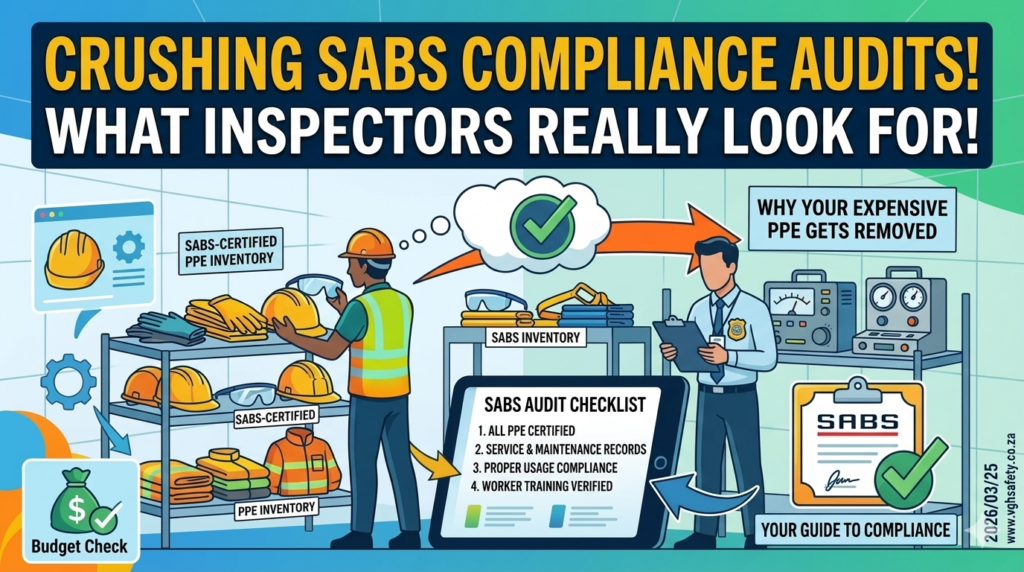
The Audit That Revealed Everything
A manufacturing facility was audited by an occupational health inspector. The company had PPE everywhere—hard hats, gloves, aprons, respirators. Spending looked good. Workers were wearing gear.
But within 15 minutes, the inspector identified critical failures:
- Hard hats didn’t match hazard: Company bought generic construction hard hats (SABS 1957 compliant, but basic impact protection). Actual hazard included chemical splash and thermal exposure. Wrong standard.
- No fit-testing records: Respirators were deployed, but no documentation showing workers had been fit-tested. Inspector asked one worker: “Can you describe how you insert earplugs?” Worker gave completely wrong answer. Zero proper training.
- Cartridges not replaced on schedule: Inspector checked respiratory cartridges. Dates showed some installed 6 months ago (way past 6–8 week lifespan). Workers breathing through saturated filters.
- No hazard assessment: Company had no documented hazard assessment showing why each piece of PPE was chosen. When asked “Why these gloves?”, manager couldn’t explain the cut-resistance level or how it matched the hazard.
- Maintenance records missing: No documentation of equipment servicing, testing, or replacement. Company claimed “everything is fine,” but had no proof.
- No incident investigation: One injury had occurred; no documented investigation into whether PPE failed or was misused.
Result: Critical non-compliance findings. Compliance order. 60 days to fix. Re-audit in 90 days.
The irony: Company had spent money on good gear. But they hadn’t documented why, hadn’t trained workers how, and hadn’t tracked what was being used when.
All of that is auditable. All of it matters.
This post covers what SABS audits actually look for, what documentation you need, how to demonstrate compliance, and how to be audit-ready at all times.
What SABS Compliance Actually Means
SABS (South African Bureau of Standards) is the national standards body. When we talk about “SABS compliance,” we usually mean:
- Equipment compliance: The PPE itself meets SABS standards (hard hats meet SABS 1957, gloves meet SABS 1968, etc.)
- Usage compliance: Equipment is used correctly, fit-tested (where required), maintained, and replaced on schedule
- Documentation compliance: The company has records showing hazard assessment, PPE selection, training, fit-testing, maintenance, and incident investigation
- Regulatory compliance: The company follows the Occupational Health and Safety Act (OHSA), which requires employers to provide adequate PPE for identified hazards
Many companies nail #1 (they buy certified equipment). They fail #2, #3, and #4 (they don’t use it properly, don’t document anything, don’t train workers).
The Five Areas an Inspector Will Check
Area 1: Hazard Assessment Documentation
What the inspector wants to see:
- Written hazard assessment for each work area
- Assessment identifies hazards (physical, chemical, biological, environmental)
- Assessment specifies which hazards are present, at what severity
- Assessment justifies why specific PPE is needed
Red flags:
- No written assessment (you guess at PPE; you fail)
- Assessment doesn’t match actual hazards (says “low noise” but floor is 95 dB; you fail)
- No link between hazard and PPE (why these gloves? “We just use them”; you fail)
How to pass:
- Conduct formal hazard assessment (can hire occupational health professional, or do it yourself systematically)
- Document in writing: “Welding area: thermal hazard (3,000°C molten metal), arc radiation (UV/IR), sparks. PPE required: FR apron (SABS EN ISO 11611), arc helmet (shade 12), long gauntlet gloves (SABS-rated).”
- Keep assessment on file
Real example of passing documentation:
HAZARD ASSESSMENT – FABRICATION LINE

Work Area: Sheet Metal Cutting & Forming
Hazard Type: Physical (sharp edges, metal splinters)
Hazard Level: High (daily contact with undeburried edges)
SABS Standard Applicable: SABS 1968 (Industrial Safety Gloves)
Minimum PPE Specification: Cut-resistant gloves, Level C minimum
Selected PPE: Pioneer Workwear Level C nylon gloves (SABS 1968 rated)
Justification: Level C provides adequate protection for moderate sharp-edge hazards; workers report good comfort/dexterity for precision work
Assessment Date: [Date]
Reviewed by: [Name, Title]
Next Review: [One year later]
Area 2: PPE Certification & Documentation
What the inspector wants to see:
- Proof that each piece of PPE has SABS (or equivalent) certification
- Certificate of conformity or product datasheet showing standard compliance
- Serial numbers or batch numbers (if applicable) linking equipment to certification
Red flags:
- “I don’t have the certificate; I lost it”
- Product has no SABS marking (unmarked equipment is suspect)
- Certificate is for different product (bought “safety glasses”; certificate is for “industrial eyewear”; close enough? No.)
- Equipment is damaged/modified (dented hard hat, torn glove, replaced lens; no longer certified)
How to pass:
- Request certificates of conformity from supplier for all PPE
- Store certificates in one place (physical or digital)
- Keep supplier documentation for each batch/purchase
- When equipment is damaged, retire it immediately (don’t re-use)
What to request from VGH or supplier:
- Certificate of conformity for hard hats (SABS 1957)
- Certificate for gloves (SABS 1968, with level specification)
- Certificate for respirators (SABS-rated, with cartridge compatibility)
- Certificate for protective clothing (SABS or ISO standards)
- Test reports or datasheets showing specifications
Area 3: Training & Fit-Testing Records
What the inspector wants to see:
- Documentation showing workers have been trained on:
- Hazard identification (what they’re protecting against)
- PPE use (how to put it on, use it, maintain it)
- Limitations (what it protects against, what it doesn’t)
- Care & storage (how to clean, store, replace)
- For respiratory protection: Fit-testing records showing each worker was tested and cleared
- For other equipment with critical fit (harnesses, helmets): Sizing records showing proper fit confirmed
Red flags:
- No training records (workers trained “verbally”; unverifiable)
- Fit-testing missing for respirators (workers using respirators without fit confirmation; major violation)
- Training records vague (“safety training conducted”; no details on what)
- Training doesn’t match hazard (trained on glove insertion but hazard is respiratory; wrong training)
How to pass:
- Create training outline for each hazard/PPE type
- Deliver training (can be manager-led, peer-led, or third-party)
- Document: Who was trained, when, what topics, who delivered training
- For respirators: Conduct fit-testing with qualified provider; keep fit-test records for each worker
Example training record:
RESPIRATORY PROTECTION TRAINING – CHEMICAL TRANSFER AREA

Date: [Date]
Attendees: [Names of 8 workers]
Trainer: [Name, occupational health professional]
Topics Covered:
- Hazard identification (solvent vapours; toluene specifically)
- Respiratory system anatomy and why vapours damage it
- Cartridge types (OV vs. P100 vs. OV+P100)
- Proper insertion technique (rolling foam, pulling ear, seating deeply)
- Duration of cartridge use (6-8 weeks)
- When to replace cartridge (if you smell breakthrough odour)
- Care & storage (keep in cool, dry place; don't store in sun)
- Limitations (doesn't work if seal is broken; doesn't provide oxygen)

Fit-Testing: All attendees fit-tested with [provider]; results on file

Next Training: [One year from date]
Signed by: [Manager], [Trainer]
Area 4: Maintenance & Replacement Records
What the inspector wants to see:
- Documentation showing equipment is inspected regularly
- Records of replacement (when gear wore out, was damaged, or expired)
- For reusable equipment (harnesses, earmuffs, respirators): Maintenance/service records
Red flags:
- “We replace gear when it wears out” (no documentation of when/what)
- Same apron in use for 3+ years (should be annual replacement)
- Respirators never serviced (no maintenance records)
- Cartridges changed “whenever we remember” (no schedule)
How to pass:
- Create replacement schedule for each equipment type
- Hard hats: Inspect monthly; replace if damaged; refresh every 5 years
- Gloves: Replace continuously as they wear (track consumption)
- Aprons: Replace annually or when damaged
- Respirators: Annual servicing; cartridge replacement every 6–8 weeks
- Cartridges: Inspect seal integrity; replace on schedule
- Log replacements in spreadsheet or maintenance tracker
- Keep receipts/invoices showing what was bought and when
Example maintenance record:
RESPIRATORY CARTRIDGE REPLACEMENT LOG – FABRICATION

Equipment: Half-mask respirator, all workers

Install Date    Worker Name         Cartridge Type    Removal Date      Notes
Jan 15, 2025    Miguel Santos      OV + P100         Mar 30, 2025      Routine replacement
Jan 15, 2025    Maria Garcia       OV + P100         Mar 30, 2025      Routine replacement
[Continue for all workers]

Cartridge expiry: ~8 weeks from install
Replacement interval: Mar 30, 2025 (cartridge lifespan reached)
Area 5: Incident Investigation & Corrective Action
What the inspector wants to see:
- Documentation of any PPE-related incident (injury, near-miss, equipment failure)
- Investigation showing root cause (was PPE not used? Failed? Wrong type? Wrong fit?)
- Corrective action taken to prevent recurrence
Red flags:
- Incident occurred but not documented
- Investigation vague (“worker was careless”; no analysis of PPE role)
- No corrective action (incident happened, fixed temporarily, never prevented recurrence)
- Same incident happens multiple times (shows corrective action failed or wasn’t implemented)
How to pass:
- Have incident reporting process (worker reports any injury/near-miss)
- Investigate each incident (ask: “Was PPE a factor? Did it fail? Was it used wrong?”)
- Document findings and corrective action
- Implement corrective action (and verify it worked)
Example incident investigation:
INCIDENT INVESTIGATION – CUT INJURY

Date of Incident: [Date]
Worker: [Name]
Injury: Laceration on right hand; required 8 stitches

What Happened:
Worker was cutting sheet metal without gloves. Cut-resistant gloves were available but not worn.

Root Cause Analysis:
- Gloves were uncomfortable (too stiff; worker reported reduced dexterity)
- Worker chose speed over protection (needed to finish task quickly)
- No enforcement of glove requirement

Factors:
- PPE factor: Yes (inadequate use; wrong size/material may have contributed to discomfort)
- Hazard factor: Yes (sharp undeburried edges are high-risk)
- Training factor: Yes (worker understood gloves were required but chose not to wear)

Corrective Action:
1. Changed glove material from stiff nylon to hybrid leather/synthetic (improves comfort)
2. Retrained worker on hazard severity and why gloves are mandatory
3. Manager will enforce zero-tolerance on glove requirement (daily visual check for 30 days)
4. After 30 days, check compliance rate

Follow-up (30 days later):
- Compliance improved to 95% (workers are wearing new gloves regularly)
- New gloves are more comfortable; workers report better dexterity
- No further incidents

Investigated by: [Manager]
Date: [Date]
The Audit-Ready Checklist: What You Need on File
Use this checklist before an audit to ensure you’re compliant:
Documentation Checklist
Hazard Assessment:
- Written assessment for each work area (documents hazards, severity, required PPE)
- Assessment reviewed and signed by manager/safety officer
- Assessment updated annually or when work changes
PPE Certification:
- Certificates of conformity for all PPE (hard hats, gloves, respirators, protective clothing)
- Datasheets showing SABS/ISO standards compliance
- Batch numbers or serial numbers linking certificates to actual equipment
Training Records:
- Training list for each hazard type (who trained, when, what topics)
- Documentation of fit-testing for respiratory protection (with dates and provider)
- Proof of annual refresher training
Maintenance & Replacement:
- Inspection logs for reusable equipment (monthly checks)
- Replacement log (what was replaced, when, why)
- Cartridge replacement schedule and compliance
- Service records for SCBA or other complex equipment
Incident Records:
- Any incident/injury reports (even minor)
- Investigation documentation (root cause, corrective action)
- Evidence that corrective action was implemented
Regulatory:
- Current policy on PPE (written, signed, dated)
- Evidence of compliance with OHSA requirements
- Contact information for occupational health provider (if used)
The Red Flags That Trigger Deeper Inspection
Auditors don’t have time to check everything. But certain red flags trigger deeper scrutiny:
Red flag 1: Inconsistent equipment
- Some workers wearing Level B gloves, others Level C
- Hard hats from different manufacturers/batches
- No clear reason for variation
Fix: Standardise equipment. One spec per hazard type.
Red flag 2: Workers can’t explain their gear
- Inspector asks worker: “Why are you wearing this respirator?”
- Worker: “Because my supervisor said so” (doesn’t understand the hazard)
- Shows training was ineffective
Fix: Ensure workers understand the hazard and why specific PPE protects against it.
Red flag 3: Equipment is damaged and still in use
- Cracked hard hat, torn glove, dented earmuff cup
- Shows lack of inspection/replacement
Fix: Retire damaged equipment immediately. Visual daily checks.
Red flag 4: No documentation of anything
- No certificates, no training records, no maintenance logs
- Inspector asks: “When was this hard hat purchased?”
- Manager: “I don’t know; it’s been here a while”
Fix: Document everything. It takes 30 minutes to create a good system; auditors spend hours fixing bad ones.
Red flag 5: Same incident happens multiple times
- Two workers cut their hands last year (no gloves)
- Worker just got cut again (still no gloves)
- Shows corrective action didn’t work or wasn’t implemented
Fix: Investigate thoroughly. Implement corrective action. Verify it worked.
SABS Standards: Quick Reference for Key Equipment
Hard Hats & Helmets
- SABS 1957: Industrial safety helmets (hard hats)
- What it covers: Impact protection from falling objects
- Lifespan: 5–10 years; 5-year refresh recommended
- Audit requirement: Certificate showing SABS 1957 compliance
Gloves
- SABS 1968: Industrial safety gloves
- What it covers: Cut resistance (levels A–F), chemical protection, flame resistance (depending on material)
- Lifespan: 6–12 months (depends on use; consumable)
- Audit requirement: Specify which level of SABS 1968 is used and why it matches the hazard
Protective Eyewear
- SABS 1821: Industrial safety eyewear (glasses, goggles)
- What it covers: Impact protection, splash protection
- Lifespan: 2–3 years
- Audit requirement: Certificate showing SABS 1821 compliance; if used for chemical splash, confirm suitability
Hearing Protection
- SANS 10103: Code of practice for occupational noise exposure
- What it covers: Noise exposure limits; when hearing protection required
- Requirement: Baseline audiometric testing before exposure; annual follow-up if noise >85 dB
- Audit requirement: Audiometry records; cartridge/earplug replacement schedule
Respiratory Protection
- SABS-certified respirators: Half-mask, full-face, SCBA
- Cartridge compatibility: OV (organic vapours), P100 (particulate), ABEK (multi-gas)
- Lifespan: Equipment lasts years; cartridges last 6–8 weeks of use
- Audit requirement: Fit-testing records; cartridge replacement log; maintenance records
High-Visibility Clothing
- SABS EN ISO 20471: High-visibility safety clothing
- Classes: 1 (minimal), 2 (moderate), 3 (maximum)
- Lifespan: Annual replacement (fluorescent material fades)
- Audit requirement: Certificate showing class level; justification for why that class matches hazard
Protective Clothing (Chemical & Biological)
- SABS/ISO standards vary: Depends on material (PVC, nitrile, non-woven)
- Chemical compatibility: Verify material is compatible with specific chemicals used
- Lifespan: 6–18 months (reusable); single-use for disposables
- Audit requirement: Certificate showing material compatibility with hazards; replacement schedule
Getting Audit-Ready: A 30-Day Action Plan
If an audit is coming (or you want to be ready), here’s a simple 30-day plan:
Week 1: Documentation Audit
- Gather all PPE-related documents (certificates, training records, maintenance logs)
- Create a folder (physical or digital) with all documents
- Identify what’s missing (likely: incident investigation records, fit-testing records)
Week 2: Hazard Assessment
- Walk each work area; identify hazards
- Document hazards in writing
- Specify PPE required for each hazard
- Verify current equipment matches spec
Week 3: Training & Fit-Testing
- Identify workers who need fit-testing (especially respiratory protection)
- Schedule fit-testing with occupational health provider
- Conduct/schedule training on PPE (even if refresher)
- Document training in writing
Week 4: Cleanup & Verification
- Retire any damaged equipment
- Verify all equipment has SABS certification
- Create maintenance/replacement logs (even if backdated based on actual history)
- Do a final walk-through with the checklist above
Day 30: Mock Audit
- Ask someone (manager, safety officer, or even external consultant) to simulate an audit
- Walk them through documentation
- Ask a worker to explain their PPE
- Identify remaining gaps
What Happens If You Fail
Non-compliance findings can include:
Minor: “Documentation incomplete; complete within 30 days”
- Example: Missing fit-testing records
- Action: Conduct fit-testing; document it; submit proof
Major: “PPE inadequate for identified hazard; implement corrective action within 60 days”
- Example: Buying Level B gloves for Level D hazard; re-assess and specify correct level
- Action: Assess hazard; specify correct PPE; purchase; train; document
Critical: “Non-compliance poses immediate risk; must correct before continuing operation”
- Example: Workers using respirators without fit-testing; no proof of cartridge replacement
- Action: Immediate fit-testing; immediate cartridge replacement; potential work stoppage until compliant
Consequences:
- Fine (R20,000–50,000+ depending on severity)
- Workers’ compensation liability (if injury occurs during non-compliance)
- Reputational damage (audit findings may become public)
- Insurance impact (coverage may be denied if company knowingly non-compliant)
- Stop-work order (in critical cases)
The Bottom Line
SABS compliance isn’t about buying fancy gear. It’s about:
- Understanding your hazards (written assessment)
- Choosing appropriate PPE (certified equipment matching the hazard)
- Using it correctly (training, fit-testing, maintenance)
- Proving you did it (documentation)
Most companies fail on #3 and #4. They buy good gear but don’t train workers or document anything. Then when inspectors ask “prove you did this,” they have nothing.
To be audit-ready:
- Document your hazards (written assessment)
- Request certificates for all PPE (proof of certification)
- Train workers and keep records (proof of training)
- Replace equipment on schedule and log it (proof of maintenance)
- Investigate incidents and document fixes (proof of corrective action)
Time investment: ~10 hours upfront to build a good system. Maintenance: 2–3 hours per month (logging replacements, updates).
ROI: Pass audits. Avoid fines. Reduce incident risk. Insurance acceptance. Worker confidence.
Questions on SABS Compliance or Audit Preparation?
Audit-readiness is complex. VGH can help.
Email [contact] with:
- Current audit status (upcoming? Last audit findings?)
- Main documentation gaps (what are you missing?)
- Equipment inventory (what PPE do you have; is it certified?)
- Team size and hazards
We’ll provide:
- Documentation templates (hazard assessment, incident investigation, etc.)
- SABS standard overview for your specific equipment
- Supplier documentation support (certificates, datasheets)
- Audit-readiness checklist customised to your operation
Being audit-ready isn’t about perfection. It’s about demonstrating you thought through hazards, chose appropriate gear, trained your team, and maintained everything. Document that, and you’ll pass.