
The Summer Collapse Nobody Planned For
A Johannesburg construction site was running smoothly through autumn and winter. PPE compliance was solid. Workers wore hard hats, gloves, and protective gear without much fuss.
Then summer arrived. Temperatures hit 35°C+. Site was outdoor, full sun, no shade.
Within two weeks, incident reports spiked. Heat-related issues (fainting, dizziness). Workers removing gear to cool down. Glove compliance dropped from 90% to 40%. One worker collapsed mid-shift.
Manager was shocked: “Nothing changed. Why is compliance suddenly terrible?”
Everything changed. Temperature jumped 15°C. Humidity shifted from comfortable to oppressive. Workers who tolerated gear in autumn couldn’t tolerate it in summer.
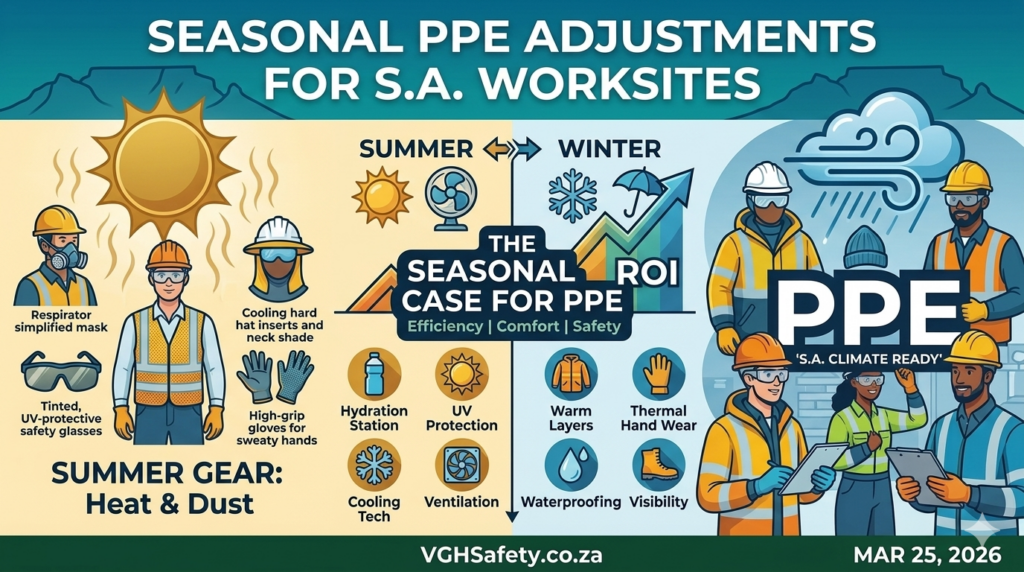
This post covers what changes with season and climate in South Africa, how PPE performance degrades, and what adjustments are needed to maintain compliance through extreme conditions.
The Environmental Factors That Break PPE Compliance
PPE specs are designed for “normal” conditions. But South Africa has extreme seasonal and regional variation that breaks those assumptions.
Factor 1: Heat & Humidity (Summer)
What happens:
- Protective gear traps heat (especially full-body protective suits, respirators with face seals, heavy aprons)
- Temperature inside gear rises 5–15°C above ambient (inside a respirator mask in 35°C heat = 45–50°C)
- Worker perspires heavily; gear gets wet; seal integrity compromised
- Heat stress symptoms: dizziness, nausea, fatigue, impaired judgment, heat exhaustion, heatstroke
- Compliance crashes: Workers remove gear to cool down
Real impact:
- Hard hat with foam padding: Temperature inside rises 8°C
- Full-face respirator: Temperature inside rises 12–15°C
- Flame-resistant protective suit: Temperature inside rises 10–20°C
- Gloves in 35°C+ heat: Hand temperature rises, sweat accumulates, grip becomes slippery
Where it’s worst:
- Open outdoor sites (construction, mining, road work, agricultural)
- Gauteng & Limpopo (summer highs 35–40°C+)
- August–March (peak heat season)
Factor 2: Wet Season & Humidity (Summer/Early Autumn)
What happens:
- Humidity rises above 70% (makes evaporative cooling ineffective)
- Sweat doesn’t evaporate; gear stays wet
- Wet gear loses insulating properties; heat transfer changes
- Wet feet in sealed boots = maceration, fungal infections, discomfort
- Wet protective clothing = mold/mildew growth; material degrades
- Respirator seals degrade (moisture affects foam cushions)
Real impact:
- Respirator fit-testing may fail in high humidity (moisture affects seal)
- Protective suits become uncomfortable within 30 minutes (not hours)
- Gloves become slippery (sweat inside glove, reduced grip)
- Footwear develops fungal issues (wet feet, warm environment)
- Gear develops odor (mold/mildew); workers resistant to wearing it
Where it’s worst:
- KwaZulu-Natal (coastal humidity 70–90%)
- Limpopo during rainy season
- Manufacturing in enclosed buildings without AC (humidity inside often >75%)
- Any site near water (dams, rivers, wetlands)
Factor 3: Cold & Dry (Winter)
What happens:
- Dry air causes static electricity (especially in manufacturing with synthetic materials)
- Cold reduces blood flow to extremities; hands become numb
- PPE materials become brittle (some synthetics, rubber, certain foams)
- Respirator foam cushions harden; seals become ineffective
- Protective gloves become stiff; dexterity drops
- Worker overheats if over-layering (wearing PPE + winter jacket)
Real impact:
- Hearing protection foam becomes hard; fit worsens
- Respirator seals fail (foam is no longer pliable)
- Gloves are too stiff for precision work; workers remove them
- Static discharge risk (especially in powder handling, chemical environments)
- Cold hands + thick gloves = workers can’t perform tasks; compliance drops
Where it’s worst:
- High altitude areas (Lesotho, Eastern Cape highlands): Freezing temps at night
- Overnight shifts in winter
- June–August (peak cold months)
Factor 4: Altitude (Mining & High-Elevation Work)
What happens:
- Oxygen levels decrease (~15% less oxygen at 2,000m elevation)
- Temperature drops ~1°C per 100m elevation
- Respiratory effort increases; workers breathe harder
- Air pressure changes affect respiratory equipment seals
- Exertion is more taxing (less oxygen = higher heart rate for same work)
- Altitude sickness (headache, nausea, shortness of breath) at 2,000m+
Real impact:
- Respirators need higher flow rates (standard cartridges may be inadequate)
- Workers fatigue faster; compliance drops (worker removes gear to breathe easier)
- SCBA duration decreases (less atmospheric pressure = less air in cylinder)
- Respiratory cartridge lifespan may be shorter (higher breathing rate = faster saturation)
- Heat loss is faster (colder + lower pressure)
Where it’s worst:
- Mining operations (Witwatersrand, Mpumalanga coal fields)
- Lesotho (2,500m+ elevation)
- Eastern Cape highlands
- Altitude 1,500m+ (noticeable effects)
Factor 5: Dust & Sand (Dry Season, Windy Areas)
What happens:
- Dry conditions create fine dust (silica, coal, agricultural)
- Wind disperses dust widely (outdoor sites, poorly ventilated indoor areas)
- Dust clogs respirator filters (cartridges clog faster)
- Dust gets into seal areas of respirators (compromises fit)
- Dust accumulates on protective clothing (washes away, shortens lifespan)
- Dry air + dust = skin irritation, eye irritation
Real impact:
- Cartridge replacement frequency increases (clogged, air resistance high)
- Respirator filters become restrictive (harder to breathe; workers remove)
- Hearing protection foams get clogged with dust; acoustic properties change
- Protective clothing needs more frequent washing (accelerates material degradation)
- Eye irritation (dust + dry air) requires frequent eye care
Where it’s worst:
- Northern areas (Limpopo, North West)
- Dry season (May–August)
- Dusty industries (mining, construction, agriculture)
- Windy locations (high plains, open coast)
PPE Adjustments by Season: What Actually Works
Summer Adjustments (October–March, 35°C+ heat, high humidity)
Challenge: Heat stress, compliance drops, gear failures
Adjustments:
- Swap heavy gear for lighter alternatives (where possible)
- Frameless hard hats (less padding = less heat trapping) instead of full-padded
- Mesh gloves instead of heavy leather (if cut hazard permits)
- Lighter-weight respirators with better ventilation
- Short-sleeve FR shirts instead of full long-sleeve (if flame hazard is moderate)
- Increase rest periods & hydration
- In high heat, worker in full protective gear can only work 45–60 minutes continuously
- Build in 15-minute shade/cool-down breaks every hour
- Provide water stations (workers in PPE dehydrate faster)
- Monitor for heat stress signs (dizziness, confusion, excessive sweating)
- Schedule heavy work during cooler hours
- Start early (6–7 AM; cooler temperatures)
- Take long midday break (11 AM–3 PM; hottest hours)
- Resume work late afternoon (4–6 PM)
- This is standard in many Middle Eastern/Australian sites; applicable in SA summer
- Upgrade respirator components
- Use half-mask instead of full-face (less seal area = less heat trapping)
- Switch to elastomer cartridges (withstand heat better than carbon)
- Use goggles + half-mask instead of full-face respirator (if eye hazard is low)
- Enforce daily gear inspection & replacement
- Heat degradation accelerates material lifespan
- Inspect gloves, aprons, gear daily in summer (vs. weekly in winter)
- Replace more frequently (e.g., gloves every 3 days in summer vs. every 5 days in winter)
- Adjust fit-testing frequency
- Heat + humidity affects respirator seal
- Re-test quarterly in summer (vs. annually in winter)
- If worker reports seal problems, re-test immediately
Real example (success): A Johannesburg demolition company implemented summer adjustments: Started work 6 AM, took 3-hour midday break, resumed 3 PM. Used lighter hard hats, half-mask respirators. Increased water intake. Compliance remained 88% in summer (was 92% in winter; acceptable drop). Zero heat-related incidents.
Wet Season Adjustments (Rainy months, 70%+ humidity)
Challenge: Moisture degrades seals, respiratory equipment fails, fungal growth
Adjustments:
- Protect respiratory equipment from moisture
- Store respirators in breathable bags (not sealed; moisture needs to escape)
- Use silica gel packets in storage (absorb moisture)
- Replace respirator cartridges more frequently (humidity reduces lifespan; assume 4-week lifespan instead of 8-week)
- Check seal integrity weekly (humidity compromises foam cushions)
- Replace waterproofing on gloves & gear
- Apply hydrophobic coating to gloves (helps water bead off instead of absorbing)
- Switch to neoprene gloves (more water-resistant than nitrile)
- Use rubber aprons instead of PVC (better moisture resistance)
- Manage foot health
- Provide waterproof boots (sealed, not just water-resistant)
- Require daily foot inspection (watch for maceration, fungal growth)
- Provide fungal prevention (powder, antifungal cream)
- Change socks frequently (multiple pairs per worker per day)
- Increase laundry frequency for reusable gear
- Wash protective clothing every 2–3 days (vs. weekly in dry season)
- Use antifungal detergent
- Air-dry in sun (kills mold, natural disinfection)
- Don’t store wet or damp gear (mold grows in 24 hours)
- Monitor respirator performance
- Conduct mini-fit-tests monthly (instead of quarterly) in wet season
- If seal is compromised, replace foam cushions
- Switch to positive-pressure respirators if standard seals fail
Real example (failure): A manufacturing plant in coastal KZN didn’t adjust for humidity. Respirators stored in sealed lockers (moisture trapped inside). Cartridges used past lifespan (nobody tracked wet-season acceleration). Workers reported breathing difficulty; management assumed it was just “hard work.” Investigation later found cartridges were saturated, providing minimal filtration. Two workers developed respiratory issues.
Winter Adjustments (May–August, <15°C, dry)
Challenge: Material brittleness, seal failures, reduced dexterity, static electricity
Adjustments:
- Replace cold-sensitive components
- Swap respirator foam cushions for cold-resistant versions (some foams harden below 10°C)
- Use flexible glove materials (leather, hybrid materials) instead of stiff synthetics
- Replace hard hearing protection foam (becomes brittle; switch to gel-filled cushions)
- Maintain equipment flexibility
- Store gear at room temperature (not in cold vehicles overnight)
- Before use in cold, warm gloves/respirators for 5 minutes (improves flexibility)
- Allow equipment to acclimate before fit-testing (cold equipment may not seal properly initially)
- Manage static electricity
- In dry conditions, static risk increases
- Use anti-static gloves if handling flammable powders/liquids
- Ground equipment & workers (wrist straps, conductive footwear)
- Increase humidity in indoor spaces (humidifier in work area, if applicable)
- Adjust workwear layering
- Don’t over-layer (worker heats up during exertion; then cools rapidly at rest)
- Provide moisture-wicking base layer + insulating middle + protective outer
- Remove layers during exertion; replace at rest
- Monitor for “sweat-cool cycle” (causes hypothermia faster than cold alone)
- Increase break frequency
- Cold exertion is more taxing; workers need more rest
- Provide warm breaks (indoor, warm beverages)
- Watch for early hypothermia signs (shivering, confusion, loss of dexterity)
Real example (success): A Johannesburg factory used winter adjustments: Pre-warmed respirators before use, switched to flexible glove materials, implemented 10-minute warm breaks every 90 minutes. Compliance stayed high through winter. No cold-related incidents.
Altitude Adjustments (Mining, High-Elevation Work 1,500m+)
Challenge: Lower oxygen, respiratory stress, altitude sickness, equipment changes needed
Adjustments:
- Adjust respiratory protection specifications
- Workers at altitude breathe faster (lower oxygen = higher respiratory rate)
- Cartridge lifespan decreases (assume 50% reduction; 4-week lifespan instead of 8-week)
- Use supplied-air systems instead of cartridge respirators (altitude affects filtration efficiency)
- SCBA cylinders hold less usable air (air expands at lower pressure); plan shorter missions
- Increase cartridge inspection frequency
- Monthly inspection (vs. quarterly at sea level)
- Replace on schedule, even if cartridge seems “fine”
- Pre-stage replacement cartridges (worker may need to change mid-shift)
- Monitor for altitude sickness
- Headache, nausea, shortness of breath = red flags
- Workers should acclimate over 3–5 days (avoid strenuous work first 2 days)
- Provide oxygen if acute sickness develops
- Some workers can’t acclimate; rotate them to lower-altitude work
- Adjust work schedules
- Reduce work duration in first week (acclimation phase)
- More frequent breaks (lower oxygen = faster fatigue)
- Shift work every 2–4 weeks (prevent chronic altitude stress)
- Maintain respiratory equipment in thin air
- Test seal integrity at elevation (thin air = different pressure differential)
- Fit-testing may need to happen at elevation (not at sea level)
- Use equipment designed for altitude (not all respirators perform the same)
Real example: A mining operation in Lesotho (2,400m elevation) didn’t adjust for altitude. Workers from low-lying areas started work immediately. Two developed altitude sickness; one required evacuation. Investigation found: respirator cartridges weren’t being replaced frequently enough, work wasn’t scheduled for acclimation, and fit-testing had been done at coastal facility (different pressure).
Environmental Hazards That Require PPE Changes
Dust-Heavy Seasons (Dry Season, Windy Areas)
Adjustments:
- Increase cartridge replacement frequency (dust clogs filters)
- Use P100 filters instead of weaker filters (fine dust penetrates)
- Clean helmet/glasses more frequently (dust accumulation reduces visibility)
- Wash protective clothing more frequently (dust accelerates material wear)
Wet/Rainy Conditions (Rainy Season, Water-Based Work)
Adjustments:
- Use waterproof PPE (not just water-resistant)
- Inspect seals more frequently (moisture compromises them)
- Dry gear thoroughly after use (prevent mold/fungal growth)
- Replace hearing protection foam if saturated (loses acoustic properties when wet)
Salt/Corrosive Environments (Coastal Areas)
Adjustments:
- Use stainless steel or plastic hardware (not steel; rust)
- Wash gear after salt spray exposure (salt accelerates corrosion)
- Replace gear more frequently (salt accelerates degradation)
- Use neoprene or polyethylene instead of leather (leather degrades faster in salt)
The Seasonal Adjustment Checklist: What to Review Each Season
Use this checklist to adjust PPE program for seasonal changes:
Before Summer (September)
- Assess heat tolerance of current PPE
- Identify lighter-weight alternatives (half-mask vs. full-face, mesh vs. leather gloves, etc.)
- Schedule additional fit-testing for summer (quarterly instead of annual)
- Order lighter gear (if upgrading)
- Brief workers on heat stress risks & cooling strategies
- Identify shaded rest areas or provide umbrellas/tents
Before Wet Season (November)
- Check respirator seals (test for moisture resistance)
- Order moisture-resistant cartridges (if applicable)
- Provide antifungal treatment for footwear & gloves
- Arrange more frequent gear washing
- Stock silica gel packets for storage
- Test respirator performance in humid conditions
Before Winter (April)
- Check cold-sensitive components (foam, seals, materials)
- Order cold-weather versions (cold-resistant foam, flexible gloves)
- Test equipment at cold temperature (store overnight in cold room; test seal)
- Plan layering strategy (avoid over-layering)
- Identify warm break areas (indoor, heat source)
- Brief workers on hypothermia risks
Before Altitude Season (March, if applicable)
- Assess altitude impact on work (if elevation >1,500m)
- Review respiratory equipment specs for altitude (cartridge lifespan, supplied-air need)
- Plan acclimation schedule (3–5 days reduced work)
- Stock extra cartridges (shorter lifespan at altitude)
- Brief workers on altitude sickness symptoms
- Plan equipment testing at elevation
Regional Considerations: SA Geography-Specific Guidance
Gauteng & Limpopo (Hot, Dry, Windy)
Challenges: Extreme summer heat (35–40°C), low humidity, dust storms, altitude (1,500–1,800m)
Year-round adjustments:
- Summer: Lightweight gear, frequent breaks, early/late work schedule
- Winter: Cold-resistant materials, manage static electricity
- Year-round: Dust management (frequent cartridge replacement, protective glasses)
KwaZulu-Natal (Humid, Hot, Coastal)
Challenges: High humidity (70–90%), warm year-round (25–35°C), salt spray (coastal), moisture management
Year-round adjustments:
- Summer: Heat + humidity combined; needs aggressive heat management + moisture control
- Winter: Mild (15–20°C); minimal cold adjustments; humidity still challenges respiratory equipment
- Year-round: Antifungal protocols for footwear/gloves, frequent gear washing, salt spray protection (coastal)
Eastern Cape (Variable, Cold Highlands)
Challenges: Altitude in highlands (1,800–2,500m), cold winters (<5°C), windy, occasional snow
Year-round adjustments:
- Summer: Moderate; heat not extreme like Gauteng
- Winter: Cold-resistant gear critical; altitude compounds respiratory challenges
- Year-round: Manage altitude if >1,500m
Western Cape (Moderate, Windy)
Challenges: Moderate temperatures year-round (8–25°C), strong winds, salt spray (Cape Town), sun intensity, altitude variation
Year-round adjustments:
- Summer: Heat not extreme; focus on sun protection + wind management
- Winter: Mild; minimal adjustments
- Year-round: Salt spray protection (coastal), wind management (can tear or displace gear)
North West & Northern Cape (Hot, Dry, Remote)
Challenges: Extreme heat in summer (37–42°C), low humidity, dust, limited infrastructure
Year-round adjustments:
- Summer: Aggressive heat management; lightweight gear; frequent hydration & rest
- Winter: Moderate; some cold management
- Year-round: Dust management, remote location means supply chain challenges (pre-stage supplies)
Real-World Example: Gold Mining Operation (Gauteng, 2,200m Elevation)
Year-Round PPE Adjustment Strategy:
Summer (Oct–Mar, 30–38°C, low humidity, dust-heavy):
- Use half-mask respirators with P100 cartridges (dust-intensive season)
- Cartridge replacement every 3 weeks (dust clogs filters)
- Start underground work at 4 AM (cooler surface temperature at depth helps)
- Lightweight hard hats with ventilation holes
- Short breaks every 45 min above ground; water stations at lift-off points
- Re-test respirator fit monthly (temperature affects seal)
Winter (Jun–Aug, 5–18°C, low humidity, static risk):
- Switch to respirators with cold-resistant foam
- Use neoprene gloves (remain flexible in cold)
- Warm underground is less of an issue (mining goes ~2 km down; temperature stable ~50°C)
- Above-ground work gets cold-weather adjustment (warm breaks, layering strategy)
- Anti-static protocols for powder handling (dry winter air increases risk)
Year-Round (Altitude 2,200m):
- Cartridge lifespan: Assume 4 weeks (50% reduction from sea-level 8 weeks)
- Monthly cartridge replacement schedule (vs. quarterly at sea level)
- Supplied-air option for extended underground work (cartridge-based inadequate)
- Acclimation period for new workers: 5 days reduced work, then full schedule
- Fit-testing: Quarterly at elevation (not at coastal reference facility; pressure different)
Result: Consistent compliance 85%+ year-round. Zero respiratory incidents over 5-year period.
The Bottom Line
PPE specs work for average conditions. South Africa’s extreme seasonal and regional variation breaks those assumptions.
You need to adjust for:
- Summer: Heat & humidity (reduce workload, lightweight gear, frequent breaks)
- Winter: Cold & dry (flexible materials, manage static, layering strategy)
- Wet season: Moisture (protect seals, antifungal, frequent washing)
- Altitude: Thin air (adjust respiratory specs, shorten cartridge lifespan)
- Regional: Heat (North), humidity (KZN), salt (coast), dust (inland)
Without adjustments, PPE compliance drops 20–50% seasonally. Incident risk increases. Equipment fails prematurely.
With adjustments, you maintain 80%+ compliance year-round. Equipment lasts longer. Workers stay healthy.
The investment: Minimal. Most adjustments are scheduling (work hours), monitoring (fit-testing frequency), and consumable replacement (extra cartridges, fresh gear).
The ROI: Prevented incidents, compliant program, worker confidence that company cares about seasonal challenges.
Questions on Seasonal Adjustments or Regional Guidance?
VGH can help customize PPE strategy for your region and season.
Email [contact] with:
- Your location (province, altitude if >1,500m, coastal/inland)
- Your industry (mining, construction, manufacturing, agriculture)
- Current PPE program (what you’re using now)
- Seasonal challenges you’re facing (heat compliance, moisture, dust, etc.)
We’ll provide:
- Region-specific PPE adjustment recommendations
- Seasonal gear swaps (what to upgrade/replace per season)
- Supplier support (sourcing cold-resistant foam, lightweight gear, moisture-resistant cartridges, etc.)
- Seasonal checklist (customized for your region)
Climate shouldn’t break your safety program. Adjust for it.