
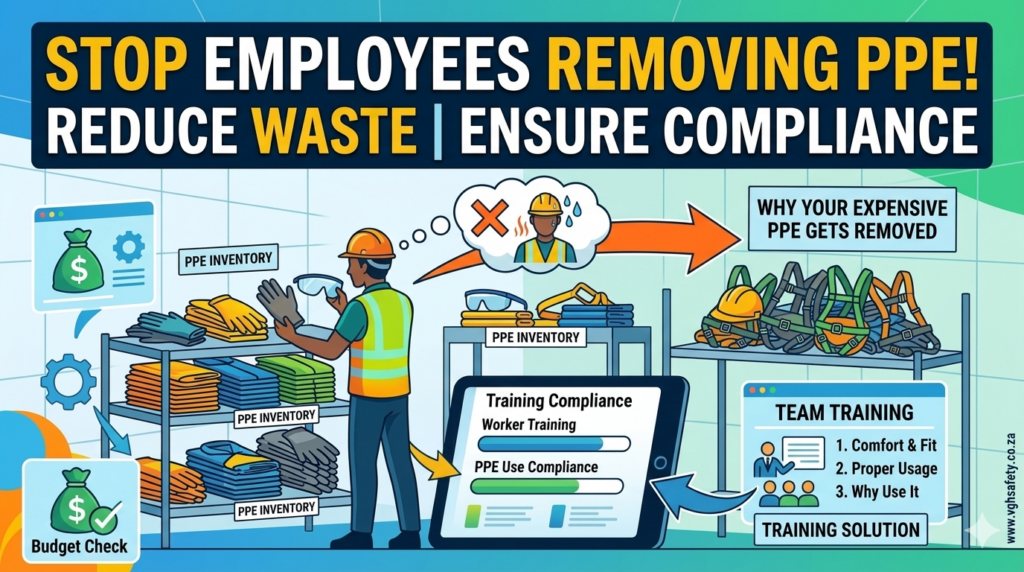
The Perfectly Specified Gear That Nobody Wears
A fabrication shop manager invested R120,000 in Level D cut-resistant gloves, flame-resistant aprons, and arc helmets for his 15-person welding team. Perfect spec. Right materials. SABS certified. Quality equipment.
Three weeks later, he walked the floor and found workers wearing:
- One guy had removed his apron (complained it was too stiff)
- Two workers were sharing a single pair of gloves (ran out; didn’t ask for more)
- Another was wearing an old, torn apron he’d found in a locker (preferred it because it was “softer”)
- Three workers had removed their arc helmets during breaks and weren’t putting them back on
He’d spent R120,000 on protection. His workers had created a workaround system that avoided using most of it.
The bitter truth: Buying the right PPE is 30% of the problem. Getting workers to actually wear it is the other 70%.
This post covers why workers remove PPE, how to design compliance systems that work (not lecture-based), how to fit-test properly, and enforcement strategies that don’t breed resentment.
The Root Causes: Why Workers Remove PPE
Before lecturing workers about safety culture, understand why they remove gear. There are usually real reasons.
Reason 1: Discomfort
The problem:
- Tight gloves restrict blood flow; hand fatigue after 2 hours
- Stiff flame-resistant aprons reduce mobility; workers can’t reach or bend properly
- Heavy respirators cause neck strain after 30 minutes
- Thick safety glasses fog up; can’t see work properly
- Hard hats with poor ventilation trap heat; headaches by mid-shift
Worker logic: “I can work faster and better without this gear. It slows me down and hurts.”
Result: Worker removes gear. Tells himself “just for this quick task.” Quick task becomes 2 hours. No protection.
Why it happens: Managers spec protection based on hazard severity, not worker comfort. If hazard is severe = heavy protection. But if heavy protection makes work slow/painful, workers remove it.
Real scenario: A welding shop bought Level D gloves (necessary for their hazard). But Level D gloves are stiff and hot. Workers complained they couldn’t feel the work, made welding slower and worse quality. Within two weeks, half the team was back to lighter gloves (inadequate protection, but faster work).
Reason 2: Workflow Friction
The problem:
- Respirator with cartridges slows down entry/exit of confined space (10 min to don/doff; makes short work impossible)
- Protective gown for medical work requires help to remove; workers spend 15 minutes on doffing; temptation to skip at end of shift
- Harness and lifelines for height work add 20 minutes to setup; workers cut corners
- Changing gloves between tasks (chemical glove → cut-resistant glove) adds 2 min per change; workers skip changes to save time
Worker logic: “This process is slowing me down. If I skip this step, I can finish on time.”
Result: Worker creates workaround (skips steps, wears wrong PPE for task, removes gear partway through)
Why it happens: Managers don’t observe the actual workflow. They design PPE spec in isolation. Then reality collides with the work process, and workers adapt by removing gear.
Real scenario: A chemical transfer operation required workers to change into chemical-resistant gloves before handling solvent, then back to regular gloves for assembly. Workers hated the changeover. After a month, they stopped changing—just wore one glove type and hoped. Eventually, a solvent splash and minor chemical burn drove compliance, but it took an injury.
Reason 3: False Confidence or Habit
The problem:
- Worker has done task 1,000 times without incident; believes the hazard is low (cognitive bias)
- Worker’s experienced peers don’t wear gear; worker mimics peers (social norm)
- Worker wore lighter gear yesterday and was fine; assumes today is fine too
- Worker doesn’t understand the hazard (doesn’t know arc radiation causes delayed eye damage, thinks “my eyes feel fine”)
Worker logic: “I’ve done this before without gear. Nothing happened. The hazard can’t be that real.”
Result: Worker skips PPE or wears wrong type
Why it happens: Absence of injury is interpreted as absence of hazard. But occupational disease (hearing loss, arc eye damage, chemical sensitisation) builds slowly and invisibly.
Real scenario: A manufacturing floor with chronic low-level solvent exposure. No acute incidents (no splashes, no obvious problems). Workers gradually stopped wearing respirators (felt unnecessary). After 15 years, two workers developed chronic solvent sensitivity and permanent neurological damage. Investigation showed: ongoing exposure to below-threshold levels that, over time, exceeded safe cumulative dose.
Reason 4: Lack of Proper Fit or Access
The problem:
- Only one size available (all medium gloves for a team with XS–XL hands)
- Gloves in wrong bin; workers grab whatever’s closest
- Equipment missing/damaged; workers jury-rig solutions or skip
- New worker doesn’t know where gear is; doesn’t ask; works without
Worker logic: “I can’t find the right size/the gear isn’t available/I don’t know where it is.”
Result: Worker works without proper gear, or uses wrong size (doesn’t work properly)
Why it happens: Supply chain and communication failures. Gear is available but hard to access. Or managers haven’t set up a system for new workers to find gear.
Real scenario: A warehouse expanded team from 20 to 40 workers overnight (new contract). Didn’t update PPE inventory. New workers showed up, didn’t know where gloves were, nobody told them, they worked without. One worker got a serious laceration that would have been prevented by proper gloves.
Reason 5: Peer Pressure (Negative)
The problem:
- Experienced workers don’t use certain gear (or mock it); new workers follow suit
- Team culture normalises cutting corners (“we all skip this step”)
- Senior people model non-compliance; junior people can’t say anything
Worker logic: “Everyone else skips this. If I don’t, I’ll look like I don’t trust my team / I’m overly cautious / I’m new and nervous.”
Result: Worker removes gear to fit in with team culture
Why it happens: Safety culture is set by visible behavior, not policy. If experienced workers skip gear, that becomes the norm.
Real scenario: A construction site where the foreman (20 years’ experience) didn’t wear hard hats “because I’m careful.” New workers saw this and copied. Even though the company policy required hats, the team norm was to skip them. When an inspector visited, it became obvious the safety culture was broken.
Designing for Compliance: Systems That Actually Work
Most companies lecture workers about safety. “Safety is our top priority. Follow the rules. PPE is mandatory.”
Workers ignore lectures. But they follow systems.
System 1: Make Proper PPE the Path of Least Resistance
The principle: Default to the right choice. Make doing it correctly easier than not doing it.
Examples:
For glove compliance:
- Instead of: One bin with mixed sizes, workers grab whatever
- Do this: Five separate bins (XS/S/M/L/XL), clearly labelled, with photo of hand size for sizing
- Result: Workers naturally grab the right size because it’s where they reach first
For apron compliance:
- Instead of: Aprons stored in a locker; workers need to walk to locker, change, remember to remove after shift
- Do this: Aprons hanging on hooks at each work station; worn apron goes in wash bin at end of shift
- Result: Workers put on apron because it’s right there; it’s the default
For respirator cartridge replacement:
- Instead of: Cartridges stored with maintenance; workers need to request replacement
- Do this: Calendar on wall showing when cartridge was installed and when to replace (e.g., “Replace on Oct 15”); new cartridge staged nearby with installation guide
- Result: Worker sees calendar date, grabs new cartridge, replaces it (system tells them when, where, how)
Cost of system design: Minimal (labelled bins, wall calendar, hanging hooks). ROI: Huge (compliance improves without constant nagging).
System 2: Make Discomfort Visible and Actionable
The principle: If gear is uncomfortable, you’ll know about it, and you’ll fix it.
How: Trial period with worker feedback.
Process:
- Trial: Roll out new gear (e.g., new Level D gloves, new arc helmet) to 3–5 volunteers for 2 weeks
- Feedback: Specifically ask: “What’s uncomfortable? What doesn’t work? What would you change?”
- Iterate: Based on feedback, adjust if possible (different glove material, better helmet design, lighter protection for certain tasks, etc.)
- Implement: Once comfort issue is solved, roll out to team
- Document: Share the “we heard you and changed based on feedback” story with team; builds trust
Real scenario (success): A fabrication shop bought Level D flame-resistant aprons. Workers complained they were stiff and restricted movement. Instead of ignoring complaints, manager asked workers to test three different aprons. Workers preferred a hybrid design (less flame-resistant on shoulders/back, full protection on front and chest). Cost slightly more, but compliance went from 40% to 95%.
Real scenario (failure): Another shop bought Level D gloves. Workers complained about stiffness. Manager said “deal with it, safety doesn’t have to be comfortable.” Workers started removing gloves for long tasks. One laceration later, manager was defensive and blamed workers for “non-compliance,” not realizing the equipment was the problem.
System 3: Fit-Testing & Sizing (Not a One-Time Event)
The principle: Proper fit = compliance. Improper fit = removal.
How: Conduct fit-testing, but make it ongoing.
For PPE with critical fit (respiratory protection, harnesses, helmets):
- Initial fit-test: Before first use, worker tries on equipment; supervisor checks seal, comfort, range of motion
- Quarterly refit: Worker’s body changes (weight loss/gain, muscle development, posture changes). Refit every 3 months
- Damage/wear refit: If equipment is damaged or worn, refit before returning to use
- After incident: If equipment is involved in any near-miss or incident, refit immediately
For gloves and other sizing-based PPE:
- Hand tracing: Trace worker’s hand; use chart to select proper size (not visual guessing)
- Movement test: Worker puts on gloves, tests grip, bending, fine motor; confirms fit is right
- Comfort validation: Worker wears gloves for 30 minutes of actual work; reports comfort. If poor, try different size
Cost: 30 minutes per worker per quarter for fit checks. ROI: Prevents “wrong size = not worn” problem.
System 4: Enforcement That Doesn’t Breed Resentment
The principle: Enforce rules, but fairly and consistently.
What doesn’t work:
- Random shaming (“Why isn’t your helmet on?” in front of coworkers)
- Punitive (“You removed your gloves, you’re sent home”)
- Inconsistent (supervisor enforces; senior worker skips without consequence)
- Vague (“Be safe out there” without defining what that means)
What does work:
- Clear expectations: “Hard hats on-site, period. No exceptions, no ‘quick 5-minute jobs.'”
- Consistent enforcement: Everyone follows the rule; no senior-worker exemptions
- Supportive framing: “We’re enforcing this because we want everyone going home healthy”
- Progressive: First violation = conversation; second = warning; third = discipline
- Root-cause focus: If worker removes gear, ask why (is it uncomfortable? wrong size? don’t understand the hazard?) rather than just punishing
Real scenario: A construction site had a culture where hard hats were optional “if you’re just walking, not working.” Injuries didn’t distinguish between “walking” and “working”—a falling object hits your head whether you’re standing still or actively working.
New safety officer implemented zero-tolerance: hard hats on-site, always. First week, she saw the foreman (20 years’ experience) working without a hat. She asked him to put it on. He was annoyed (“I don’t need it; I’m careful”). She was calm: “The rule is for everyone. Including me, including you. Please put it on.”
He put it on. Over the next month, when she consistently enforced the rule (without anger, just matter-of-fact), the culture shifted. People started seeing hard hats as normal. Compliance went from 40% to 98%.
Training That Changes Behavior (Not Just Lectures)
Most PPE training is ineffective because it’s a lecture. Workers sit in a room, listen to statistics, and forget everything by the next day.
Effective training changes behavior. Here’s how.
Training Type 1: Hazard Immersion (Show, Don’t Tell)
What: Show the actual hazard, not a slide.
Example (arc eye):
- Lecture approach: “Welding arc radiation causes arc eye. 85 dB UV. Painful. Prevention: wear helmet.”
- Immersion approach: Show worker a real example—actual arc eye patient (with permission), photos of painful eye, testimonial from person who developed arc eye, or demonstrate arc intensity with light meter
Effect: “UV causes eye damage” is abstract. Seeing a person with damaged eyes is real.
Example (cut hazards):
- Lecture: “Sheet metal edges are sharp. Level D gloves stop them.”
- Immersion: Bring sheet metal edge into training. Let worker feel the edge (with protection). Show them the difference between cotton glove (tears instantly) and Level D glove (stays intact)
Effort: 30 minutes to gather examples; one-time investment.
Training Type 2: Skill Practice (Hands-On)
What: Let workers practice proper use, not just hear about it.
Example (respirator fitting):
- Lecture: “Insert earplugs by rolling foam, pulling ear back, inserting deeply.”
- Skill practice: Give worker foam plugs. Have them practice insertion 5 times under supervision. Verify they do it right. Correct on the fly.
- Result: Worker can actually insert plugs properly; not just heard about it
Example (harness donning):
- Lecture: “Put on harness, check all straps, clip D-ring.”
- Skill practice: Give worker harness. Have them put it on. Check for proper fit. Have them do it again, timed. Repeat until they can don harness in 60 seconds without prompting.
- Result: When real emergency happens, they can don harness quickly and correctly
Effort: 1 hour per training session; annual refresh.
Training Type 3: Real-Consequence Stories (Not Statistics)
What: Tell true stories of people injured due to non-compliance, not generic statistics.
Bad: “5,000 people per year suffer hand laceration. Protect yourself with cut-resistant gloves.”
Good: “A fabricator named Miguel worked the line for 10 years. He thought he didn’t need gloves for ‘quick jobs.’ One Tuesday, he grabbed sheet metal without gloves. Severe laceration across three fingers. Surgery. Permanent loss of grip strength. He can’t do fabrication anymore. Different job, lower pay, regrets every day.”
Effect: Statistics are abstract. Stories are real. Workers remember stories.
Effort: Find local examples or use real cases (anonymised if needed).
Training Type 4: Peer-Led (Not Manager-Led)
What: Senior workers or respected peers deliver training.
Why: Workers trust peers more than management. If an experienced guy says “this glove saved my hand,” workers believe it more than manager saying “safety is important.”
How:
- Identify respected workers (experienced, safety-minded)
- Train them to deliver training (1 day)
- Have them lead PPE training for their teams
- Managers observe; don’t dominate
Effect: “If Marco says this is important, I listen” works better than “management says this is important.”
Creating a Safety Culture (Not Safety Theater)
Culture is created by visible behavior, not policy documents.
Visible Behavior 1: Leaders Wear the Gear
If: Site supervisor doesn’t wear hard hat on-site Message: “Hard hats aren’t that important”
If: Safety officer wears hard hat everywhere, every time, without exception Message: “This is non-negotiable”
Real example: A mining operation had poor hard-hat compliance. New mine manager started his first day wearing a hard hat before anyone else. Wore it everywhere—walking around office, outside, underground. Never exempted himself. Within 3 months, compliance went from 60% to 98%. His behavior was louder than any policy.
Visible Behavior 2: Incident Response Focuses on Root Cause, Not Blame
Bad response to incident: “Why didn’t you wear gloves?! Reckless! Sent home without pay.”
Good response: “You got cut without gloves. Let’s figure out what happened. Did the gloves feel uncomfortable? Were they wrong size? Did you not have them available? Let’s fix the problem so it doesn’t happen again.”
Effect of bad response: Worker is afraid to report incidents; culture becomes secretive
Effect of good response: Worker trusts the system; reports problems; management learns what’s actually preventing compliance
Visible Behavior 3: PPE Investment Gets Noticed
If: Company buys cheap, low-quality PPE Message: “We spend the minimum on safety”
If: Company invests in good gear and replaces it regularly Message: “We value your health”
Real example: A manufacturing company switched from cheap unrated gloves to SABS-certified Level C gloves. Didn’t make a big announcement; just happened. But workers noticed the quality difference. One worker said: “The new gloves are so much better. They feel like the company actually cares.” That’s culture. That’s compliance.
The Conversation That Stops Non-Compliance
When you see a worker without proper gear, don’t lecture. Ask.
Bad approach: “Why aren’t you wearing gloves?! Safety first! Put them on NOW!” Result: Worker is defensive; compliance is temporary; resentment builds
Good approach: “Hey, I noticed you’re working without gloves. I know this job requires them. What’s going on? Do they not fit? Are they uncomfortable? Can we figure out what’s wrong?”
Possible answers and responses:
“The gloves don’t fit my hands right.” → “Okay, let’s find your size. Walk with me to the glove bin. What size are you usually?”
“They slow me down. I work faster without them.” → “I get it. But if you get a cut, you’re off 2 weeks. That’s way slower. Let’s make sure you have the right size and try again.”
“I ran out, and I forgot to ask for more.” → “No problem. Let’s restock the bin right now. And let’s set up a system so you know when we’re low.”
“The older guys don’t wear them, so I figured it was okay.” → “The older guys are breaking the rule. I’m enforcing it for everyone now. Let’s all step up.”
The conversation solves the real problem. Yelling and punishment don’t.
New Worker Onboarding: Get It Right From Day One
Most non-compliance starts with poor onboarding. New workers don’t know where gear is, what sizes fit, why certain gear is needed.
Proper onboarding:
Day 1:
- Show worker where all PPE is stored
- Have worker try on all gear (hard hat, gloves, glasses, etc.) while supervisor checks fit
- Explain the hazards for their role and why specific gear is needed
- Have worker practice putting on gear (especially anything with fitting requirements)
- Have worker spend first 30 min of work with supervisor (mentor mode) watching their PPE compliance
Week 1:
- Check in daily with new worker (quick conversation: “How are the gloves fitting? Any discomfort? Any gear giving you problems?”)
- Fix any issues immediately (wrong size, missing items, discomfort)
Month 1:
- Quarterly fit-check on day 30
- Informal feedback on how they’re doing with compliance
Result: New worker starts with proper habits. Compliance is the default, not a struggle.
The Metrics That Matter (Not Just “Compliance %”)
Most companies track “% of workers wearing gear.” This is a useless metric (workers can wear gear poorly and still be “compliant”).
Better metrics:
Proper-fit compliance: “% of workers with properly-fitting gear checked via fit-test”
- Measure: Monthly fit audits on random workers
- Goal: 95%+
Incident-free duration: “Days since last PPE-related injury”
- Measure: Track any injury that would have been prevented by proper PPE use
- Goal: 365+ days
Consumption accuracy: “Actual glove consumption vs. forecast”
- Measure: End of month, compare projected consumption to actual
- Goal: Within 10% (if you forecast 1,100 pairs, actual is 1,000–1,200)
Worker satisfaction: “Would you recommend our PPE / Do you feel the gear is appropriate for your work”
- Measure: Quarterly anonymous survey
- Goal: 80%+ positive
Reporting rate: “Near-misses or hazard observations reported”
- Measure: Workers reporting PPE issues, discomfort, or hazard observations
- Goal: High reporting rate (shows trust in system)
The Bottom Line
You can buy perfect PPE and have it sit in lockers.
Or you can buy reasonable PPE and have workers actually use it.
The difference is compliance culture. And compliance culture is built on:
- Systems that make compliance easy (right gear in right place, proper fit available)
- Removing friction (comfort balancing, workflow integration)
- Training that changes behavior (hazard immersion, skill practice, real stories, peer-led)
- Leadership that models compliance (leaders wear gear, enforce fairly, invest in quality)
- Root-cause focus (ask why compliance fails; fix the system, not just the person)
Most companies do zero of these. They buy gear, write a policy, and wonder why workers don’t comply.
If you do these five things consistently:
- Compliance will improve from 30–40% to 80%+
- Workers will see gear as normal, not burdensome
- Culture will shift from “safety is what management wants” to “safety is what we do”
Questions on Training Design or Compliance Systems?
Building a compliance culture is complex. VGH can help.
Email [contact] with:
- Current PPE compliance rate (if known)
- Main compliance challenges (workers removing gear, wrong sizes, workflow friction, etc.)
- Team size and primary hazards
- Current training approach (if any)
We’ll provide:
- Customised training outline for your hazards
- Compliance-system recommendations
- Supplier support (ensuring proper sizing, fit-testing, inventory)
Your PPE investment is wasted if workers don’t wear it. Get compliance right.