South Africa’s industrial environments present some of the most punishing climatic and operational challenges on the African continent. If you are managing a site in the iron ore and manganese mines of the Northern Cape, you are battling a blistering, dry heat that regularly pushes the mercury past 40 degrees Celsius. Conversely, operations in the agricultural hubs or platinum belts of Limpopo deal with a stifling, heavy humidity that makes cooling down nearly impossible.
For Occupational Health and Safety (OHS) officers and procurement managers, this extreme weather creates a permanent operational dilemma: how do you protect your workforce from severe physical and chemical hazards without inadvertently causing heat exhaustion, dehydration, or fatal heatstroke?
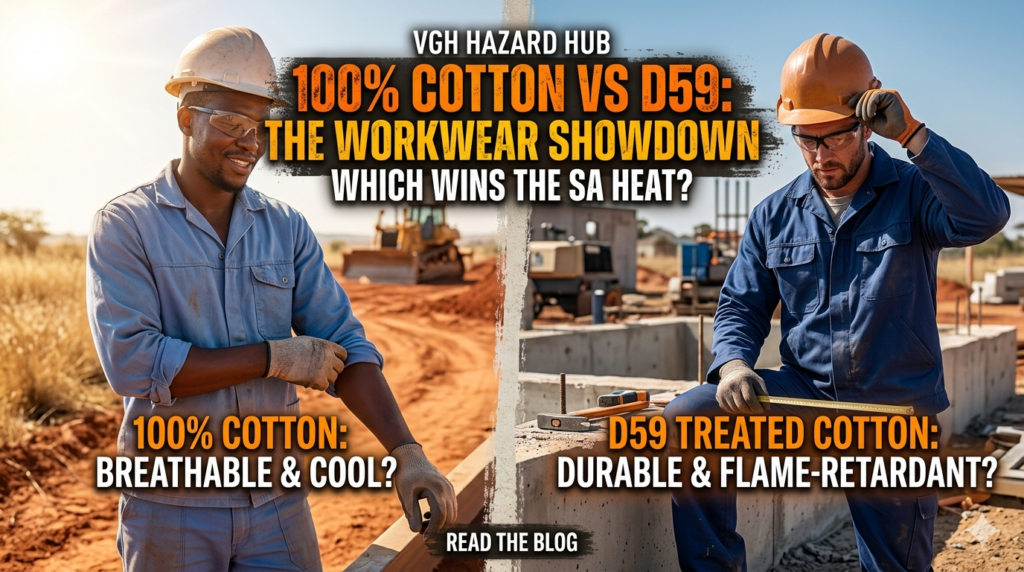
The answer always comes down to fabric selection. When sourcing protective clothing, procurement teams generally find themselves weighing two heavy hitters against each other: standard 100% Cotton and specialized D59 Flame Retardant/Acid Resistant treated cotton.
This guide conducts a comprehensive, side-by-side technical comparison of these two materials. By evaluating their durability, breathability, and legal compliance, we will help you build a safer, more efficient workwear procurement strategy tailored for the South African heat.
Understanding the Contenders
Before comparing their performance on site, it is crucial to understand the structural and chemical differences between these two fabrics. A common misconception on the workshop floor is that D59 is a synthetic material. It is not. Both options are cotton-based, but their engineering pathways diverge significantly to serve different purposes.
The Lightweight Champion: 100% Standard Cotton
Standard 100% cotton workwear (often referred to in the industry by its weave standard, like J54) is the traditional go-to for general labor.
- The Make-up: It is a natural, woven cellulose fiber. For industrial applications, it is typically woven into a twill pattern to provide a baseline of durability while remaining relatively lightweight (usually ranging between 200gsm and 240gsm).
- The Core Strength: The natural, untreated fibers allow for exceptional airflow and moisture absorption, making it highly comfortable against the skin.
- The Limitation: Because the fibers are completely untreated and relatively light, standard cotton offers zero specialized protection against sparks, flames, or corrosive chemicals. It is also highly susceptible to wear and tear in highly abrasive environments.
The Heavyweight Defender: D59 Treated Cotton
D59 is essentially cotton on steroids. It is a heavy-duty, tightly woven cotton drill fabric that must meet stringent SABS (South African Bureau of Standards) requirements.
- The Make-up: D59 is significantly heavier than standard cotton twill, usually weighing in at around 270gsm to 330gsm. Furthermore, the “D59” designation indicates a highly specific, dense weave designed to resist tearing.
- The Core Strength: The magic of D59 lies in its aftermarket chemical treatments. The fabric undergoes a rigorous finishing process to make it inherently Flame Retardant (FR) and Acid Resistant (AR). When exposed to a flame or a welding spark, the chemical treatment causes the fabric to char and self-extinguish rather than catch fire and melt onto the skin.
- The Limitation: The combination of a heavier weave and multiple chemical coatings severely reduces the fabric’s natural porosity. It traps heat and does not wick moisture away from the body as effectively as untreated cotton.
The Ultimate South African Heat Test
To determine which fabric belongs on your site, we need to run them through three real-world South African industrial scenarios, evaluating breathability, durability, and compliance.
Scenario 1: The Midday Sun (Breathability and Heat Stress)
Imagine a surface worker operating heavy machinery or performing manual track maintenance in the Northern Cape at 1:00 PM. The primary hazard here is not a chemical splash; it is thermal load.
- 100% Cotton: Standard cotton wins this category flawlessly. As the worker sweats, the untreated natural fibers absorb the moisture and allow it to evaporate rapidly in the dry air. This evaporation creates a natural, physiological cooling effect on the skin. The looser twill weave allows prevailing winds to penetrate the garment, circulating fresh air over the body and preventing core temperatures from spiking dangerously high.
- D59: D59 struggles in this environment. The dense drill weave and the FR/AR chemical coatings act as a mild barrier to airflow. While it breathes better than full synthetic options like nylon or polyester, it traps a significant amount of body heat compared to standard cotton. In the humid conditions of Limpopo, this becomes even more problematic, as the sweat cannot evaporate through the treated fabric quickly enough, leaving the worker drenched, exhausted, and at high risk of heat cramps or heatstroke.
Scenario 2: The Workshop Floor (Durability and Abrasion)
Move away from the open sun and into a bustling heavy-duty maintenance workshop, a bustling logistics yard, or an underground staging area. Here, the environment is full of jagged metal edges, rough concrete, and heavy components. Workers are constantly kneeling, crawling, and carrying abrasive materials.
- 100% Cotton: In highly abrasive environments, standard cotton deteriorates rapidly. The lighter weight and untreated fibers are easily snagged by sharp edges, leading to tears. Continual friction on the knees and elbows will wear through the fabric, resulting in a short lifespan. From a procurement perspective, the replacement cycle for standard cotton in heavy-industry roles is costly and frequent.
- D59: This is where the structural engineering of D59 shines. The heavy 300gsm drill weave provides exceptional tensile strength and abrasion resistance. It can withstand constant friction against rough surfaces and resists tearing even when snagged on jagged metal. D59 garments will outlast standard cotton by a significant margin in rough environments, delivering an excellent return on investment despite the higher initial purchase price.
Scenario 3: The Hazard Zone (Protection and Legal Compliance)
Consider a boilermaker welding structural steel, an electrician working near high-voltage panels, or a technician handling battery acids and petrochemicals.
- 100% Cotton: Standard cotton fails catastrophically in these environments. It offers no thermal barrier against arc flashes, it will easily ignite and continue to burn if exposed to heavy welding spatter, and it will absorb corrosive acids straight through to the worker’s skin. Utilizing standard cotton in these zones is a direct violation of the Occupational Health and Safety Act and opens your company up to massive legal liabilities.
- D59: D59 is legally mandated for these applications for a reason. The flame-retardant treatment ensures that slag and sparks bounce off or merely char the surface without sustaining a flame. The acid-resistant finish causes dangerous chemicals to bead up and roll off the fabric, giving the worker precious seconds to remove the garment before the chemical can penetrate. In the hazard zone, the heat-retention drawbacks of D59 are entirely outweighed by its life-saving protective properties.
The Procurement Verdict: How to Split Your Spend
The ultimate takeaway for South African procurement managers is that there is no single “winner.” Specifying a blanket workwear policy for an entire mining operation or manufacturing plant is an outdated and inefficient strategy.
To optimize safety, worker comfort, and budget, modern procurement requires strategic segmentation based on specific job profiles and micro-environments:
- Specify 100% Cotton For: General laborers, surface vehicle drivers, warehouse pickers, agricultural workers, and site management. If a worker operates entirely outdoors in the extreme heat of Limpopo or the Northern Cape and does not handle hazardous chemicals or perform hot works, untreated cotton is the safest choice to prevent heat-related illnesses and maximize productivity.
- Mandate D59 For: Welders, boilermakers, electricians, petrochemical handlers, mechanics, and underground miners. For these roles, the physical and chemical hazards far outweigh the risk of heat stress. You must rely on D59 to maintain legal compliance and prevent catastrophic burn injuries. To mitigate the heat issues associated with D59, safety officers should enforce stricter hydration protocols and mandated cooling breaks.
By intelligently analyzing the specific risks of your site, you can procure a dual-workwear system that keeps your workforce both comfortable and fully compliant. To explore high-quality options tailored for both general and high-hazard South African environments, you can review the extensive VGH Workwear Collection, which features specialized garments engineered for ultimate durability and breathability. Combining the right fabric with the right role is the cornerstone of modern, effective safety procurement.