
The South African industrial landscape is evolving. Women are increasingly taking up critical roles across all heavy-duty sectors—from surface drilling and deep-level mining to civil engineering, construction, and manufacturing. However, while hiring practices have modernized, occupational health and safety (OHS) procurement has often lagged dangerously behind.
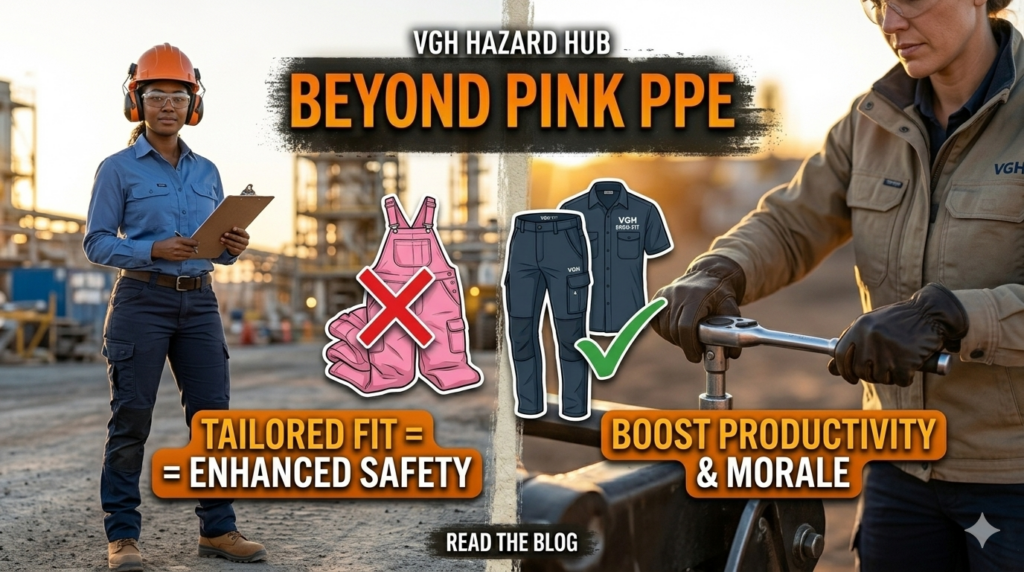
For decades, the industry standard for outfitting female workers was a concept casually known as “shrink it and pink it.” Manufacturers simply took standard male workwear patterns, scaled down the sizing, and occasionally dyed the fabric a stereotypically feminine color. When the industry finally moved away from pink, it adopted an equally flawed strategy: the “unisex” garment.
To be clear from an OHS perspective: there is no such thing as a true unisex fit in heavy industrial workwear. A “unisex” overall or jacket is almost universally based on a male anatomical block. For procurement managers and safety officers, forcing female workers into ill-fitting, male-proportioned Personal Protective Equipment (PPE) is no longer just an issue of comfort or inclusivity—it is a direct, measurable safety hazard.
This guide breaks down the ergonomic realities of female workwear and explains why gender-specific cuts are a non-negotiable requirement for site safety.
The Myth of “Unisex” and the Reality of Ergonomics
The human body is biomechanically diverse. Male and female bodies, on average, have fundamentally different proportions. Women typically have a higher hip-to-waist ratio, a shorter torso length, narrower shoulders, and a different chest profile compared to men.
When a female worker puts on a standard “unisex” (male) boiler suit or a pair of standard work trousers, the garment physically fights against her anatomy. The waistline sits incorrectly, the crotch drops too low, the shoulders slump off the sides, and the sleeves and pant legs are invariably too long.
In an office environment, an ill-fitting shirt is an annoyance. In a petrochemical plant, a manufacturing workshop, or on a scaffolding tower, an ill-fitting garment is a critical vulnerability.
The Direct Safety Threats of Ill-Fitting PPE
When procurement relies on bulk unisex sizing to save time or money, they inadvertently introduce three major physical hazards onto their site:
1. The Trip and Fall Hazard
Falls from height and slips on uneven terrain are leading causes of industrial injuries in South Africa. When a female worker wears unisex pants, the crotch often hangs significantly lower than her natural anatomy dictates. This artificially restricts her stride length and limits her range of motion when climbing ladders, stepping up onto heavy machinery, or navigating steep staircases. Furthermore, excessively long pant legs that drag on the floor—even when tucked into boots—create a persistent, dangerous trip hazard, particularly in environments cluttered with cables or rubble.
2. The Snag and Catch Hazard
Baggy, oversized clothing is strictly prohibited around moving machinery. However, when a woman wears a unisex jacket or shirt that accommodates her hips but is far too large for her shoulders and waist, the excess fabric balloons out. This loose material creates severe catch hazards around lathes, drill presses, conveyor belts, and PTO shafts. To compensate for sleeves that extend past the hands, female workers frequently roll their sleeves up. If that garment is treated with D59 flame retardant or acid-resistant chemicals, rolling the sleeves instantly neutralizes the protective barrier, exposing the forearms to sparks and chemical burns.
3. The Mobility and Fatigue Drain
Heavy industrial fabrics like heavy-duty cotton drill or canvas are stiff and rigid. When a worker is forced to carry excess, poorly distributed fabric, it restricts their natural biomechanics. The worker expends unnecessary energy simply fighting the garment to reach overhead, bend down, or twist. Over a 10-hour shift in the South African heat, this restricted mobility drastically accelerates physical fatigue. A fatigued worker is a worker whose situational awareness drops, making them far more susceptible to catastrophic accidents.
The Psychological Impact on Safety Culture
Safety is heavily reliant on site culture. If a female worker is handed a baggy, oversized men’s overall on her first day, the unspoken message from management is clear: “You are an afterthought here.”
Workers who feel undervalued are less likely to actively participate in safety initiatives, report near-misses, or speak up about procedural hazards. Furthermore, if a worker is constantly distracted by hiking up her pants, rolling up her sleeves, or adjusting a heavy jacket that keeps slipping off her shoulders, she is not 100% focused on the high-risk task in front of her. Ergonomic workwear eliminates these distractions, allowing the worker to focus entirely on the job.
Updating Your Procurement Strategy
Modernizing your PPE procurement to include female-specific workwear does not require completely overhauling your budget; it simply requires intentional purchasing.
- Audit Your Workforce: Look at the women on your site. Are their sleeves rolled up? Are their pants hemmed with safety pins? Are they wearing their own civilian clothes underneath open overalls because the provided gear doesn’t fit? These are immediate red flags.
- Specify “Contoured” or “Women’s Fit”: Transition away from bulk unisex orders. Workwear manufacturers now engineer garments using specific female anatomical blocks. These garments feature articulated knees aligned to shorter leg lengths, contoured waistbands that sit comfortably on the hips, and darted chests to eliminate baggy fabric without restricting breathing.
- Invest in Specialized Garments: For everyday site wear, surface work, or logistics, source high-quality, gender-specific options. Supplying garments like specially tailored Women’s Denim Jeans and contoured safety shirts ensures that your female workforce benefits from the exact same durability and abrasion resistance as their male counterparts, but with a fit that actually protects them.
Conclusion
The era of “shrink it and pink it” is over, and the era of the “unisex” compromise must follow it out the door. Providing female-specific, ergonomically designed workwear is not about fashion, vanity, or special treatment. It is a fundamental, non-negotiable component of hazard mitigation.
When a garment fits correctly, the protective features function exactly as engineered. By prioritizing women’s ergonomic workwear in your next procurement cycle, you eliminate unnecessary trip and catch hazards, reduce site fatigue, and send a clear, powerful message that the safety of every single worker on your site is taken seriously.