
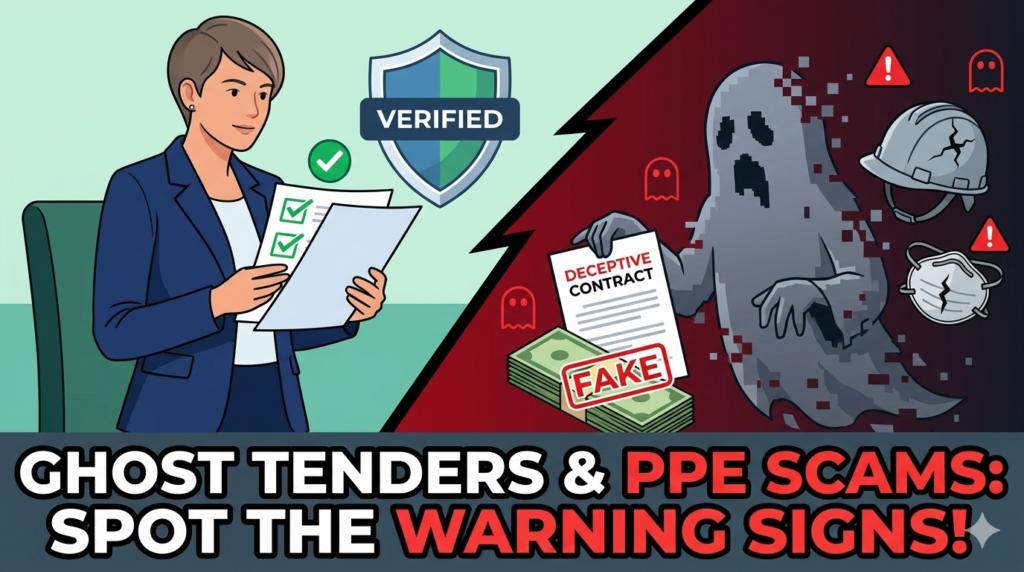
The South African occupational health and safety sector is built on trust. Procurement managers rely on established supply chains to deliver life-saving equipment, and suppliers rely on legitimate corporate and government channels to fulfill those needs. However, the surge in demand for specialized Personal Protective Equipment (PPE) over the last few years has attracted a highly sophisticated, organized criminal element to our industry.
Today, the threat is no longer just the guy selling counterfeit boots out of a car boot; it is the highly organized, corporate-facing “Ghost Tender.”
These fraudulent Requests for Quotation (RFQs) are meticulously designed to deceive even the most seasoned procurement officers and business owners. They drain millions of Rands from the South African economy and, critically, they risk introducing substandard, non-compliant safety gear into hazardous work environments.
As a trusted authority in South African industrial safety, we believe it is our responsibility to protect our clients and partners. This guide breaks down the anatomy of a Ghost Tender, highlights the critical red flags, and provides actionable steps to ensure you are dealing with verified, legitimate safety professionals.
Understanding the “Ghost Tender” Scam
A Ghost Tender (also known as an Advance Fee Fraud or the “Sole Supplier Scam”) does not target the end-user; it targets the middleman. The scam relies on social engineering, urgency, and the promise of a highly lucrative government or corporate contract.
Here is exactly how the modern PPE Ghost Tender is executed:
- The Bait (The Fake RFQ): A business receives an unsolicited, highly official-looking Request for Quotation via email. It appears to be from a legitimate government department (like the Department of Health or Public Works) or a massive blue-chip mining corporation. The documents feature stolen logos, realistic tender numbers, and signatures of actual officials.
- The Catch (The Obscure Product): The RFQ asks for a massive quantity of a highly specific, obscure piece of PPE. For example, instead of standard S7 safety boots, they might request 5,000 units of a fictitious “XB-900 Advanced Respiratory Filter Unit.”
- The Trap (The “Sole Supplier”): When the targeted business searches online for this obscure product to fulfill the quote, they will only find one supplier that stocks it. This “sole supplier” has a professional-looking website, but it is actually controlled by the exact same scammers who sent the fake RFQ.
- The Sting (The Upfront Payment): To secure the lucrative contract, the victim orders the goods from the sole supplier, who demands a 50% or 100% upfront deposit. Once the money is paid, the supplier vanishes, the website is taken down, and the “government department” stops returning calls. The tender never existed.
Critical Red Flags: How to Identify a Fraudulent RFQ
Scammers are constantly refining their tactics, but their methods always leave digital and operational footprints. If you receive an RFQ for safety equipment, look out for the following warning signs.
Spoofed Email Domains
This is the most common point of failure for scammers. An email might say “Department of Mineral Resources” in the display name, but the actual email address is a slight variation of the real domain.
- The Real Domain:
@dmre.gov.za - The Fake Domain:
@dmre-gov.org,@dmre-procurement.co.za, or even a standard@gmail.comaddress. - Action: Always hover your mouse over the sender’s name to reveal the exact email address. Legitimate South African government tenders will always come from a verified
.gov.zadomain.
Unsolicited Urgency
Legitimate government and corporate procurement processes in South Africa are notoriously slow and bound by strict Public Finance Management Act (PFMA) protocols. If you receive an unsolicited tender that demands an immediate turnaround, cites an “emergency operational crisis,” or gives you only 48 hours to submit a massive bid, be highly suspicious. Scammers use urgency to force you into making mistakes and bypassing your own due diligence.
The “Sole Supplier” Anomaly
In the PPE industry, very few products are manufactured by a single, unknown entity. If an RFQ requests a specific brand of safety harness, gas monitor, or specialized workwear that you have never heard of, and Google only shows one distributor located in an obscure industrial park, you are likely being set up. Legitimate RFQs generally specify SABS or EN ISO standards (e.g., “EN ISO 20345:2022 compliant footwear”) rather than insisting on an unknown, proprietary brand.
Strange Delivery Locations and Contact Details
Ghost tenders often request that the massive order of PPE be delivered to a vague location, such as a self-storage facility, an empty lot, or a residential address, rather than an official government depot or established corporate headquarters. Furthermore, if the only point of contact is a mobile phone number (starting with 082, 076, etc.) rather than a verifiable landline linked to the corporate switchboard, proceed with extreme caution.
The Collateral Damage: Counterfeit PPE
While the Ghost Tender scam is primarily a financial crime, there is a secondary, far more dangerous scam plaguing the South African market: counterfeit safety gear.
Scammers will often copy the branding of reputable PPE manufacturers, producing substandard helmets, harnesses, and flame-retardant clothing that lack proper structural integrity or chemical treatments. These items are then sold at seemingly unbeatable prices to cost-cutting procurement managers.
When a counterfeit D59 jacket fails to self-extinguish during a welding accident, or a fake safety boot fails to absorb a heavy impact, the cost is measured in human lives and massive legal liabilities for the employer. Trusting verified, established suppliers is the only way to guarantee that the equipment you purchase actually meets the safety standards printed on the box.
How to Protect Your Business
Protecting your company from these sophisticated scams requires strict internal protocols:
- Verify the Source Independently: If you receive a tender from a government department or a large mining house, do not call the number on the RFQ document. Go to their official, verified website, call the main switchboard, ask for the procurement department, and verify the tender number directly with them.
- Refuse “Emergency” Deposits: Never pay a massive upfront deposit to an unknown supplier without conducting a full background check, requesting company registration documents (CIPC), and verifying their VAT number.
- Stick to Trusted Networks: Build relationships with established, reputable OHS suppliers who have a verifiable history in the South African market.
VGH Safety’s Commitment to Authenticity
At VGH Safety, we pride ourselves on absolute transparency and rigorous adherence to South African and international safety standards. We do not use obscure third-party brokers, we do not operate through unverified email domains, and we stand behind the certified compliance of every piece of equipment we supply.
If you ever receive a quote, an invoice, or a tender document claiming to be from or affiliated with our company, and something feels off, do not proceed. The safety of your workforce and the security of your business are too important to leave to chance.
The only definitive way to confirm the validity of a VGH Safety quote, verify our banking details, or establish a secure procurement channel is to reach out to us directly through our official platforms. Please visit our Contact Page to speak with our verified team. If it doesn’t come directly from our official channels, it isn’t us.