
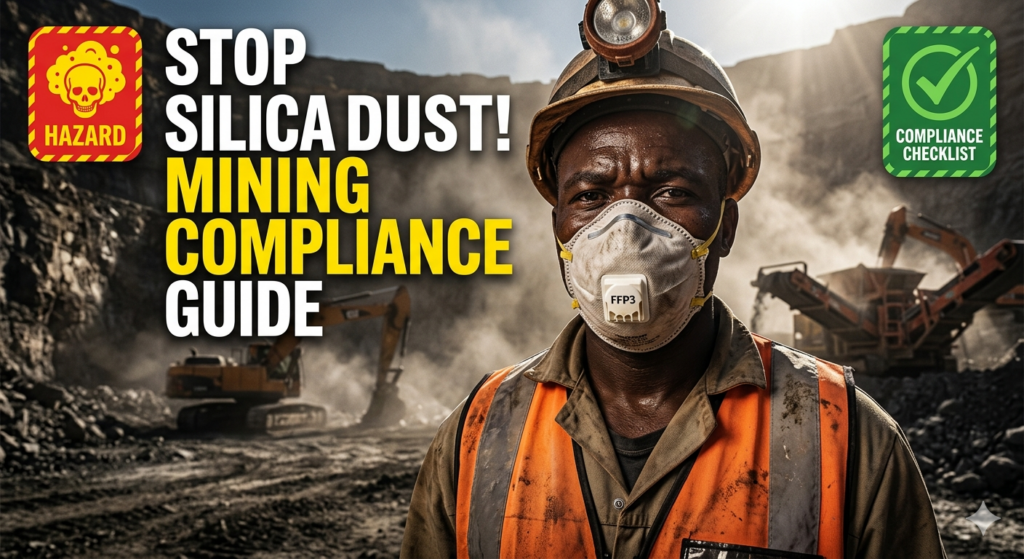
South Africa’s mining and heavy industrial sectors are built on the continuous extraction, crushing, and processing of rock. However, this fundamental industrial process releases one of the most insidious, long-term threats to occupational health on the continent: Respirable Crystalline Silica (RCS) dust.
Unlike standard nuisance dust or wood shavings, silica particles are microscopic—often 100 times smaller than a grain of standard sand. Because they are so small, they easily bypass the body’s natural respiratory defenses, settling deep within the alveolar region of the lungs. Over time, these jagged microscopic particles cause severe scarring and fibrogenesis, leading to irreversible, fatal conditions such as silicosis, chronic obstructive pulmonary disease (COPD), and silicotuberculosis.
Because silica dust is invisible to the naked eye, site managers cannot rely on visual cues to gauge danger. You must rely on strict data, rigorous adherence to South African legislation, and the exact correct specification of respiratory Personal Protective Equipment (PPE).
This guide breaks down the critical differences between FFP2 and FFP3 respirator ratings, explains the legal requirements under South African law, and provides a definitive compliance checklist for site managers operating in dust-heavy environments.
The Legal Framework: The South African OEL for Silica
Under the Mine Health and Safety Act (MHSA) and the Occupational Health and Safety Act (OHSA), South African employers bear the ultimate legal responsibility to provide a safe working environment. This includes taking all reasonably practicable steps to eliminate or mitigate airborne pollutants.
Currently, the South African Occupational Exposure Limit (OEL) for respirable crystalline silica dust is set at 0.1 mg/m³, calculated over an 8-hour Time-Weighted Average (TWA).
If routine occupational hygiene measurements reveal that your workers are exposed to silica concentrations exceeding this strict limit—or if there is a risk of sudden exposure spikes during specific tasks like blasting or dry-cutting—the provision of specialized respiratory protection is a non-negotiable legal mandate. Failing to provide adequate respirators opens your company up to severe Department of Mineral Resources and Energy (DMRE) penalties, site shutdowns, and devastating compensation claims.
Demystifying the Ratings: FFP2 vs. FFP3
When procuring disposable or reusable half-mask respirators, the terminology is heavily regulated by EN 149 (adopted locally as SANS 50149). FFP stands for “Filtering Facepiece,” and the number dictates the exact level of filtration efficiency.
Buying the wrong class of mask for a silica-heavy environment is a critical safety failure.
FFP2: The Standard Defender
- Filtration Efficiency: FFP2 respirators are mandated to filter out a minimum of 94% of airborne particles, dust, and aerosols.
- The Application: FFP2 masks are the workhorses of general industry. They are highly effective for mitigating moderate levels of fine dust, concrete dust, wood dust, and general agricultural particulates.
- The Silica Limitation: In environments where silica dust concentrations are exceptionally high or highly concentrated in enclosed spaces, the 6% inward leakage allowed by an FFP2 mask is simply too high a risk factor for prolonged exposure.
FFP3: The Silica Standard
- Filtration Efficiency: FFP3 respirators provide the highest level of protection for filtering facepieces, mandated to filter out a minimum of 99% of airborne particles.
- The Application: For deep-level mining, heavy quarrying, sandstone cutting, foundry shake-out operations, and any prolonged direct drilling into rock, FFP3 is the absolute minimum standard.
- Why it Matters: The 99% filtration efficiency, combined with a much tighter mandatory face seal, ensures that microscopic crystalline silica cannot penetrate the breathing zone. If your workers are actively cutting, grinding, or blasting rock, FFP3 is the only acceptable procurement choice.
The Valve Advantage
You will often see FFP2 and FFP3 masks equipped with a plastic exhalation valve. This valve does not affect the filtration of incoming air; it simply allows exhaled breath and moisture to escape quickly. In the blistering heat of a South African underground mine or surface quarry, a valved FFP3 mask drastically reduces heat stress and prevents safety goggles from fogging up, dramatically increasing the likelihood that workers will actually keep the mask on for their entire shift.
The Silica Environment Compliance Checklist
Merely purchasing boxes of FFP3 masks and handing them out at the site gate does not constitute legal compliance. To ensure your workforce is genuinely protected against silicosis, site managers must implement the following checklist:
1. Conduct Occupational Hygiene Monitoring
You cannot protect against a hazard you haven’t quantified. Before ordering PPE, an approved occupational hygienist must conduct personal air sampling on your workers to determine your exact Time-Weighted Average (TWA) silica exposure. This data forms the legal baseline for your Respiratory Protection Programme.
2. Match the Mask to the Risk
Review your site’s risk assessment and divide your workforce into exposure zones.
- General surface workers far from the blast site or crushing plant may only require FFP2 protection against general wind-blown dust.
- Drill operators, crushers, blasters, and sweepers must be issued FFP3 respirators.
3. Implement Mandatory Fit Testing
A respirator only works if all inhaled air passes through the filter material. If the mask does not seal perfectly against the worker’s face, the air (and the silica dust) will simply take the path of least resistance through the gaps. Conduct qualitative or quantitative fit testing for every single worker to ensure the specific brand and size of mask you procure actually fits their unique facial structure.
4. Enforce the “Clean Shaven” Policy
This is often the most heavily debated rule on site, but the physics are indisputable: you cannot achieve an airtight seal over facial hair. Even a few days of stubble lifts the edge of an FFP2 or FFP3 mask away from the skin, allowing silica dust to flood the breathing zone. Under strict OHS guidelines, workers required to wear tight-fitting respirators must be clean-shaven where the mask seals against the face.
5. Establish Disposal and Replacement Protocols
Disposable FFP masks are designed for single-shift use. As the filter traps more and more dust, it becomes harder for the worker to breathe, causing fatigue. If a mask becomes visibly caked in mud, crushed, or soaked with sweat, it must be discarded and replaced immediately. Do not allow workers to store used, dust-filled disposable masks in their lockers for the next day.
Elevating Your Respiratory Procurement
Protecting your workers from silicosis requires sourcing equipment that blends uncompromising filtration standards with ergonomic comfort designed for the South African climate. Substandard masks lead to poor compliance, and poor compliance leads to long-term health tragedies.
Ensure your site is equipped with fully certified, high-performance protective gear by exploring our Respiratory Protection range within the Pioneer category. By combining correct risk assessment, rigorous fit testing, and premium FFP3 filtration, you can safeguard your workforce’s health and secure your site’s legal compliance against the invisible threat of silica dust.