
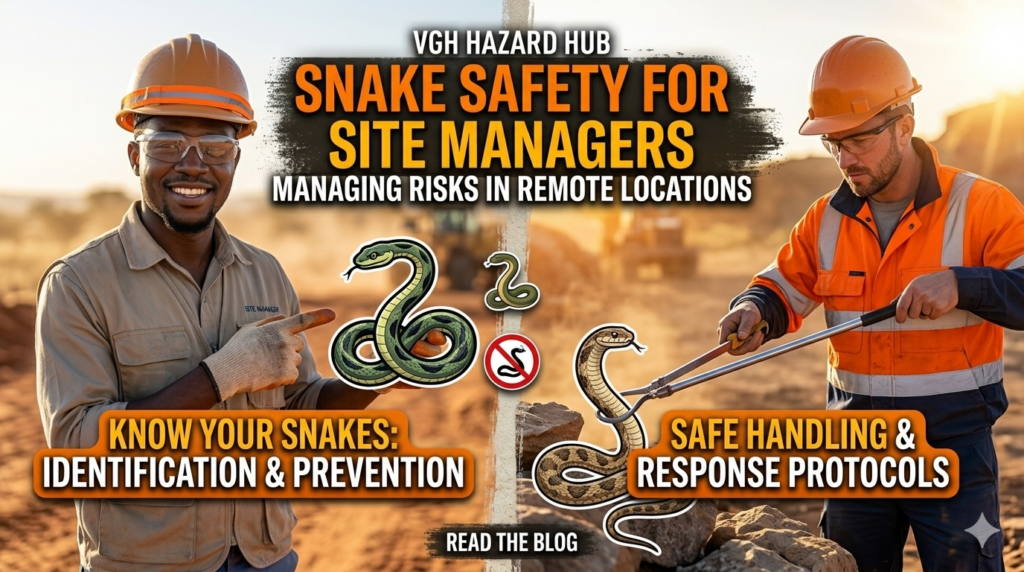
Working in South Africa’s remote industrial sectors—whether you are breaking ground on a civil construction project in the dense bushveld of Mpumalanga, managing a deep-level mining surface operation in the North West, or overseeing massive agricultural harvests in the Free State—comes with highly specific environmental challenges. Site managers in these regions are not just managing heavy machinery, tight deadlines, and complex logistics; they are actively operating within a thriving, unpredictable, and potentially lethal natural ecosystem.
Among the myriad of environmental hazards, one of the most sudden and terrifying risks your workforce will face is an unexpected encounter with a venomous snake. For Occupational Health and Safety (OHS) officers and site managers, treating snake safety as an afterthought is a catastrophic operational failure. A single snakebite can lead to tragic loss of life, massive medical evacuation costs, severe site downtime, and intense legal scrutiny.
This guide provides practical, actionable advice on how to preemptively identify high-risk areas on your site, establish strict “first-contact” safety protocols, and procure the specialized gear necessary to handle these high-stress situations without injury.
The South African Context: Knowing the Threat
Before you can manage the risk, you must understand the reality of the environment. Snakes do not inherently want to attack humans; bites are almost exclusively defensive reactions triggered by surprise or perceived aggression. However, a busy industrial site accidentally provides a snake with everything it needs to survive: shelter from the elements, artificial water sources, and an abundance of prey (like rodents attracted to site waste).
Depending on your region, your workers are likely to encounter several highly venomous species:
- The Puff Adder: Responsible for the majority of severe snakebites in South Africa. They rely on their excellent camouflage and will freeze rather than flee when approached, making them incredibly easy for an unsuspecting worker to step on.
- The Snouted Cobra: A large, highly active forager often found hunting around building rubble and seeking shade during the heat of the day.
- The Black Mamba: Extremely fast, nervous, and highly venomous. They frequently seek refuge in dark, quiet spaces like abandoned site containers or roof cavities.
Identifying High-Risk Zones on Your Site
Preventing a bite starts with environmental awareness. Site managers must train their workforce to be hyper-vigilant around specific micro-environments on the site that act as magnets for snakes.
Warm Machinery and Vehicles
During the cold winter months or chilly desert nights, a heavy excavator, diesel generator, or site bakkie that has been running all day becomes a massive, metallic heat sink. Snakes, being cold-blooded, will naturally gravitate toward engine bays, wheel arches, and tracks to survive the night temperatures. Operators must be trained to conduct a visual sweep of their tracks and engine compartments before starting machinery in the morning.
Scrap Metal, Pallets, and Rubble
Snakes follow their food. Poor waste management on a site quickly attracts mice and rats, which in turn attracts cobras and mambas. Stacks of wooden pallets, heaps of corrugated iron, unused concrete pipes, and general building rubble create perfect artificial reefs for rodents and safe hunting grounds for snakes. Keep these storage areas far away from high-traffic pedestrian zones and ensure they are kept as neat as possible to reduce hiding spots.
Pump Stations and Ablution Blocks
During the blistering peak of the South African summer, snakes desperately seek cool, damp environments to regulate their body temperature and find water. Open trenches, pump stations, water tanks, and site ablution blocks are prime real estate. Workers entering these areas, especially in the early morning or late afternoon, must approach with caution and ensure the areas are well-lit before entering blind corners.
The “First-Contact” Protocol: What to Do When a Snake is Spotted
The moment of discovery is the most dangerous phase of a snake encounter. Statistics show that up to 90% of snakebites occur when untrained personnel attempt to bravely kill or illegally capture the snake. To maintain absolute safety, site managers must aggressively enforce a strict “first-contact” protocol.
If a worker spots a snake, they must follow these exact steps:
- Stop and Step Back: The worker must immediately freeze, identify where the snake is, and slowly back away to a minimum distance of 5 meters. Snakes cannot strike across this distance.
- Evacuate the Immediate Area: Quietly and calmly warn other workers in the immediate vicinity to clear the zone. Do not shout or cause a panic, which may startle the snake into defensive movement.
- Maintain Visual Contact: From the safe 5-meter distance, the worker (or a designated spotter) must keep their eyes on the snake at all times. If you lose sight of the snake in a cluttered workshop, the entire area must be shut down until it is found, resulting in massive operational delays.
- Call the Designated Handler: Use the site radio to immediately call the OHS officer or the specifically trained, designated on-site snake handler.
- Do NOT Attack: Under absolutely no circumstances should a general worker throw stones, hit the snake with a shovel, or attempt to pin it down. This is an immediate violation of safety protocol and a potentially fatal error.
Essential Gear Breakdown: Arming Your Handlers and Workforce
Managing a venomous snake on site requires highly specific, purpose-built Personal Protective Equipment (PPE). Relying on general workwear is insufficient and dangerous.
For the General Workforce in High-Risk Zones:
If you have surveyors, brush-clearers, or geologists walking through thick, uncleared bushveld, standard safety boots are not enough. Procurement must supply knee-high snake gaiters. These puncture-resistant guards protect the lower leg—the most common strike zone for a Puff Adder. Additionally, workers in areas known for spitting cobras (like the Mozambique Spitting Cobra) should be mandated to wear impact-resistant safety goggles to prevent venom from entering the eyes and causing permanent blindness.
For the Designated Site Handlers:
Your designated responders must be properly equipped to safely remove and relocate the animal. Equipping your safety officers with proper ASI Snake Handling Equipment is a non-negotiable requirement for legal compliance and handler safety. Essential specialized gear includes:
- Snake Tongs (Minimum 1.5 meters): To safely grasp and lift the snake while keeping the handler well out of the strike zone.
- Snake Hooks: Essential for maneuvering the snake into a containment area or lifting heavy-bodied snakes that could be injured by tongs.
- Transparent Snake Tubes/Buckets: Lockable, secure containment vessels that allow the handler to safely transport the snake off-site for release without risking an escape in the vehicle.
Procurement Advice: The Danger of Makeshift Tools
Procurement teams must understand the immense legal liability of ignoring specialized snake handling gear. If an OHS budget is tight, it is incredibly tempting for a site manager to allow a safety officer to use a broom, a modified PVC pipe, or a branch to pin a snake.
This is a disastrous procurement failure. Makeshift tools lack the precision, grip, and length required to safely control a thrashing, highly venomous animal. If a worker is bitten while using a broom handle because the company refused to purchase a dedicated set of tongs, the subsequent Compensation for Occupational Injuries and Diseases Act (COIDA) claims, Department of Labour investigations, and potential civil lawsuits will be severe. The cost of a professional handling kit is an infinitesimally small price to pay for the guaranteed safety of your workforce and the legal protection of your company.
By understanding the local ecology, identifying site-specific risks, enforcing strict protocols, and investing in the correct equipment, South African site managers can transform a potentially fatal wildlife encounter into a safely managed, routine operational procedure.