
South Africa’s industrial landscape is as diverse as it is demanding. From the deep-level gold and platinum mines of the Witwatersrand to the bustling manufacturing hubs in KwaZulu-Natal and the expansive agricultural sectors of the Western Cape, our industries require uncompromising safety standards. At the very foundation of this occupational health and safety ecosystem is protective footwear.
For over a decade, South African safety officers, site managers, and procurement professionals have relied heavily on the EN ISO 20345:2011 standard (which was adopted locally as SANS 20345). It served as the undisputed gold standard for defining what constituted a safe, reliable, and compliant work boot. However, the global industrial landscape has shifted significantly. New synthetic materials have been developed, highly specific modern workplace hazards have been identified, and testing methodologies have advanced far beyond the capabilities of the previous decade.
Enter EN ISO 20345:2022. This updated standard represents the most comprehensive and significant overhaul in safety footwear certification in over ten years. For South African procurement managers, understanding these structural changes is no longer optional—it is a critical compliance and safety imperative that will dictate purchasing strategies for the foreseeable future.
This guide provides an in-depth, technical breakdown of the newly implemented safety rating codes, including the highly anticipated S6 and S7 classifications, and explains exactly what these changes mean for your procurement strategy, your site safety, and your workforce in 2024 and beyond.
1. The Shift: Why EN ISO 20345:2022 Matters in South Africa
Under the Occupational Health and Safety Act (Act 85 of 1993), South African employers bear the ultimate legal responsibility for providing adequate, hazard-appropriate Personal Protective Equipment (PPE). Relying on outdated specifications or failing to understand the limits of older footwear classes not only puts workers at physical risk but also exposes companies to severe financial and legal liabilities under the Compensation for Occupational Injuries and Diseases Act (COIDA).
The 2022 update directly addresses modern workplace realities. Previously, safety footwear standards lacked granular nuance in critical areas like slip resistance testing, non-metallic puncture resistance performance, and comprehensive waterproofing. The new standard introduces radically stricter testing parameters and highly specific sub-categories. This modernization allows procurement managers to strategically select Safety Footwear that is precision-engineered for their exact site hazards, rather than relying on broad, generic categories.
While there is currently a transition period allowing the sale and use of older 2011-certified stock, forward-thinking procurement teams are already aggressively updating their tender specifications to align with the 2022 standards. Staying ahead of the curve ensures that your workforce is protected by the latest safety technology.
2. Demystifying the New Rating Codes: The Rise of S6 and S7
Historically, the safety classes ranged from SB (Safety Basic) up to S5. The core, non-negotiable requirement for all these boots is a toe cap capable of withstanding a massive 200-Joule impact and 15kN of resting compression.
Under the old standard, if a worker needed a boot that was fully waterproof, procurement managers had to look for an S2 or S3 boot that specifically had an additional “WR” (Water Resistant) marking appended to it. This caused massive industry confusion, as many buyers falsely assumed the standard “WRU” (Water Resistant Upper) meant the entire boot was waterproof, leading to wet feet and compromised comfort in harsh conditions.
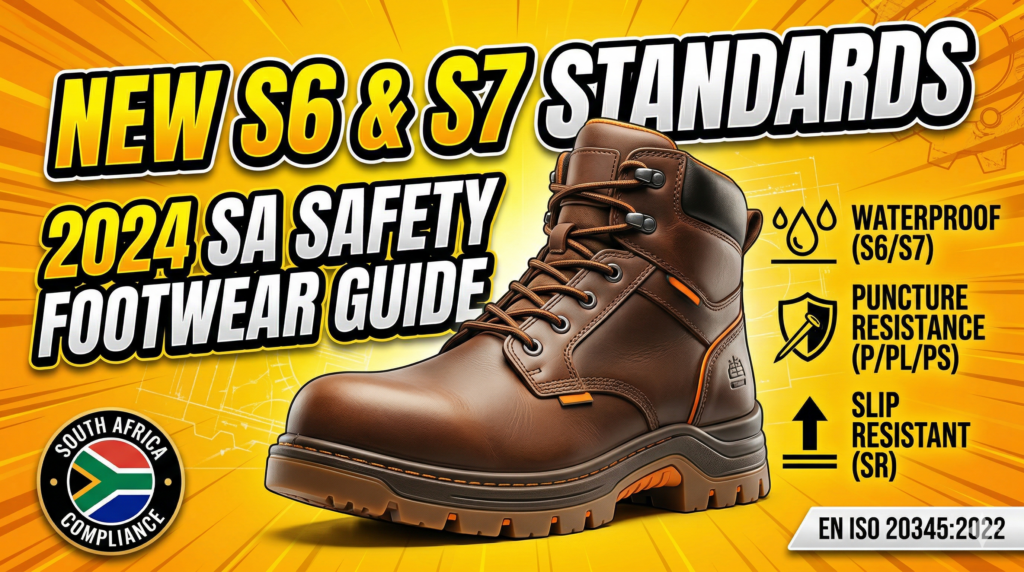
To definitively eliminate this deadly and uncomfortable ambiguity, the 2022 standard introduces two entirely new, standalone core classifications: S6 and S7.
The S6 Classification
The S6 classification is essentially the modern, fully waterproof, and technologically advanced evolution of the S2 boot.
- What it includes: It meets all the foundational requirements of an S2 boot (which includes the 200J toe cap, antistatic properties, targeted energy absorption in the heel area, and a water-resistant upper) PLUS it legally mandates that the entire footwear must pass the rigorous new Water Resistance (WR) test.
- The Testing Mechanism: To earn this rating, the boot is placed in a trough of water and mechanically flexed thousands of times to simulate a worker walking through puddles or mud. If even a drop of water penetrates the interior lining, the boot fails the certification.
- The SA Procurement Context: The S6 standard is absolutely ideal for South African agricultural workers, civil engineers, municipalities, and outdoor facility managers who work in persistently wet conditions or high rainfall areas, but who do not routinely face severe underfoot puncture hazards (like exposed nails, rebar, or sharp metal offcuts).
The S7 Classification
The S7 rating is unequivocally poised to become the ultimate heavy-duty standard for the South African industrial sector. It is the fully waterproof, armored evolution of the beloved S3 boot.
- What it includes: It meets all robust S3 requirements (200J toe cap, antistatic, heel energy absorption, water-resistant upper, a heavily cleated outsole for rough terrain, and a puncture-resistant midsole) PLUS the mandatory full-boot Water Resistance (WR) certification.
- The SA Procurement Context: If you are procuring PPE for deep-level mining operations, heavy commercial construction during the rainy season, or wet-plant manufacturing environments, S7 is your new non-negotiable benchmark. It guarantees that a worker’s foot will remain completely dry while simultaneously being protected from crushing falling objects and dangerous upward punctures from site debris.
3. The Puncture Resistance Paradigm Shift (P, PL, PS)
One of the most critical and life-saving updates in the 2022 standard relates directly to puncture resistance. In the legacy 2011 standard, any boot outfitted with a puncture-resistant midsole was simply marked with a broad “P” designation.
However, modern safety boots frequently utilize non-metallic, composite, or densely woven Kevlar midsoles rather than traditional heavy steel plates. Non-metallic midsoles are significantly lighter, much more flexible, and crucially, they do not conduct heat or electricity. However, they react very differently to different types of sharp objects compared to steel. The 2022 standard addresses this discrepancy by splitting puncture resistance into three highly distinct, specialized categories:
- P (Metallic): This is tested with a traditional 4.5mm diameter steel nail. If a boot utilizes a classic steel midsole plate, it retains the simple “P” designation.
- PL (Non-Metallic, Large): This indicates a non-metallic (composite or high-density fabric) puncture-resistant insert that has been successfully tested with a standard 4.5mm diameter nail. This rating is perfectly suitable for general construction sites where typical hazards consist of thicker nails, large screws, and heavy jagged metal.
- PS (Non-Metallic, Small): This is a massive leap forward. It indicates a non-metallic insert tested with a much sharper, thinner 3.0mm diameter nail.
The Procurement Implication: This is a monumental change for specialized site safety. If your workforce is exposed to fine, extremely sharp debris—such as glass shards, thin wire, metal shavings, or hypodermic needles (which are unfortunately common in municipal waste management, recycling plants, or certain specialized manufacturing sectors)—specifying a PS rating is now absolutely critical. For general heavy construction, PL or P will suffice. Therefore, when ordering, an S7 boot might now be marked as S7S (meaning S7 with a Small-nail non-metallic midsole) or S7L (Large-nail non-metallic midsole).
4. Slip Resistance Redefined: Goodbye SRA, SRB, and SRC
If you have been in health and safety procurement for any length of time, you are intimately familiar with the ubiquitous “SRC” demand. Historically, slip resistance was graded as SRA (tested on a ceramic tile lubricated with soap), SRB (tested on a steel floor lubricated with glycerol), or SRC (the highest rating, meaning it passed both tests).
The 2022 standard completely and permanently removes SRA, SRB, and SRC from the terminology.
Why the change? Because slip resistance is so incredibly fundamental to the very concept of a safety boot that it is no longer considered an optional “add-on” feature to be tested separately.
- Under the new standard, passing a basic slip resistance test (which is very similar to the old SRA test on ceramic tiles with a detergent solution) is mandatory for all safety footwear just to receive basic EN ISO 20345:2022 certification.
- The “SR” Mark: If a manufacturer wants to officially claim exceptional slip resistance above and beyond the basic requirement, they must undergo an additional, highly rigorous test on ceramic tiles heavily coated with glycerine (which accurately simulates an industrial oil spill). Boots that successfully pass this extreme test receive the new standalone SR marking.
- The “Ø” Mark: Conversely, if a boot is designed for very specific, extreme environments and features deep metal spikes or large specialized cleats that physically cannot be tested on smooth tiles, it will be prominently marked with a Ø symbol to clearly warn the user that it has not been slip-tested for smooth surfaces.
The Procurement Implication: Procurement officers must stop putting “Must be SRC rated” in their modern tender documents. Update your specifications to demand baseline EN ISO 20345:2022 compliance, and intentionally specify the SR marking only if your specific site involves severe oil, grease, or hydrocarbon slip hazards.
5. New Granular Protection Markings: SC, LG, and WPA
The new standard also introduces highly specific, targeted markings that address niche, yet incredibly common, workplace hazards that cause rapid boot deterioration or specific injuries.
- SC (Scuff Cap Abrasion): Many trade workers—such as block pavers, mechanics, roofers, and plumbers—spend hours working on their knees. This posture rapidly wears out the leather or synthetic material on the toe, prematurely exposing the steel cap underneath and ruining the boot. Boots can now be rigorously tested for physical abrasion resistance on the exterior toe cap area. If the protective overcap survives 8,000 continuous abrasion cycles, it earns the SC mark. Procuring SC-rated boots for kneeling workers will drastically increase the lifespan of your PPE inventory, saving massive amounts of money in the long run.
- LG (Ladder Grip): Falls from height, specifically from ladders, remain a leading cause of industrial injury and death in South Africa. The new LG marking guarantees that the heel breast of the boot meets highly specific geometric and depth requirements designed to safely hook onto a standard ladder rung, physically preventing the worker’s foot from slipping forward. This feature should be mandated for telecoms workers, scaffolders, electricians, and warehousing staff.
- WPA (Water Penetration and Absorption): This replaces the old WRU (Water Resistant Upper) mark. It is much clearer terminology, indicating that only the upper materials—not the whole boot—are resistant to water.
6. Integrating Footwear with the Broader PPE Ecosystem
It is vital to remember that safety footwear does not operate in a vacuum. The most technologically advanced, world-class S7S safety boot is entirely compromised if the worker is wearing inadequate trousers or overalls that allow chemical spills, sparks, or extreme weather to penetrate the boot from above the ankle opening.
When you are taking the time to update your footwear procurement strategy and tender documents, it presents the perfect, natural opportunity to conduct a holistic, top-to-bottom audit of your site’s entire protective gear ecosystem. Ensure that the advanced water resistance and chemical protection of your newly specified S6 and S7 boots are properly matched by high-quality, hazard-appropriate workwear. You can explore a comprehensive range of complementary gear by visiting our protective clothing division, ensuring your workforce is heavily armoured from head to toe against the harshest South African industrial elements.
7. The Procurement Manager’s Action Plan for 2024 and Beyond
To ensure a smooth organizational transition, maximize operational efficiency, and guarantee absolute legal compliance, South African procurement managers should actively take the following steps immediately:
- Conduct a Micro-Hazard Assessment: Do not buy a one-size-fits-all boot for your entire company. Assess specific operational zones. Do your waste-sorters need PS (small nail) protection? Do your maintenance teams need LG (ladder grip) boots? Do your outdoor workers need full S7 waterproofing?
- Update Tender Boilerplates and Specs: Permanently remove obsolete terms like “WRU” and “SRC” from your RFQs. Replace them with “WPA” (Water Penetration and Absorption), “SR” (Slip Resistance), and clearly define whether you require “P”, “PL”, or “PS” midsoles based on your site’s specific debris profile.
- Engage with Reputable Suppliers: The South African PPE market will undoubtedly be flooded with heavily discounted old stock over the next year as manufacturers and distributors desperately try to clear out their 2011-certified boots. While these are technically still legal to purchase and use during the transition phase, ensure your suppliers are completely transparent about exactly what standard you are purchasing. Always demand official EN ISO 20345:2022 certification documents for any new, long-term PPE supply contracts.
- Educate Your Workforce on the Ground: Introduce targeted toolbox talks specifically explaining what the new alphanumeric codes printed on their boot tongues actually mean. A worker who understands that their boot is an “S7L SR SC” is an empowered worker who intuitively understands the specific limits, capabilities, and correct applications of their life-saving protective gear.
Conclusion
The rollout of the EN ISO 20345:2022 standard is not just bureaucratic red tape; it is a vital, life-saving evolution in global industrial safety protocols. By finally providing crystal-clear clarity on full-boot water resistance (S6/S7), refining the critical nuances of puncture testing for modern materials (P, PL, PS), and standardizing slip resistance requirements, the new codes empower South African procurement managers to make highly accurate, data-driven purchasing decisions. By proactively updating your internal procurement policies today, you guarantee that your workforce steps onto the site tomorrow equipped with the most scientifically advanced, hazard-specific protection available on the market.