In the South African construction and heavy industry sectors, the workday rarely conforms to perfect daylight hours. From the early morning mist rolling over civil engineering projects in KwaZulu-Natal to the late-night roadworks on the N1 highway, site managers are constantly battling the dangers of low-light conditions.
When visibility drops, the risk profile of a site skyrockets. Yet, when procurement budgets tighten, high-visibility (hi-vis) workwear is often treated as a basic compliance checkbox rather than a strategic investment. Buyers frequently opt for the cheapest reflective vests available, unaware that this minor cost-saving measure exposes their company to massive financial and operational liabilities.
This guide breaks down the true Return on Investment (ROI) of premium high-visibility gear. By analyzing the harsh realities of South African construction statistics, we will demonstrate how investing in quality reflective equipment is not just about keeping workers safe—it is about dramatically reducing project downtime, protecting your bottom line, and managing your insurance premiums.
The Reality of Low-Light Hazards in South Africa
The statistics surrounding workplace safety in South Africa paint a sobering picture. Every year, more than 200,000 workplace accidents are reported to the Compensation Commissioner. In the construction sector specifically, a significant portion of fatalities and severe injuries are categorized as “struck-by” incidents—cases where a worker is hit by moving vehicles, heavy machinery, or swinging plant equipment.
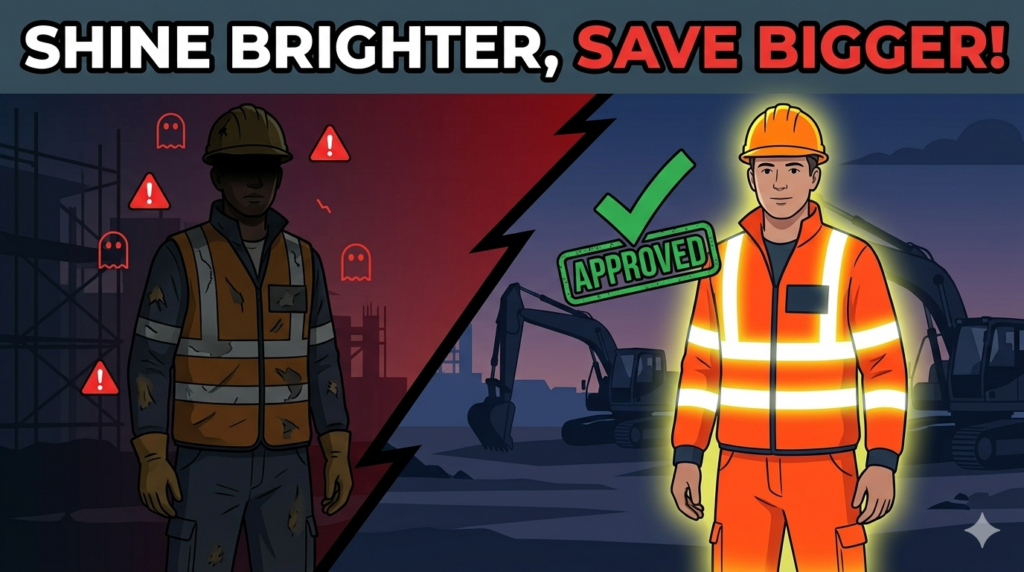
When you factor in low-light conditions, these hazards multiply. A heavy excavator operator, an articulated dump truck driver, or a forklift operator already has restricted fields of vision. In the early dawn, heavy rain, or dusty night shifts, a worker wearing faded, substandard reflective gear is practically invisible against the chaotic backdrop of a bustling site. By the time the operator spots the worker, it is often too late to brake.
The “Iceberg Effect” of Site Accidents
To understand the ROI of premium hi-vis gear, site managers must understand the true cost of an accident. The financial impact of a site injury operates on the “iceberg principle”—the visible costs are just a fraction of the total financial devastation hidden below the surface.
The Visible Costs:
- Initial first-aid and ambulance transport.
- Direct medical expenses.
- Basic compensation claims (COIDA).
The Hidden (Uninsured) Costs:
- Project Downtime: A severe accident immediately halts production. The site may be shut down for days by Department of Employment and Labour (DEL) inspectors, blowing out strict project timelines and triggering massive penalty clauses from clients.
- Equipment Damage: An operator swerving to avoid a worker can easily roll a multimillion-Rand piece of machinery or destroy site infrastructure.
- Administrative Burden: Hours of management time spent on accident investigations, reports, and legal consultations.
- Replacement Labor: The cost of sourcing, hiring, and training temporary skilled staff to replace the injured worker.
- Reputational Damage: A poor safety record can disqualify your company from securing future lucrative government or corporate tenders.
How High-Visibility Gear Impacts Insurance Premiums
One of the most significant, yet rarely discussed, financial impacts of site accidents is the effect on your company’s insurance profile.
Workers’ compensation and corporate liability insurance premiums are calculated based on your risk profile and claims history. Frequent accidents inevitably lead to skyrocketing premiums. However, this equation also works in reverse.
Insurance underwriters favorably view companies that proactively manage risk. By equipping your workforce with premium, scientifically tested high-visibility gear, you actively reduce the frequency of “struck-by” accidents. A clear, sustained reduction in claims demonstrates a strong safety culture to your insurers, putting your broker in a powerful position to negotiate lower annual premiums. Over a multi-year construction project, the savings on insurance premiums alone will completely offset the initial cost of upgrading your PPE inventory.
The Difference Between “Cheap” and “Premium” Reflective Gear
Why not just buy the cheapest reflective vests available? Because cheap gear creates a false sense of security, which is arguably more dangerous than wearing no reflective gear at all.
- Durability and Wash Cycles: Substandard reflective tape degrades rapidly. After just five or six heavy washes in industrial laundry machines, cheap tape loses its retro-reflective properties. A worker might be wearing a vest, but they are no longer visible. Premium gear is engineered to withstand dozens of industrial washes without losing its photometric performance.
- Breathability and Compliance: Cheap nylon vests trap heat, causing workers to sweat profusely in the South African sun. To stay cool, workers often leave them unzipped or take them off entirely when the safety officer isn’t looking—instantly voiding their protection. Premium gear integrates the reflective tape into breathable, moisture-wicking fabrics (like treated cotton or specialized meshes) that workers actually want to wear.
- SANS and EN Compliance: High-quality gear meets strict South African National Standards (SANS) and European (EN ISO 20471) standards. This guarantees that the tape reflects a specific amount of light (candela) back to the source, and that there is sufficient fluorescent background material for daytime visibility.
Upgrading Your Procurement Strategy
To realize the ROI of high-visibility equipment, procurement managers must shift their mindset from “cost per unit” to “cost per lifecycle and risk reduction.”
- Conduct a Visibility Audit: Walk your site during the early morning or evening shift. Shine a flashlight at your workers from 50 meters away. If their reflective gear does not brilliantly bounce the light back, it is time to replace it.
- Specify Standards in Tenders: When ordering PPE, do not just ask for “reflective vests.” Specify that the gear must meet EN ISO 20471 Class 2 or Class 3 standards, ensuring maximum photometric performance.
- Invest in Trusted Brands: Rely on manufacturers who specialize in visibility science. For example, outfitting your team with Pioneer Reflective Gear ensures that you are providing industry-leading retro-reflective technology that stays brighter for longer, surviving the harsh realities of South African sites.
Conclusion
In the heavy construction industry, you cannot eliminate the need for low-light work, nor can you eliminate the presence of heavy machinery. You can, however, eliminate the risk of your workers blending into the shadows.
Every accident prevented by a bright, highly reflective garment is a delayed project saved, an insurance claim avoided, and, most importantly, a life protected. When viewed through the lens of operational efficiency and risk management, premium high-visibility workwear is one of the highest-yielding investments a South African site manager can make.