South Africa is in the midst of a massive, rapid energy transition. Solar arrays are blanketing the Northern Cape, while wind turbines increasingly dominate our coastal skylines.
This vital expansion has created thousands of jobs, but it has also introduced an entirely new landscape of occupational hazards.
Too often, contractors attempt to repurpose traditional heavy industry or mining PPE for these modern renewable projects. This “one-size-fits-all” approach leaves workers dangerously exposed to critical, sector-specific threats.
Solar Farm Safety: The Invisible Electrical Threat
Building and maintaining a massive solar array is fundamentally different from a standard construction site. The primary hazards are often completely invisible.
High-Voltage DC Environments
Utility-scale solar arrays generate massive amounts of high-voltage direct current (DC). This requires specialized protection against severe electrical burns and arc flashes.
Standard cotton or poly-blend workwear is highly flammable and offers zero insulation during an electrical event.
Workers interacting with inverters or combiner boxes must be equipped with Arc-Flash rated clothing to mitigate the severe thermal energy released during an electrical explosion. Furthermore, specialized dielectric footwear is non-negotiable to prevent fatal electrical currents from grounding through a worker’s body.
Extreme UV and Heat Stress
Ground-mount installations in regions like the Karoo expose teams to relentless, extreme solar radiation.
Standard heavy overalls trap heat, vastly increasing the risk of heatstroke, while offering minimal focused UV protection.
Procurement managers must prioritize lightweight, moisture-wicking garments with high UPF ratings. These should be deployed alongside modular hydration packs and specialized cooling neck gaiters.
Wind Energy: High-Altitude Protection
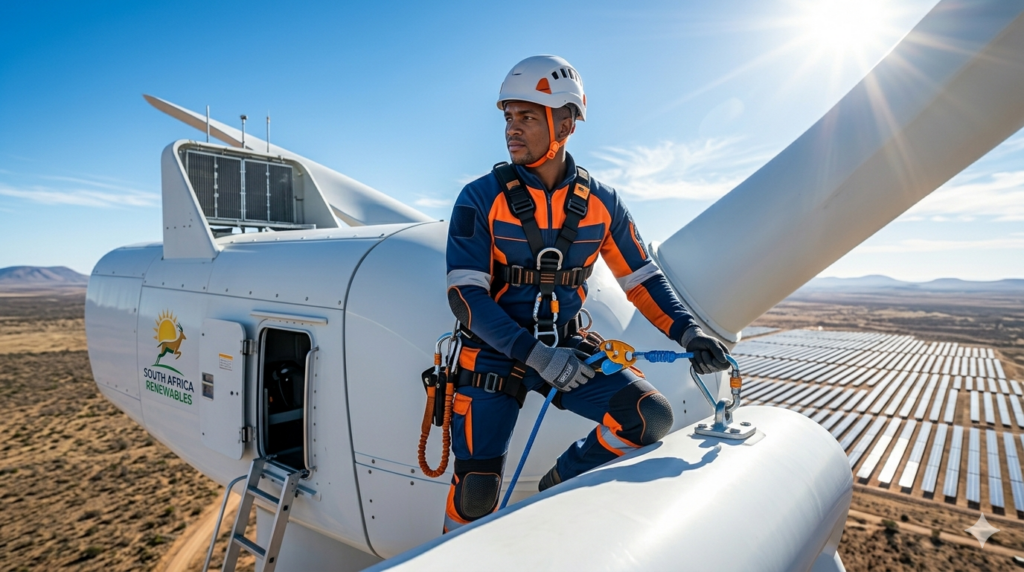
Wind turbine construction and maintenance require extreme high-altitude work. It combines the complex hazards of confined spaces with towering, high-wind environments.
Advanced Fall Arrest Systems
A standard construction safety belt or basic harness is a death trap on a 100-meter turbine.
Technicians require specialized, multi-point fall arrest systems designed specifically for extended suspension and vertical mobility.
Crucially, these harnesses must feature integrated suspension trauma relief straps. These allow a fallen worker to stand within their harness, preventing fatal blood pooling in the legs while awaiting rescue.
Specialized Headgear and Rescue Devices
Heavy, brimmed mining hard hats act like sails in high coastal winds and restrict the upward visibility required for climbing.
Technicians need lightweight, low-profile climbing helmets equipped with secure, multi-point chin straps.
Additionally, because standard bucket-truck rescues are impossible at turbine heights, every worker must be trained and equipped with self-rescue descent devices for emergency evacuations from the nacelle.
The Danger of “Repurposing” Gear
Handing a wind turbine technician a pair of rigid, heavy mining boots destroys their mobility on a vertical ladder, increasing the likelihood of a slip.
Similarly, outfitting a solar electrician in an unrated, standard high-vis vest near a high-voltage inverter creates a massive fire hazard waiting to happen.
Repurposing traditional gear creates a false sense of security. It introduces critical compliance gaps and severely hinders worker agility.
Equip Your Teams for the Energy Transition
The renewable energy sector operates on the cutting edge of technology. Your safety protocols and equipment must match that level of innovation.
Protecting your workforce requires a specialized safety partner who understands these entity-level risks, not just a supplier shipping generic catalog items.
Are you ready to equip your teams for the future of energy?
Contact VGH Safety today to audit your current equipment and source bespoke, highly compliant PPE designed specifically for South Africa’s wind and solar sectors.