
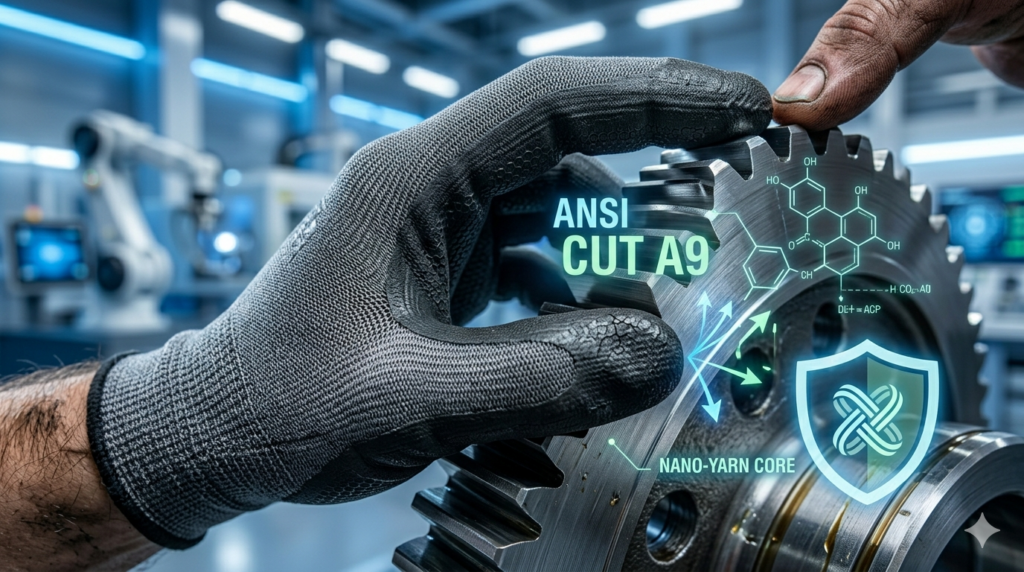
Despite immense advancements in workplace safety, hand injuries remain the number one preventable incident on industrial floors globally. In the high-stakes environments of South African manufacturing and chemical processing, a standard leather riggers glove or a basic disposable nitrile barrier is no longer sufficient.
The science of hand protection has evolved dramatically. Today, safeguarding your workforce requires a precise, microscopic understanding of material engineering and global testing standards. Welcome to Hand Protection 2.0.
Decoding the Cut Resistance Standards
For years, procurement managers wrestled with vague ratings that failed to accurately represent the hazards of modern manufacturing. The shift toward the granular ANSI/ISEA 105 and updated EN 388 standards has eliminated this guesswork, replacing it with rigorous, scientifically backed metrics.
The Science of the Test: The TDM-100
To truly understand the rating on the back of a glove, you must understand how it is tested. Under the modern EN 388 (specifically the ISO 13997 method) and ANSI standards, cut resistance is measured using a Tomodynamometer (TDM-100).
Instead of a circular blade rolling over the fabric until it cuts through (which dulled the blade and skewed results for modern engineered yarns), the TDM-100 slides a straight, fresh blade across the material under a specific, controlled weight. The rating is determined by the exact grams of pressure required to slice through the fabric at a 20mm distance.
ANSI A1-A9 vs. EN 388 A-F
This testing gives us a highly specific alphanumeric scale:
• ANSI Levels A1 to A9: Measures the load from 200 grams (A1) all the way to a massive 6,000+ grams (A9).
• EN 388 Levels A to F: Measures the load from 2 Newtons (A) up to 30 Newtons (F).
Practical South African Use-Cases:
• ANSI A2 / EN 388 B: Ideal for general warehouse material handling and light assembly in automotive plants.
• ANSI A4 – A5 / EN 388 D – E: Required for sheet metal handling, HVAC installation, and handling moderately sharp stamped parts.
• ANSI A7 – A9 / EN 388 F: Strictly necessary for extreme hazards, such as heavy metal stamping, handling large raw glass panes, or meat processing.
Navigating Chemical Resistance: Degradation vs. Permeation
In the chemical sector, the concept of a “universal chemical glove” is a dangerous myth. Protecting hands from harsh solvents, acids, and bases requires matching the specific industrial chemical to the correct synthetic polymer.
To do this correctly, safety officers must understand two distinct modes of failure:
• Degradation: The physical breakdown of the glove material (swelling, cracking, or stiffening) upon contact with a chemical.
• Permeation: The insidious process where a chemical passes through the glove on a molecular level. A glove can look perfectly intact on the outside while allowing toxic solvents to seep directly into the wearer’s skin.
Matching the Polymer to the Hazard
Selecting the right compound is a matter of organic chemistry:
• Nitrile: Excellent for general manufacturing involving oils, greases, and petroleum-based solvents. However, it offers poor protection against ketones.
• Neoprene: The go-to for handling broad-spectrum acids, caustics, and alcohols.
• PVC (Polyvinyl Chloride): Highly effective for handling petrochemicals, strong acids, and refining operations, offering excellent abrasion resistance.
• Butyl Rubber: The premium choice for highly aggressive chemicals, including ketones (like MEK or acetone) and esters, providing the highest permeation resistance for gases and water vapors.
The “Dexterity vs. Protection” Dilemma Solved
Historically, achieving an ANSI A7 cut rating or high chemical resistance meant equipping workers with thick, rigid armor. The result? Workers would remove their gloves to perform delicate, tactile tasks, instantly exposing themselves to the very hazards the gear was designed to prevent.
Hand Protection 2.0 solves this through advanced material science.
Today, manufacturers utilize High-Performance Polyethylene (HPPE), Kevlar®, and microscopic steel or fiberglass cores woven into engineered yarns. These materials are then knitted using ultra-fine 18-gauge machines.
The result is a glove that fits like a second skin, offering high tactile sensitivity for operating touchscreens or handling tiny screws, while simultaneously delivering extreme cut resistance. By eliminating the need to remove the glove, you eliminate the risk.
Partner with the Experts in Technical Safety
Navigating the intersection of TDM-100 cut tests, polymer permeation rates, and ultra-fine gauge knits requires far more than flipping through a supplier catalog. It requires deep, technical expertise and a strategic approach to risk mitigation.
Do not leave your facility’s safety to guesswork.
Contact VGH Safety today to schedule a comprehensive, site-specific hand protection audit. We will analyze your unique operational hazards and pair your workforce with the exact Hand Protection 2.0 technology required to keep them safe, compliant, and productive.