
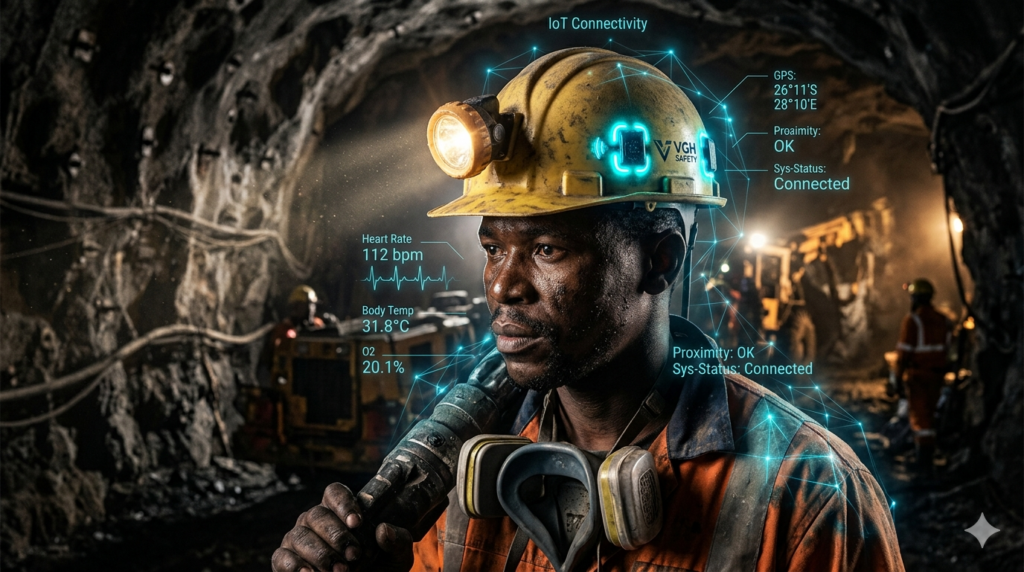
The South African mining sector is renowned for its scale and its extremes. With some of the deepest and most complex shafts in the world, the stakes for worker safety have never been higher. For decades, the industry has relied on a foundational line of defense: heavy-duty boots, high-visibility clothing, and hard hats.
While this traditional personal protective equipment (PPE) remains absolutely essential, the reality of modern deep-level and open-cast operations is that static gear is no longer enough. To reach the industry-wide goal of “Zero Harm,” mining operations must move beyond merely shielding workers from hazards to actively predicting and preventing them.
Welcome to the era of “Smart” Mining.
What is Smart PPE and the IoT?
In a mining context, the Internet of Things (IoT) refers to a network of physical objects embedded with sensors, software, and communication technologies that connect and exchange data with other systems.
When we talk about Smart PPE, we are talking about taking everyday safety gear and giving it a “digital nervous system.” Instead of a hard hat simply deflecting a falling rock, an IoT-enabled hard hat can monitor the environment, track worker fatigue, and instantly alert a central control room if an impact occurs. It transforms passive protection into an active, connected safety network.
Key Technological Innovations Changing the Mine Face
For Site Managers and OHS Officers, upgrading to a 2026-ready procurement strategy means looking at how these wearable technologies can actively mitigate risk on the ground.
Smart Helmets: The Connected Command Center
The traditional hard hat is undergoing a massive technological upgrade. Modern smart helmets are equipped with micro-sensors that act as a worker’s digital co-pilot in hazardous environments.
• Environmental Monitoring: Built-in sensors continuously sample the air for dangerous spikes in harmful gases like methane or carbon monoxide, triggering visual and auditory alarms long before levels become fatal.
• Impact and Proximity Sensors: Built-in accelerometers detect sudden impacts. If a worker is struck by debris, the helmet instantly notifies the surface team. Furthermore, proximity sensors can warn workers when they are stepping into the blind spots of heavy mining machinery.
IoT-Enabled Boots & Wearables: Tracking and Biometrics
The lower body and wrists are prime real estate for monitoring a miner’s physical state and location in real-time.
• Real-Time Fall Detection: Smart boots and wearable tags can detect the sudden shift in momentum associated with a trip or fall, immediately dispatching a localized distress signal to rescue teams.
• Precision Location Tracking: In the event of a seismic event or shaft collapse, time is the ultimate currency. IoT wearables utilize localized mesh networks to provide exact 3D coordinates of every worker underground, removing the guesswork from search and rescue operations.
• Biometric and Heat Stress Monitoring: South African mines are notoriously hot. Wearables now track vital signs such as heart rate and core body temperature. By monitoring these biometrics, OHS teams can intervene and mandate cooling breaks before a worker succumbs to heatstroke.
The ROI of Smart Safety: From Reactive to Proactive
Investing in technological innovation is not just about compliance; it is about fundamentally changing the safety culture on site.
The traditional approach to OHS is largely reactive—an accident happens, an investigation is launched, and new protocols are drafted. Smart PPE allows operations to become entirely proactive. By analyzing the continuous stream of data from IoT wearables, data analysts and safety heads can identify “near misses” and hazardous zones that would otherwise go unreported.
This data-driven approach yields a massive Return on Investment (ROI). Preventing a single major incident saves lives, prevents devastating operational downtime, drastically reduces insurance premiums, and protects the mine’s operational license and reputation.
Equip Your Workforce for the Future
The future of South African mining is connected, data-driven, and relentlessly focused on worker well-being. As we move closer to 2026, corporate ESG goals and safety tenders will increasingly demand that suppliers and operators embrace technological innovation. Static safety programs will be left behind.
Are you ready to bridge the gap between traditional safety and total worker wellness?
Contact VGH Safety today to discuss how we can help you integrate future-ready, IoT-enabled PPE solutions into your upcoming procurement strategy. Together, we can ensure every miner returns home safely.