
In the high-velocity world of South African logistics and warehousing, the efficiency of your throughput is directly tied to the safety of your floor. Many logistics managers mistakenly view workplace injuries as unfortunate, isolated events—a cost to be absorbed by insurance or medical aid. However, from a technical operations perspective, an injury is not just an event; it is a signal of a fractured safety architecture.
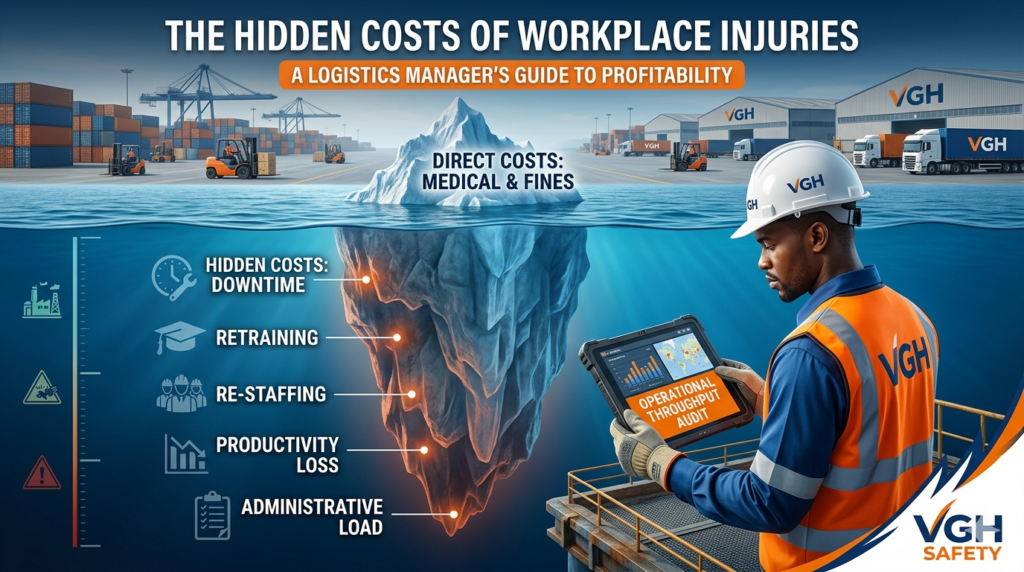
If you are only accounting for the immediate medical bills when an accident occurs, you are missing the “Iceberg Effect.” The true cost of a workplace injury is far deeper, and it is a persistent drain on your operational productivity.
1. The Iceberg Effect
Direct costs, such as medical expenses and potential OHS fines, are merely the tip of the iceberg. The hidden costs—which often go unrecorded in the ledger—are the real threats to your business’s bottom line:
- Administrative Downtime: Every injury triggers an internal investigation, incident reporting, and mandatory documentation, diverting your most valuable management hours away from logistics strategy.
- Production Stoppages: When an injury occurs in a warehouse, surrounding operations often halt for safety assessments or area clearing, resulting in a compounded loss of throughput that far exceeds the initial incident.
- The Cost of Re-staffing: Replacing an experienced team member is expensive. The costs associated with recruitment, onboarding, and the inevitable productivity dip of new personnel represent a significant, often overlooked, financial burden.
2. Quantifying the Risk
Logistics environments are dynamic, characterized by high-traffic forklift zones, heavy lifting, and complex material handling. This requires a specific, hardened safety architecture. When you rely on generic equipment that isn’t engineered for these high-stress environments, you are increasing the probability of failure. Investing in specialised safety gear is not an expense—it is a data-driven strategy to eliminate systemic risks.
3. The “Safety-First” Throughput
A truly safe warehouse is, by definition, an efficient one. When safety systems are integrated into the workflow—rather than treated as an afterthought—processes become smoother. Properly managed safety gear reduces physical fatigue and minimizes the mechanical failures that cause bottlenecks. By focusing on technical site hygiene, you are building a foundation for consistent, predictable throughput.
Strategic Partnership: Beyond Supply
Managing logistics safety requires a shift from reactive procurement to predictive management. At VGH Safety, we assist logistics managers in moving beyond the “Pretty Website Lie” of aesthetic marketing by focusing on mathematical trust and technical architecture. We don’t just supply gear; we provide a partnership that helps you audit your hazard-to-procurement pipeline to identify where hidden costs are bleeding your efficiency dry.
Is your warehouse safety strategy optimized, or are you absorbing avoidable costs? To transition your site toward a more resilient and efficient operational model, contact our team today to discuss a warehouse safety audit.