
In the industrial and commercial sectors,Personal Protective Equipment (PPE) is viewed through two rigid lenses: technical compliance (is it certified?) and fiscal efficiency (what is the total cost of ownership?). Procurement often treats PPE as a utilitarian commodity, a barrier between a worker and a hazard.
However, from an operational perspective, a safety system is only effective if it is implemented. The highest-quality, most rigorously certified safety gear is utterly useless if it is sitting in a locker or worn incorrectly because the employee lacks a sense of connection to it.
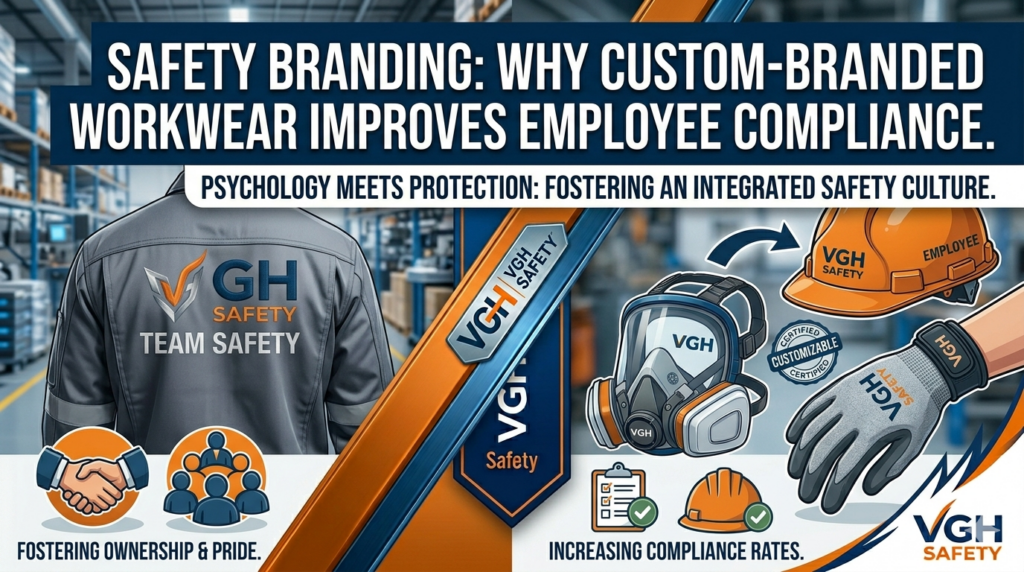
To move beyond the inefficiencies of generic supply, you must acknowledge a fundamental operational reality: PPE compliance is a behavioural challenge, not just a procurement activity. Custom-branding your custom-branded workwear is not cosmetic ‘fluff’; it is a sophisticated mechanism of psychological accountability.
1. Beyond the Aesthetic: The Missing Connection
The “Pretty Website Lie” of aesthetic marketing claims that branding is about visibility. From a technical architecture standpoint, branding is about integration. When you issue generic, unbranded overalls or jackets, you are giving employees temporary access to the company’s property. When you custom-brand that gear with their logo and their name, you are giving them their own professional suit of armour.
This integration is the critical psychological link that fosters ownership. You cannot build a durable safety culture on top of temporary equipment. Customisation transforms PPE from a mandatory requirement into a professional identity.
2. The Psychology of Accountability and Ownership
Operational safety requires consistent, voluntary compliance. Psychology teaches us that ownership is directly correlated with accountability. When an employee’s gear is personalized—featuring not just the company’s identity but their own—it increases psychological accountability.
The gear is no longer ‘that pair of company boots’; it is ‘my pair of boots.’ This subtle shift significantly reduces equipment neglect and improper usage. An employee takes greater care of gear that is perceived as personal and customized, leading to longer asset lifecycles and improved technical site hygiene.
3. Fostering Pride: Elevated Value
A high-quality branding strategy signals that safety is a value, not a mandate. Custom branding elevates the perceived value of the gear itself. If your team is issued flimsy, generic uniforms, it subtly communicates a low organizational value for safety. conversely, high-quality, customized gear communicates respect for the worker’s role and their contribution.
This fostering of professional pride encourages usage. When employees take pride in their collective identity and the equipment they use, they are far more likely to adhere to compliance standards—not just to avoid a fine, but because it is a fundamental expectation of their professional standard.
The Integrated Safety Partnership
The shift from cosmetic application to psychological compliance requires specialized expertise. You need a partner that understands how branding must coexist with, and reinforce, the technical properties of the PPE itself.
At VGH Safety, we specialize in high-authority specialized branding techniques—from embroidery to sophisticated heat transfers—that integrate with, and protect, the technical architecture of the safety gear.
Is your workplace culture strong enough to ensure voluntary PPE compliance? Do not leave your safety architecture to chance. We invite you to move past generic supply toward a strategic safety branding partnership. Contact our team today to discuss how we can integrate compliance with identity.